



ATLANTA – Just as the nuclear industry is starting to build reactors after a 30-year drought, it faces another dry spell.
Additional Photos
The industry thought it had what it needed for its rebirth: federal loan guarantees, a uniform reactor design and a streamlined licensing process. The nightmares from the 1979 partial meltdown at Three Mile Island, 1,000 new safety regulations and cost overruns would be left in the past, industry officials believed.
But what never came together was a long-term plan for how to store the used radioactive fuel. As a result, judges and regulators have slammed the brakes on new reactor projects — with two exceptions.
“Waste is an environmental concern, it’s a public health concern and it’s become a security concern because we live in a different world now,” said Sara Barczak, the high-risk energy director for the Southern Alliance for Clean Energy.
Industry officials say there is time — more than 100 years even — until the nation’s power plants run out of room to store the radioactive waste on site. But a federal appeals court ruled in June that the U.S. Nuclear Regulatory Commission — the agency charged with making sure that utilities build and operate nuclear reactors safely — could no longer say it had reasonable assurance that a long-term waste-management solution would be created. Because of this, the NRC said it will not approve any new projects for now.
This leaves Atlanta-based Southern Co. and South Carolina’s SCANA with the only utilities to win approval to build nuclear reactors from scratch after an almost 30-year gap. Other utilities that have nuclear projects but are further behind in the approval process may face an additional delay of a year or more.
Georgia Power, one of Southern’s utilities in the company’s four-state territory, is building two new reactors at Plant Vogtle with a group of municipal and cooperative electric companies. The $14 billion expansion of Vogtle, located in Waynesboro, Ga., is one of the largest economic development initiatives in state history. Georgia Power is responsible for $6.1 billion, which its customers will pay for as part of their monthly utility bills.
Southern eventually plans to build more reactors beyond the Vogtle project, but that likely won’t happen until the next decade, company executives have said.
“This is an issue of political feasibility,” said Salo Zelermyer, a former Department of Energy lawyer who now is with Bracewell & Giuliani’s environmental strategies group. “You can’t store this waste in a region where there’s intense local opposition to it.”
Efforts were made to find, research and prepare a permanent central repository during the 30-year nuclear hiatus. The federal government planned to start moving used fuel from nuclear plants to Yucca Mountain in Nevada, which scientists had been researching since the 1970s.
The government signed contracts with utilities, including Southern Co., which owns nuclear plants in Georgia and Alabama, to haul the waste there when the repository was supposed to open in 1998. A protracted approval process, environmental questions, lawsuits and mounting political pressure ground the project to a halt in 2010.
President Obama appointed a bipartisan blue-ribbon commission to find alternative plans to Yucca Mountain. The commission supported a central repository but suggested the government secure approval from local communities to prevent the same type of backlash that Yucca Mountain received.
“Scientifically, it was a perfectly good site, but politics caught up to it,” said Steven Kraft, a senior director with the Nuclear Energy Institute, a Washington-based policy group for the nuclear industry.
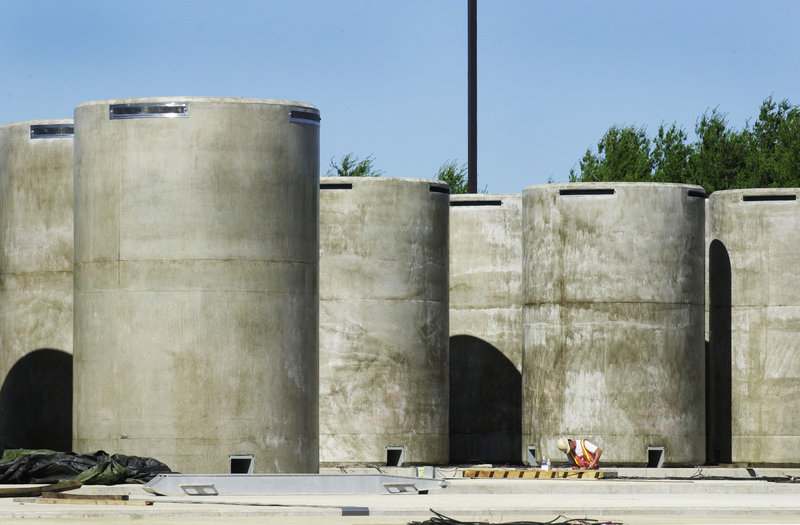
For now, the utilities that own and operate the nation’s 104 reactors house the high-level spent radioactive fuel at the power plants. The rods are first cooled in water and then moved to hardened casks made from massive steel and concrete. At Southern’s reactor sites, and at the former Maine Yankee nuclear plant site in Wiscasset, the casks are placed above ground in what’s known as independent spent fuel storage installation pads.
Plant Vogtle’s two existing reactors produce power for Georgia Power and the municipal and cooperative utilities. Southern is preparing the site to move the used fuel from large swimming pools into dry cask storage in the next year or so.
Southern’s other nuclear plants, Alabama Power’s Plant Farley and Georgia Power’s Plant Hatch, already load cooled-off fuel rods into dry storage casks.
“It’s kind of like the (federal) deficit. Eventually you are going to have to deal with it,” said Glenn Sjoden, a nuclear and radiological engineering professor at Georgia Tech. “It’s not something you can just let sit in your backyard.”
But that’s where the used fuel will sit, in the “backyard” of nuclear plants, likely for several years, because of the federal court ruling.
The Nuclear Regulatory Commission recently announced it will start a two-year environmental review of temporary waste storage, even as it refuses to grant permits for any new reactors.
“It doesn’t change anything we’re doing in used fuel management, because we were doing that anyway. But this is a very important procedural step,” said Kraft at the NEI.
Utilities store a total of 2,000 to 2,300 metric tons of used nuclear fuel a year, according to industry figures. That adds up to about 65,000 metric tons of radioactive waste currently sitting at nuclear plants.
“If we reject long-term storage, we’re left with dry casking, and that’s it,” said Cham Dallas, a professor and director at the University of Georgia’s Institute for Health Management and Mass Destruction Defense. “Yes, it’s probably safe, but can we continue this policy for an infinite number of years?”
The concerns over safely handling nuclear waste are many.
Used nuclear fuel is very concentrated. This means the amount of waste is very small, but it requires more effort to keep it protected. Some of the material loses its radioactivity after just a few days, but other parts of the fuel remain toxic.
Scientists warn of the dangers of what’s known as “re-racking.” Utilities typically shut down a reactor every 18 months to remove about one-third of the spent (yet still radioactive) fuel rods and replace them with new ones. The removed rods are placed into large racks and then submerged under water, where they stay for five years or longer. The pools were designed as a temporary cooling basin, but utilities have been able to store more fuel rods by “re-racking,” or reorganizing the way the rods sit in the pool. But the closer together the fuel rods sit, the greater the heat source.
“These pools have become sources of radioactivity much larger than the reactor itself,” said Arjun Makhijani, a nuclear physicist who runs the Institute for Energy and Environmental Research, a Takoma Park, Md., nonprofit that focuses on the security aspects of nuclear weapons production and nuclear technology.
Keeping used fuel in dry casks at dozens of reactor sites is a temporary solution that even supporters of the nuclear industry warn isn’t secure. The concern? That the dry casks could be stolen and the spent fuel offered on the black market.
“It’s a local option gone bad,” said Dallas at the University of Georgia. “Eventually somebody’s going to foul up, and (the spent fuel) gets out and is sold somewhere.”
Dominant long-term solutions, such as recycling the radioactive fuel or moving the waste to a central repository, still raise concerns.
“Thinking about just transporting it, it’s incredibly dangerous,” said Courtney Hanson, public outreach coordinator at Georgia Women’s Action for New Directions. “Putting nuclear waste on the train, on a semi-truck that’s going to drive across the interstate: Regardless of whether there’s high-level security, accidents happen.”
Copy the Story Link
Send questions/comments to the editors.

Success. Please wait for the page to reload. If the page does not reload within 5 seconds, please refresh the page.
Enter your email and password to access comments.
Hi, to comment on stories you must . This profile is in addition to your subscription and website login.
Already have a commenting profile? .
Invalid username/password.
Please check your email to confirm and complete your registration.
Only subscribers are eligible to post comments. Please subscribe or login first for digital access. Here’s why.
Use the form below to reset your password. When you've submitted your account email, we will send an email with a reset code.