



The greatest ancestor of Maine painting just might be Camille Corot (1796-1875), a leader of the Barbizon School in France.
Additional Photos
Claude Monet (1840-1926) is the obvious champion of Impressionism — the undeniable great grandparent of Maine landscape painting — and Monet did not quibble about his debt to Corot: “There is only one master here — Corot. We (the Impressionists) are nothing compared to him, nothing.”
Monet’s teacher, Eugene Boudin (1824-1898), was a pupil of Corot.
Much like how elevators made skyscrapers possible, plein air painting awaited the invention of tubes for paint. And with such tubes in hand, Corot helped take painting outside. That led to a number of changes: natural light, an interest in efficiency, wet on wet painting, less reliance on slow techniques like glazing and so on.
Glazing is the technique of overlaying many layers of thin, transparent paint to render light, atmosphere and spatial effects within a painting. It dates back to the earliest sophisticated use of oil paint by Jan van Eyck (ca. 1390-1440) and remains to this day most deeply associated with Dutch master painting.
Through the 19th century, glazing was the primary approach of Europe’s leading painters. Winslow Homer’s technique was criticized as beastly and unmediated because he didn’t glaze enough.
Maine artist Jon Allan Marshall paints like a 17th-century Dutch master: He is dedicated to glazing.
It’s a wonderful thing to see traditional Maine paintings side by side with someone who paints in a genuinely traditional style comparable to Rembrandt.
Seeing Marshall’s paintings in the same room as, say, Scott Moore’s Maine landscapes is incredibly interesting. Moore’s “Swift River Bend,” for example, features thick strokes of lusciously wet paint pushed all around amongst each other. The Impressionist technique of scumbling — putting colors next to each other — is what drives Moore’s expansive sense of color even within an ostensibly subdued, organic landscape.
Marshall’s paintings achieve qualities of light, color and space that can’t rely on brushy bravado, but rather hard work, skill and technique. This slows down the surface and draws you in. There are details that don’t follow the stroke of a brush and qualities of spaces, volumes and light that we rarely see in Maine. They are not Bob Ross studio tricks but rather time-consuming tools in the hands of a talented and patient master.
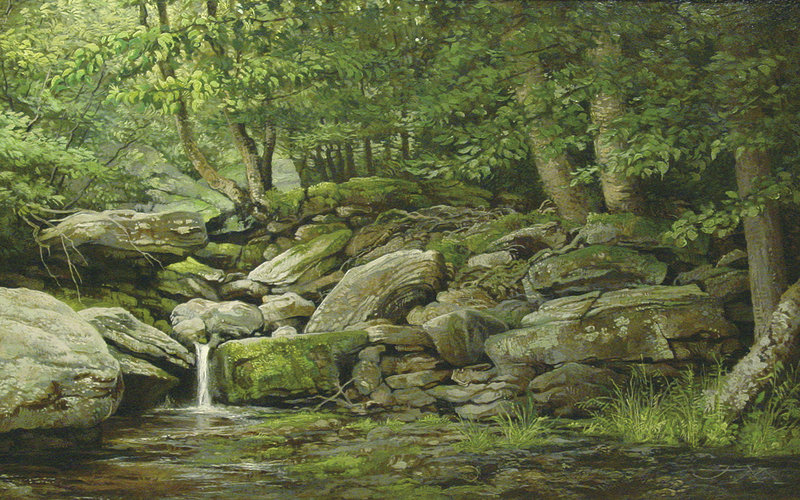
My favorite is “Interior Brook.” It’s a small oil on panel view of a stream-cooled niche in the forest. The midsummer leaves hang lazy, lush and heavy over a trickle-fall fed pool. The sun streams in from the upper right, but only reveals its brightest self on the far, deep left trees as they open along the stream that feeds the pool. The light chartreuse of the brightest leaves marks the upper end of the systematic coloration of the scene. Tumbled granite boulders — long at rest and lichen-covered — form the ground for trees that range from ancient birch on the right to bright new growth on the left.
Despite the virtuoso textures, what is particularly remarkable about “Interior Brook” is Marshall’s use of glazing for spatial effects. The layered glazes create genuine depth through which our eyes travel spatially rather than as across a colored surface.
While there is little room for flashy brushwork in Marshall’s paintings, any close glance reveals his facility with a brush.
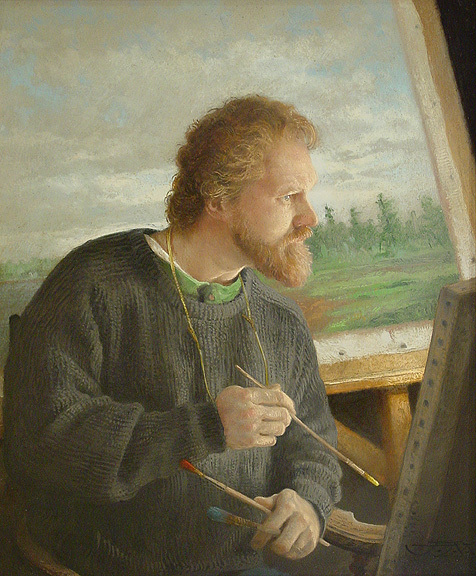
The singular exception to Marshall’s sea and landscapes is an extraordinary self-portrait. (Portraits are usually commissions, after all, rather than exhibition pieces.) It reveals Marshall’s skill like nothing else. The complex interior space and light work perfectly within the scale of his strokes to present extraordinary detail without straying into the neurotic over-focus of many hyper-realist painters. It’s the strongest portrait I have seen here in years.
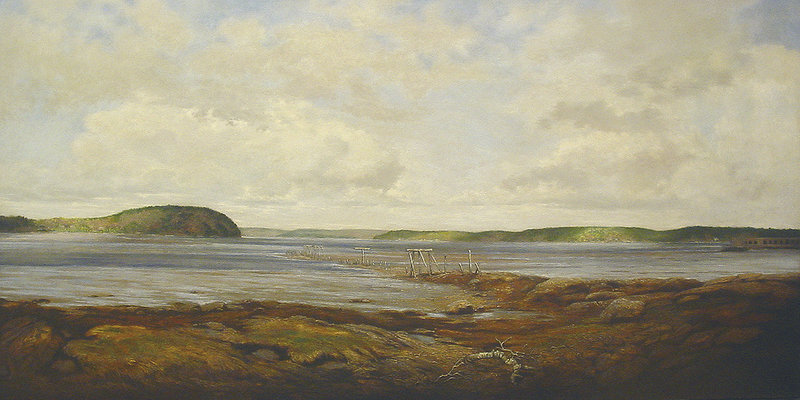
Marshall’s best paintings show a range of space. “The Kennebec River” for example, succeeds up close, through middle spaces and along the distance — all by balancing the sense of detail and light.
His “Crawford Notch,” on the other hand, shows only a deep space behind a near-ground repoussoir. While the seemingly simplified equation of near/far could disappoint, Marshall plays a very satisfying trick by using the texture of the linen’s bumpy surface (think burlap) to set the scale for the tiny trees. It reminds us that Marshall isn’t some Munsell-system painting machine but a smartly creative artist very capable of wit.
Marshall’s most intriguing two works feature creatively painted frames. Whether Mondrian or Marin, this isn’t usually my thing, but Marshall’s “Birch” is just as brilliantly witty as it is gorgeously painted. A trompe l’oeil birch sprig lies across the bottom of the frame while the painting features a drawing of birch blossoms nailed to the tree. It’s a smart bit of postmodern wit in which the old school tips its hat to the new.
Marshall is one of those artists who lives and works in Maine yet has mostly shown elsewhere. But when David Findlay Galleries closed, NYC’s loss became our gain. Marshall is an exceptional painter and it’s good to see him here.
Freelance writer Daniel Kany is an art historian who lives in Cumberland. He can be contacted at:
dankany@gmail.com
Send questions/comments to the editors.

Success. Please wait for the page to reload. If the page does not reload within 5 seconds, please refresh the page.
Enter your email and password to access comments.
Hi, to comment on stories you must . This profile is in addition to your subscription and website login.
Already have a commenting profile? .
Invalid username/password.
Please check your email to confirm and complete your registration.
Only subscribers are eligible to post comments. Please subscribe or login first for digital access. Here’s why.
Use the form below to reset your password. When you've submitted your account email, we will send an email with a reset code.