



The Bowdoin Museum of Art is hosting 10 Old Master works from the Wadsworth Atheneum. All are great. Many are very large. And each is worthy of a long encounter.
Three follow the Flemish tradition, while the others are connected to Italy — the two centers of European painting for centuries.
Additional Photos
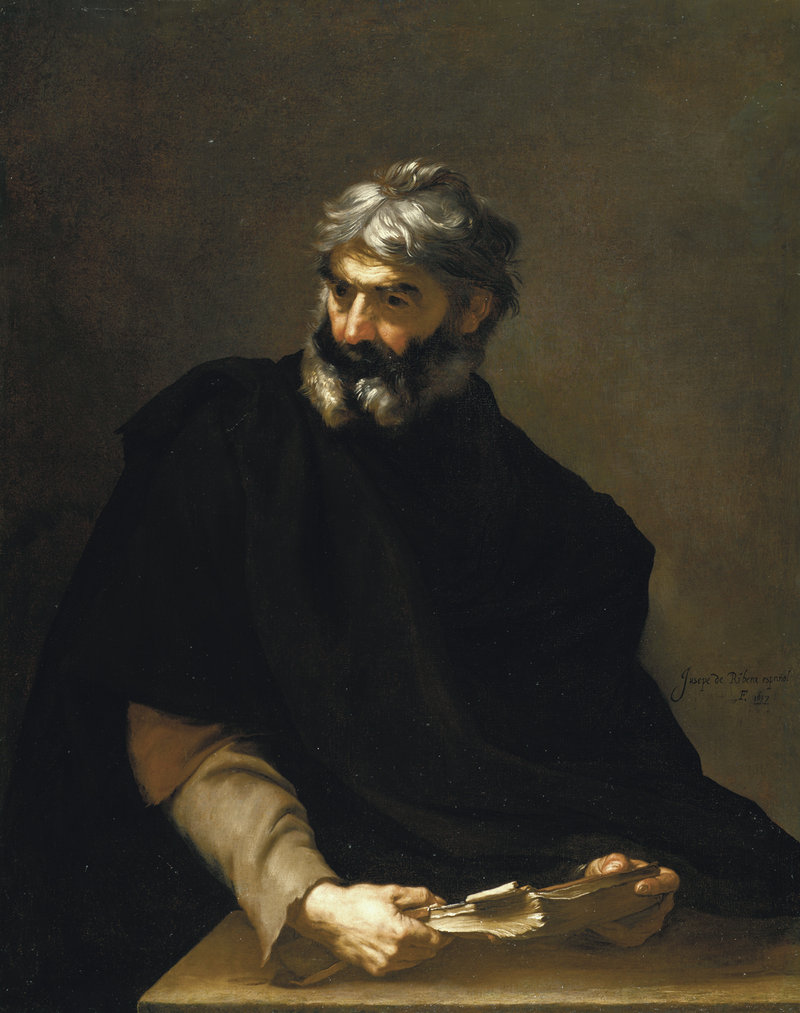
For example, Jusepe de Ribera, whose work is featured in the show, was Spanish, but even when he became one of Europe’s most celebrated painters, he remained based in Italy.
Ribera’s “Philosopher” shows why he was so successful. It features a gray-haired, bearded man in a black cloak seated at a low table. His simple sleeves are tattered, as is the well-studied book in his powerful hands. He is older, but handsome and strong. His thick locks flow uncloistered, hinting of a similarly unfettered mind. His eyes gaze backward, intense but limpid. The surface is luscious, and the composition is deliciously satisfying.
I can’t think of a picture anywhere that is painted any better.
It’s that good.
“Masterpieces” is one of those shows in which the label copy is extremely important and helpful. The few quick comments about “A Philosopher,” for example, give us all we need to know to enjoy the painting.
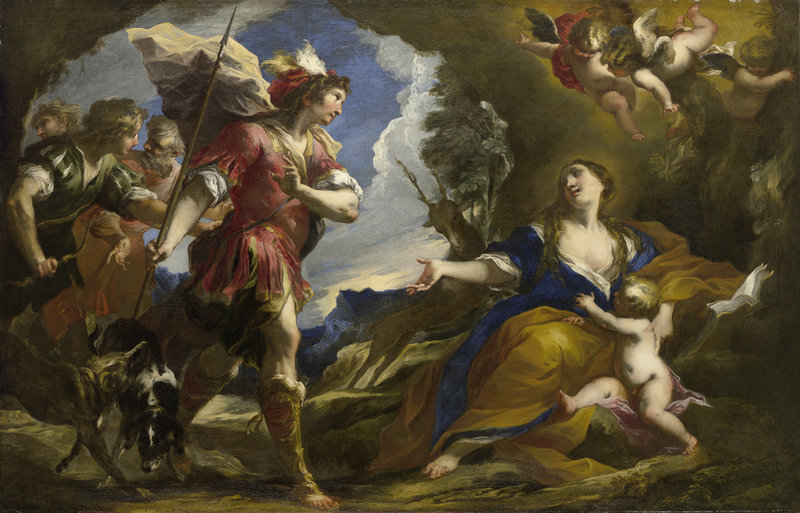
While most Baroque paintings conveyed the stuff of classical history, mythology or the Bible, some subjects, such as Valerio Castello’s “Legend of Saint Genevieve,” need to be recounted to today’s audience.
Castello is hardly a household name now, but he was a star in 17th-century Genoa. His “Genevieve” is testament to his prodigious talent, and it’s a great example of how gracefully paintings can unfurl their stories, content and mysteries.
The story is based on a medieval legend: Genevieve was falsely accused of marital infidelity and condemned, but the executioner allowed her and her infant son to escape to the woods, where they were nourished for six years by a deer until her husband was led to them by a stag while out hunting.
Superficially, High Baroque paintings often look like unnecessarily complicated, swirling melodramas. But it’s wrong to assume this is just so much affect. The visual complexity connotes emotional complexity, and while the estranged couple’s reunion is joyous, their emotions could be nothing but wildly complicated.
Castello’s picture is no mere illustration. The presence of the putti (cherubs) hints that something divine is at work. Genevieve’s son — who should be 6 — is shown as a baby. This does several things. It presents Genevieve as Mary (always shown in blue drapery) with the baby Jesus. It declares the boy’s innocence and his mother’s isolation. It visually connects the heavenly presence directly to the family.
And with his tugging at her chest, we are reminded of how the deer nourished them — echoing Genevieve’s open Bible, which has nourished her faith.
What can only be hinted at is how brilliantly Castello moves the viewer’s eyes through the painting to make connections and hint at narratives. It’s a painting from a time when composition meant so much more than the simple, formal structure of a picture.
Composition for the Old Masters was directly related to the development of the story. It had to do with design, but it also addressed spatial and temporal elements of the narrative as well. It’s easy enough to see this in Castello’s masterpiece, but we should remember that his audience expected it.
It might seem odd that Giovanni Domenico Tiepolo’s Christ is shown with a chiseled nose and forehead in flat profile when the most stunning aspect of his “Christ Healing the Blind” (1752) is the many incredible faces rendered in the round. But this was an unassailable convention. We see the same straightened face on Lelio Orsi’s Christ in his 1575 “Noli me Tangere.”
While Orsi’s Christ looks directly at Mary Magdelene, she seems to be gazing past him to empty space, where some young trees had been cut away. The theological implication is huge (and possibly heretical): Christ is a vision — not physically present.
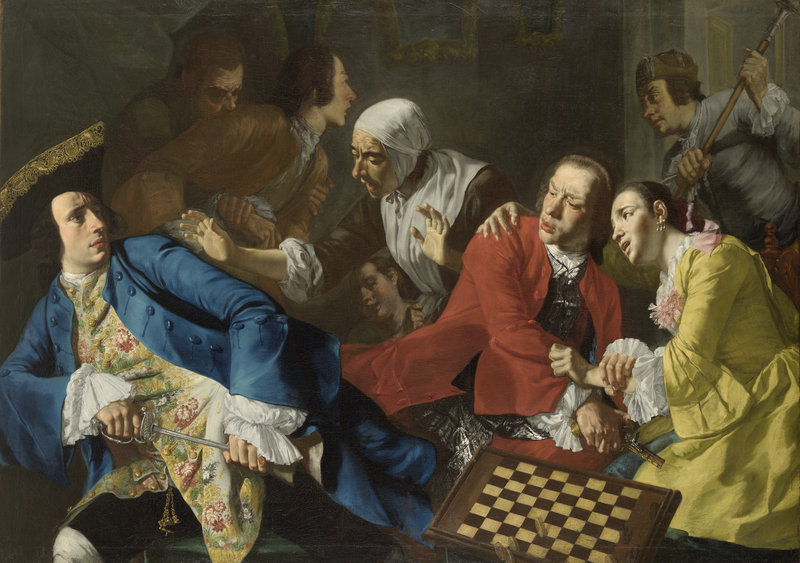
My favorite thing about “Masterpieces” involves a pair of paintings circa 1750. One, by Gaspare Traversi of Napoli, depicts a quarrel between two young men erupting into violence in an Italian tavern. The other is a stiffly wooden portrait of Bowdoin College founder James Bowdoin by Robert Feke. Bowdoin and the quarrelers, ostensibly worlds apart, are wearing the exact same fashions.
Feke handles Bowdoin’s satin waistcoat well, but the rest is sheer provincial primitivism when compared to Traversi’s voluptuously raucous flamboyance: Tables are flying, weapons are being drawn and women grasp at the men pleadingly — all gorgeously painted. James Bowdoin is hanging directly across the room, giving his handsome but staid eyes plenty to look at.
“Masterpiece” is a lofty term that inevitably raises some eyebrows, but I think these 10 pieces selected by museum director Kevin Salatino make the grade. It’s a great show for seeing and discussing with a friend or just losing yourself for a couple of hours of Arcadian bliss.
Freelance writer Daniel Kany is an art historian who lives in Cumberland. He can be contacted at:
dankany@gmail.com
Copy the Story Link
Send questions/comments to the editors.

Success. Please wait for the page to reload. If the page does not reload within 5 seconds, please refresh the page.
Enter your email and password to access comments.
Hi, to comment on stories you must . This profile is in addition to your subscription and website login.
Already have a commenting profile? .
Invalid username/password.
Please check your email to confirm and complete your registration.
Only subscribers are eligible to post comments. Please subscribe or login first for digital access. Here’s why.
Use the form below to reset your password. When you've submitted your account email, we will send an email with a reset code.