



In the organic, wild blueberry fields at Twitchell Hill Farm in Montville, a rosy green blush of new growth has been emerging from underground stems since early spring. Now, the white, bell-shaped blossoms that clustered on tender stalks are ripening into small, dark-blue fruit, promising a late-summer berry crop raised without pesticides or herbicides.
Additional Photos
But instead of depending on only honey bees to pollinate the 15-acre blueberry field, grower Doug Van Horn of Freedom has launched a project to attract tiny, wild pollinators called mason bees.
“It looks like a bee, but it’s the size of a housefly,” he said.
But size doesn’t matter when it comes to this hard-working, native pollinator, he said. “They’re about four to five times more effective as spring-season pollinators than honey bees,” said Van Horn, who has tended the organic blueberry fields for more than 35 years.
There are 12 species of tiny bees commonly called mason bees that are associated with Maine blueberry fields, according to insect ecologist Frank Drummond, Ph.D., of the University of Maine at Orono.
Mason bees do not create colonies of busy worker bees that collectively produce honey and beeswax. With no hive or honey to defend, these native bees are unlikely to sting, and their sting is mild, Drummond said.
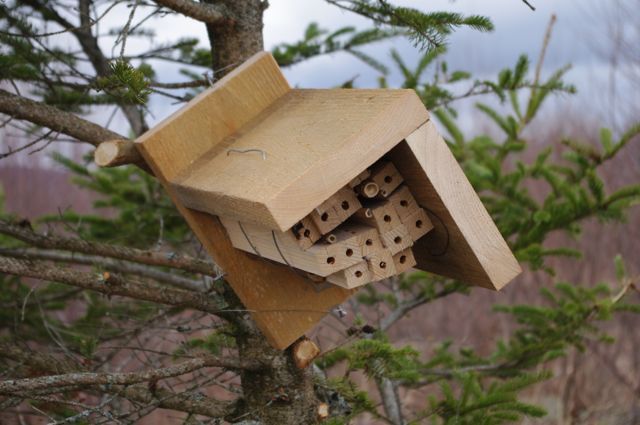
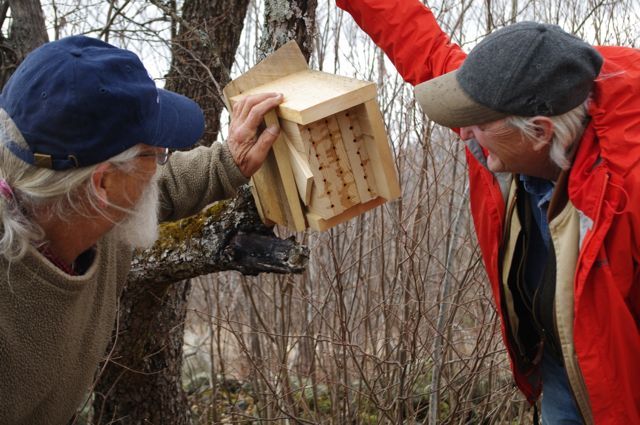
To lure these productive little pollinators into his fields, Van Horn had a local woodworker create specially designed mason bee nesting boxes made of pine, hemlock and basswood.
The boxes, roughly 8-by-8 inches in size, are comprised of 20 wooden tubes with about 1/4-inch holes.
“The bees go into the holes, lay eggs and deposit nectar and pollen, before they seal off the entrance. The eggs turn into larvae, and later, the larvae spin cocoons, which overwinter. In spring, they emerge as a fully mature bee,” said Van Horn, 67.
Mason bee boxes are available commercially. But Van Horn did extensive research to incorporate what he hopes are the best designs. Moreover, his nesting boxes were created with whimsical variations.
“Mason bees don’t like order. They like more random designs,” he said.
His mason bee nesting box project was funded, in part, by a $4,300 grant he received from the Natural Resources Conservation Service, a U.S. Department of Agriculture program.
“They have a program for organic growers to improve organic farming operations,” he said. The federal grant provided funds to create an access road to the blueberry fields, to remove weed and brush growth, to plant pollinator-attracting native plants and to create mason bee nesting boxes.
Van Horn is one of about 50 wild blueberry growers farming organically in the state, according to the University of Maine at Orono. Altogether, there are about 600 blueberry growers in Maine.
ALTERNATIVE PRACTICES
On a blustery day this spring, Van Horn was at Twitchell Hill, inspecting the 18 mason bee nesting boxes he had recently installed around his blueberry fields. With him that day was insect ecologist Drummond, who brought with him UMaine botanist Alison Dibble, Ph.D., and graduate students Kalyn Bickerman and Eric Venturini.
“There is renewed interest in native bees because of problems with honey bees caused by colony collapse disorder,” Drummond said, referring to worldwide die-offs of honey bee populations, a phenomenon first noticed in 2006.
“It’s caused in part by the synergistic reactions of bees being exposed to pesticides, viruses and fungal pathogens, parasitic mites and poor diet,” he explained.
But attracting native pollinators involves a lot more than installing nesting boxes. Drummond also is keenly interested in land stewardship practices by farmers and how those affect pollination, native bee communities and honey bee populations.
“For instance, we have been looking at the amount of (plant) forage on farms that affects bees, the effects of pesticides used and the overall landscape that farms are embedded in,” Drummond said.
That day at Twitchell Hill, UMaine student Venturini took soil samples along a three-quarter-acre strip of uncultivated land adjacent to the blueberry fields. By early June, the half-acre strip had been cultivated, limed and seeded with a trial mix of wildflower seeds known to attract bee pollinators. The mix, which contains both perennials and self-seeding annuals, was donated by Applewood Seed Co. of Arvada, Colo.
“If this mix works well, they (Applewood) will promote it,” Van Horn said.
Seeds from a dozen wildflowers were included, such as, perennial lupine, wild sunflower, purple coneflower, Indian blanket, showy goldenrod, New England aster and bergamot.
“In a field like this, it wouldn’t surprise me if there were 20 different species of wild bees, such as mason bees, orange-belted bumblebees, digger bees and sweat bees,” Drummond said. “Out of the 237 wild bee species in Maine, slightly over 100 of them visit blueberries. Hopefully, the forage plants will attract a bunch of them,” he said.
So far, the results of this first-year nest-box experiment are encouraging.
“Out of the 18 boxes, better than 50 percent have inhabitants. The holes are plugged up, which indicates mason bees have laid eggs,” he said.
In summer, larvae hatch from the eggs. Adult bees emerge from their pupal stage by fall or winter but hibernate in their insulating nests until early spring, he added.
“I’m curious to know which box designs they will like best. That’s what farming is about. It’s waiting for nature to happen,” Drummond said.
Drummond, who lives in Winterport, has been with UMaine for 25 years.
“If you put nesting boxes out, they will attract mason bees. It may take a year before you get the full results. A UMaine study in the mid-1990s showed a fourfold increase of mason bees in blueberry fields that had nesting boxes,” he said.
Only about 20 blueberry growers in Maine are providing nesting boxes for mason bees, he added.
“I’d like to see a lot more. And not just nest blocks. I’d like to see more growers encourage native pollinators by selecting pest management strategies that reduce exposure of insecticides to bees and enhance flower sources.”
HONEY BEES STILL RELIED ON
“But it’s not just organic growers who are encouraging pollinators. Some conventional growers are planting pollinator strips, too,” Drummond said.
One such conventional blueberry grower is Paul Sweetland of Searsmont. He leases 100 acres of blueberry fields in Hope, Rockport, Liberty and Waldoboro and also manages 1,300 acres of blueberry fields through Coastal Blueberry Service.
“I rely heavily on honey bees. I am always looking to use insecticides that won’t harm the bees. We try not to spray anything when blueberries are blossoming,” he said.
Sweetland said he keeps weeds out of the fields with herbicides.
“We have a lot of natural habitat in the areas that have insects that help with pollination. The native bees have been important to pollination,” he said.
Numerous studies show that cultivated fields close to natural areas like woods, pastures or meadows have more wild bees.
Organic grower Theresa Gaffney of Highland Blueberry Farm in Stockton Springs maintains 25 acres of wild blueberries with her husband, Thomas Gaffney. She believes insecticides contribute to native and honey bee declines and disrupt a delicate ecological balance.
“People put insecticides on their fields. Well, what is a bee? An insect! It boils down to this: No bees, no food. Especally for the wild Maine blueberry. It doesn’t pollinate itself. In order for us to have that bumper crop, we have to have good pollination.”
Encouraging bee-friendly habitat is a big part of her strategy. “It’s one of the reasons why I have rosa rugosa, autumn olive, wild blackberry , raspberry, lilacs, goldenrod, borage, calendula and bee balm for the native pollinators — to feed them through their life cycle. These plants encourage bees to stay around. So, when blueberries blossom in May, I have a variety of bees — bumblebees, sweat bees, mason bees,” she said.
She also avoids using herbicides and lets foraging plants go a little wild.
“You have to consider: I may not like this weed, but what else does like it? Can I manage it in a way we can both be happy?”
Drummond is confident that, over the long term, a healthy population of mason bees positively affects blueberry yield.
“We have conclusive data that shows that the more native bees there are, the better the yield,” he said.
The only caveat, he said, is the weather. “A winter with no snow and bitter cold can kill a lot of flower buds. If you have a nice winter and lots of bee pollinators and good flower buds, you will get a good yield. Bees like sunny weather,” he said.
Van Horn, a retired Unity College math teacher, owns the blueberry field collectively with a handful of friends who once lived communally in a large, hand-built wood-and-stone house set on 70 acres of woods and fields, at the end of Twitchell Hill Road.
Recently, he used weed whackers to control weeds that grew above the low bush blueberry plants, defoliating the weeds without using chemicals.
“In the last two years, I had two crop failures, partly as a result of the weather. It got me thinking about the whole pollination thing. I decided to get into the program to encourage wild bees,” he said.
Lynn Ascrizzi is a freelance writer.
Send questions/comments to the editors.

Success. Please wait for the page to reload. If the page does not reload within 5 seconds, please refresh the page.
Enter your email and password to access comments.
Hi, to comment on stories you must . This profile is in addition to your subscription and website login.
Already have a commenting profile? .
Invalid username/password.
Please check your email to confirm and complete your registration.
Only subscribers are eligible to post comments. Please subscribe or login first for digital access. Here’s why.
Use the form below to reset your password. When you've submitted your account email, we will send an email with a reset code.