




It’s Cinco de Mayo, time for sampling some local margaritas and south-of-the-border food.
In honor of the Mexican holiday, Scott Rehart agreed to talk tortilla chips and share his famous recipe for chiles rellenos and his mom’s recipe for beef enchiladas.
Additional Photos
Portlanders might remember Rehart from his El Mirador Mexican Delicatessen in the old Portland Public Market. People still ask him for the recipe for the chiles rellenos he served there.
El Mirador was also the place where his popular tortilla chips, now sold under the name Montecito Roadhouse, took off. Rehart started adding the chips to his combination plates as an extra. The chips are thicker than other tortilla chips, so they stand up well to salsas and don’t get soggy.
“We weren’t charging for them; we were just throwing them on,” he said. “We eventually got to the point where people were asking just for the chips, and so we decided we would put them in a paper bag and sell them over the counter.”
Today, the chips are available locally at Hannaford stores in their signature brown paper bag sealed with red thread. But Rehart has grander ambitions. With the help of bank financing and local investors, he hopes to expand his business this year and extend his product line.
Rehart has made tortilla chips all his life.
“I was born and raised in California and grew up eating Mexican food, loving Mexican food,” he said. “I always made it. One of the natural things when you made enchiladas or tacos, you make some chips because it’s easy to do. You’re already frying the tortilla, so you just fry some extra and fry them extra hard, and there you go.”
What makes a good tortilla chip? Start with a good tortilla, Rehart says. He buys them 1.5 tons at a time (that’s about a week’s supply), and they’re made by a division of Gruma, a Mexican company that manufactures “probably 90 percent of the flour used in tortillas,” Rehart said.
“They’re made with what’s known as a No. 8 flour,” he said. “It’s a high-quality flour. We start with that, and we cook ours in pure corn oil.”
Rehart uses his own blend of corn oils, which is one of the secrets to his tortilla chips. The chips are manufactured in a 1,500-square-foot space on Industrial Way in Portland. It’s a tight squeeze for Rehart and his three employees (two full time and one part-time).
“We have people falling all over each other trying to get chips out,” he said. “I can sell all the chips I can make. Unfortunately, I can’t make enough of them. Hannaford buys two or three pallets a week, and I’ve got other people doing the same thing.”
The chips are also sold under a private label in Philadelphia and through a small grocery chain in New York City.
In the Montecito Roadhouse manufacturing space, employees cut the tortillas and fry them in a basic fryer that came out of the Miss Portland Diner. The chips are fried at the rate of 40 pounds per hour.
When Rehart first started his business, he found he had an entire 55-gallon drum of oil left over each month — drippings from the fried tortillas. He gave the oil to a man who used it in his VW for fuel.
“He said when he drove down the street, it smelled like tortilla chips,” Rehart recalled with a chuckle.
After hearing some complaints that his chips had too much oil left on them, Rehart invented a centrifuge-like device that spins to remove excess oil from the chips right after they are fried.
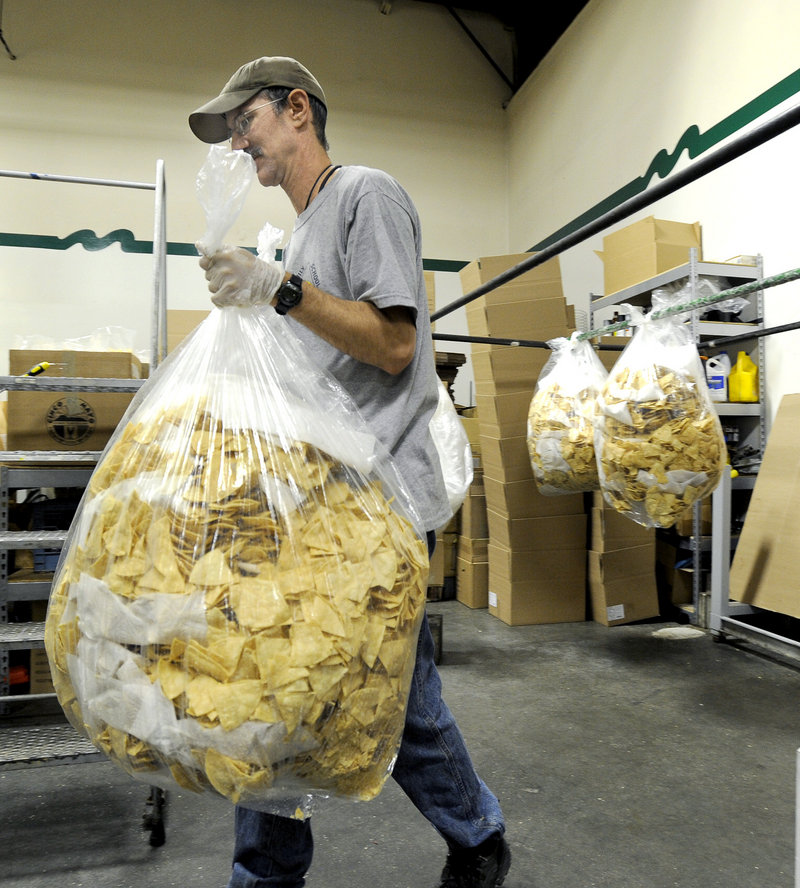
Then the chips hang in big plastic bags for 24 hours. The chips are layered with paper towels to soak up more oil.
Next, an employee pours the chips into a big metal sifter and shakes them to sift out any small broken pieces. Once he moves into a bigger space, Rehart hopes to turn these broken pieces into a seasoned coating mix that can be used like bread crumbs.
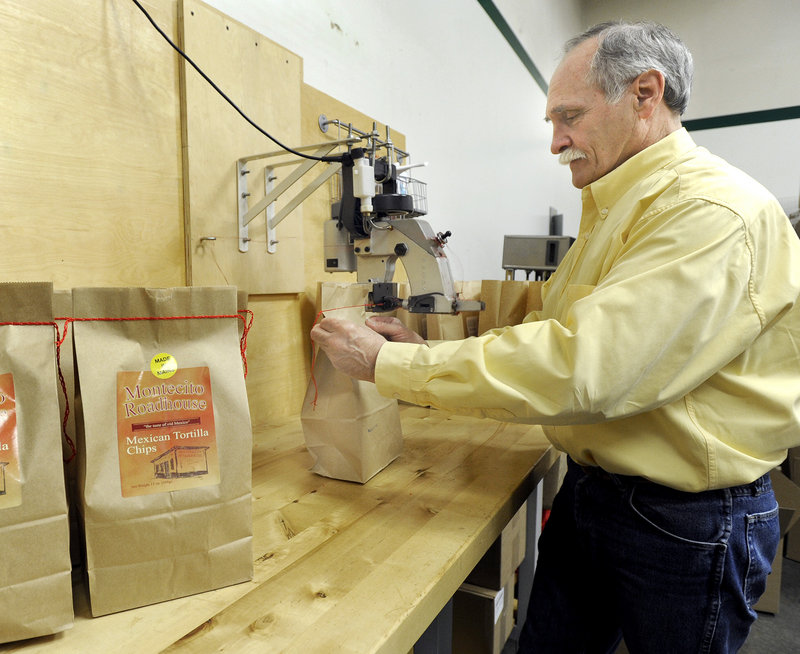
Finally, the chips are weighed and bagged at a rate of 200 bags per hour. The chips go into plastic bags that are sealed and placed into a brown paper sack. A sewing machine seals the paper sack with the bright-red thread that Rehart’s customers have come to recognize.
With national sales of tortilla chips expected to grow 4 to 5 percent per year over the next few years, Rehart is hopeful about the future.
His own sales have grown at an average annual rate of 38 percent over the past seven years, and in the first quarter of 2010, sales were 50 percent ahead of last year.
Rehart wants to buy new machinery that will help increase production and start making a spicier chip as well as the coating mix. Both steps, he thinks, will help him continue to grow.
“I think I’ll manage to get it done,” he said. “I have to move.”
Staff Writer Meredith Goad can be contacted at 791-6332 or at:
mgoad@pressherald.com
Send questions/comments to the editors.

Success. Please wait for the page to reload. If the page does not reload within 5 seconds, please refresh the page.
Enter your email and password to access comments.
Hi, to comment on stories you must . This profile is in addition to your subscription and website login.
Already have a commenting profile? .
Invalid username/password.
Please check your email to confirm and complete your registration.
Only subscribers are eligible to post comments. Please subscribe or login first for digital access. Here’s why.
Use the form below to reset your password. When you've submitted your account email, we will send an email with a reset code.