Saturday, February 4, 2012
By Meredith Goad mgoad@mainetoday.com
Staff Writer
Sarah Hesselink loves food, and she loves writing.

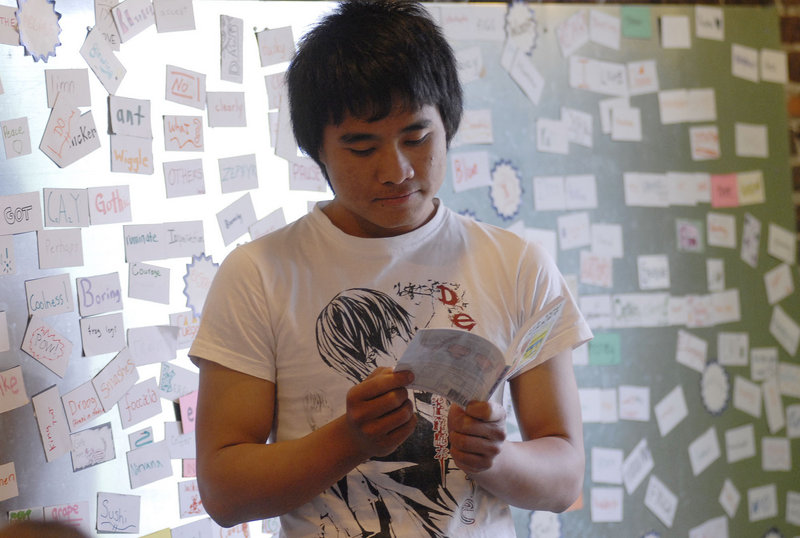
Lee Reh, 20, of Portland High School reads “Bamboo and Rattan.”
Shawn Patrick Ouellette/Staff Photographer

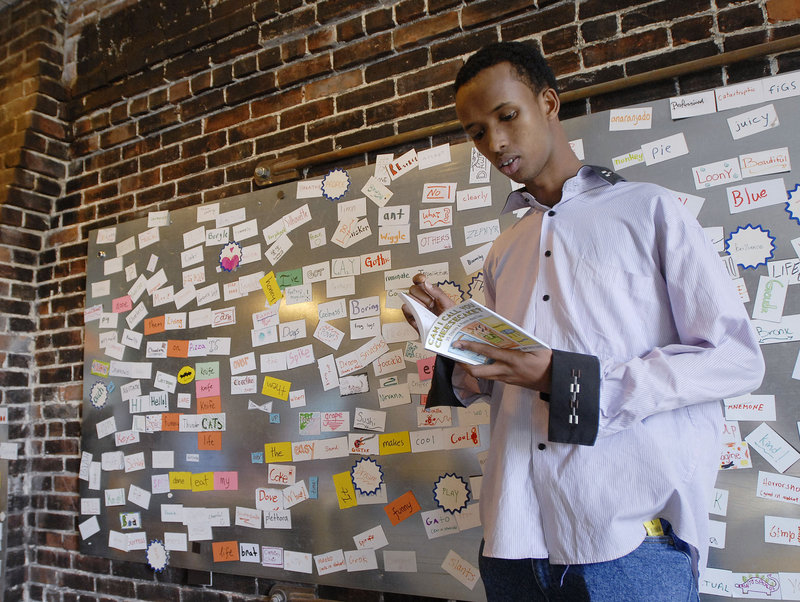
Rabiic Gedi, 17, of Portland High School reads his piece, “Lemon Stew,” from “Can I Call You Cheesecake? 35 Stories & Poems About Food,” an anthology that is the fruit of a writing exercise led by the Telling Room in Portland.
Shawn Patrick Ouellette/Staff Photographer
NEW ON THE SHELF
COPIES OF "Can I Call You Cheesecake? 35 Stories & Poems About Food" ($9.95) are available through the Telling Room's Web site, tellingroom.org, or at Longfellow Books and other bookstores and school libraries throughout the state. For more information, call 774-6064.
CASSAVA
By Jane Amwony
Cassava is tall like me. I am 5 feet 6 inches tall, and cassava roots can be from 5 to 12 feet long. Cassava is important like me. I help cook at home, but my most important family role is to listen. People talk a lot, I prefer to listen. I don’t like to talk. I listen to my family talk about life, jobs, the people we know. Cassava (guana in my language, Acholi) grows in the middle of the forest, as I am in the middle of my family, holding it together.
In Sudan, we all went out together to harvest it. I’d walk 10 minutes between my mom and sister, each of us carrying our own knives. We’d find the plants that were ripe, and we’d cut them out of the ground. We’d harvest a lot all at once and carry heavy ropes of them home on our heads. I’d get tired carrying the big bundles on my head, even more tired than I get carrying my full backpack to school now. When we’d get home, I’d help my mom cook with it. She’d peel it first, and then cut it lengthwise. She’d cook it with meat sometimes. We ate cassava every day in my house. In Sudan, women dry the flour made from it in the sun in colorful pans in the dust.
We still eat cassava every day now that we live in the U.S., for breakfast. My grandma cooks it in sauce with meat. I don’t like Cheerios or breakfast cereal; cassava is so much better. We get it from the Sudanese store next to Maine Medical Center, and we carry it home in a big bag in the car. It’s much easier on our heads to carry it this way. They sell the flour at the store, too, so we don’t have to dry it outside in the sun to cook with it. I help my grandma cook it in the evenings, and we make it just like my mom used to in Sudan.
CHEESECAKE
By Sabir Abdalla
Can I call you Cheesecake?
'Cause you sweeter than Kool-Aid.
Every time I eat cake
I be thinking about you, Cheesecake.
You're so sweet
You make Kool-Aid weep.
The way you speak
Feels like I'm eating sweets.
The way you smile
Feels like a day outside
With some sunshine.
The first time we met
You ignored me and left.
The next time we met
You stayed with me and talked.
Now when you see me
You hug me and tease me
Please me and squeeze me.
A SPOONFUL OF FUDGE
By Madeline Curtis
It's annoying, never being alone. Never lonely though. I, being the largest and most used measuring spoon of my bunch, have the ability to tell them to shut up, but it never lasts long, a year or two at most. It is horribly depressing, knowing you must live forever, a mere cooking utensil connected by a ring to your chattering brethren.
After many years, I no longer shine. Whiteness has settled like a coat of dust over me, and no amount of scrubbing is able to wash it away. I envy the humans, and their short, eventful lives. I cannot feel love, or taste the food so close to me. I must live before and after them, and see the suffering their actions cause. I have scooped all my life, poured sugar and water, flour and cocoa. I have measured out ice cream, cakes and fudge, each time neat and perfectly. From my place in an open drawer, on a nail in a wall, or splayed on a table, I have spooned wartime rations, served medicine to the sick and dying, and seen gloating despite the hunger of others. I have seen too much of the humans, and I long to fall into a blissful, eternal sleep.
BERRY BACKLASH SLUSHIE
By Hannah Smith
My mom went to go pay for gas. She came out with three .79 slushies from Cumberland Farms. One for her, one for my little sisters to split, and of course, one for little old moi. I FREAKED OUT! It was the biggest, most amazing slushie I had ever laid my eyes on.
I centered in on Berry Backlash. I felt my eyes blur. As I sipped slowly, the cells in my body got their fix. I have these slushies all the time. I thought, somewhere, someone was probably feeling the same thing I was.
I soon discovered that these slushies were even better with a candy bar. My friend Izzy lives a block away from Cumberland Farms so every time we chill at her pad it's slushie insanity! Of course, there are 7-11 slushies, but nothing compares to Cumbie's well, with the exception of Salvie's slushie.
A long time went by and I hadn't had a decent slushie since I had moved here from Boston. In Massachusetts they call slushies Italian Ice; but hey, what's the difference? It's all the same ingredients: ice, syrup whatever the other slushie stuff is. Well, it's almost the same, except Salvie is my BFF and he put stuff in his to make them even better.
Salvie was a rather large fellow. And Italian. Italians are cool. He was close friends with the whole family. His little shop was in between some apartments and another little corner store, just a block from my house. We always took family walks with the dogs, or friends.
We got different flavors from Salvie's but mostly mango slushies. They were cold and sweet, with a bit of zip to them. They were sort of an orange Creamsicle color (Did you know National Creamsicle Day is August 14th every year? Yeah. It is.) but they were almost trying to rebel and broke out into a hint of red.
I had only been four when we moved here but it very well could have been yesterday. I'd remember it as much as I do now. I'll always want Salvie's slushie, but unfortunately, his shop closed and I moved. Luckily Cumbie's Berry Backlash keeps me sane.
So when the 14-year-old from King Middle School was given the assignment to write about food, she couldn't wait to get started. She knew almost immediately what her subject would be: latkes.
"They're one of my favorite foods," Hesselink said, "and they also kind of say a lot about my family. And they really do tell a story."
Sarah is one of 35 budding Maine food writers who have just published a collection of their stories and poems about food in a new anthology, "Can I Call You Cheesecake?" It's the culmination of a year's worth of workshops and mentoring by the staff and volunteers of the Telling Room on Commercial Street, a nonprofit writing center where children and young adults learn how to tell their own stories.
The anthology is not just another collection of reminiscences about lobsters and whoopie pies.
"When I was 9, I wished I could be a carrot," writes Christina Murray, who attends Catherine McAuley High School. "I could've disappeared behind a cliff of meatloaf or under a river of gravy at the dinner table."
Some of the students whose stories made it into the book were born in Maine, but others hail from India, Iraq, Somalia, the Dominican Republic, Burma, Uganda and Sudan.
Agustin Nyapir, a native of Sudan who attends Casco Bay High School, wrote a lovely and humorous account of trying to make aseeda, a Sudanese porridge, one day when his mother left him home alone and he got hungry: "Aseeda looks white because of the flour it is made with, and it is as pale as the sky, the color of the first day of snow. It tastes like freshly baked bread. It feels soft enough to sleep in while you dream."
The students write about everything from the thrill of a Berry Backlash slushie to life from the point of view of a spoon. One or two of the stories includes a recipe.
Gibson Fay-LeBlanc, executive director of the Telling Room, says the staff has always used food as a way to get students interested in writing. With this project, they wanted to expand food's role in the group's workshops because "it's just a great window into family and culture and geography."
Often, the staff will bring out different foods for the students to taste and smell, hoping that a jar of olives or a whiff of stinky cheese will unleash their creativity. The students hold unnamed spices under their noses and linger on the scent of sage or mint or cumin, "and let that carry them somewhere," Fay-LeBlanc said.
"What does this remind you of? So often, smell, in particular, just goes right back to memory, so in terms of writing personal stuff, that's a great starting point."
An olive, wrote Janet Mathieson of the Middlesex School in Massachusetts, "tastes like the bottom of a pond."
Many of the pieces start off being about food, then turn into very personal accounts of life and family. Some of the stories are warm; some are heartbreaking.
Writing her story about her mother's latkes sizzling in hot oil helped Hesselink learn more about her grandmother.
"I didn't know her very much when she passed away because I was only 2 or 3," she said, "so it was really cool to learn about her and about how she was when she was younger."
Lee Reh, a 20-year-old student at Portland High School, teamed up with his brother, Ti, to write about rattan in their native Burma.
"It has no smell but the fruit of the rattan tastes sour and good," they wrote. "Our father risked his life to get it for us."
writing about rattan, Reh and his brother ended up learning more about their family's journey from Burma to a refugee camp in Thailand and then to America.
Rabiic Gedi, a 17-year-old from Portland High School, wrote about his mother's lemon stew and how she taught him to make rice with lemon. Over the course of three weeks, Gedi interviewed his mother about lemons in Somalia, and learned that in the United States, lemons grow in Arizona and California. He drew pictures of lemon trees.
Gedi's ode to lemons eventually segues to the story of how his father was killed by a stray bullet from street fighting while working in a shop in Mogadishu.
After his father's death, his family moved to a refugee camp in Kenya, where they ate lemons every day.
"When I sit with my family at the table, I need to forget that there has been a war in our country for 20 years, longer than my whole life," Gedi writes. "It is easier to forget about my father than be sad, but the smell of my mother's stew reminds me."
Staff Writer Meredith Goad can be contacted at 791-6332 or at: mgoad@pressherald.com
Tweet
![]() click image to enlarge
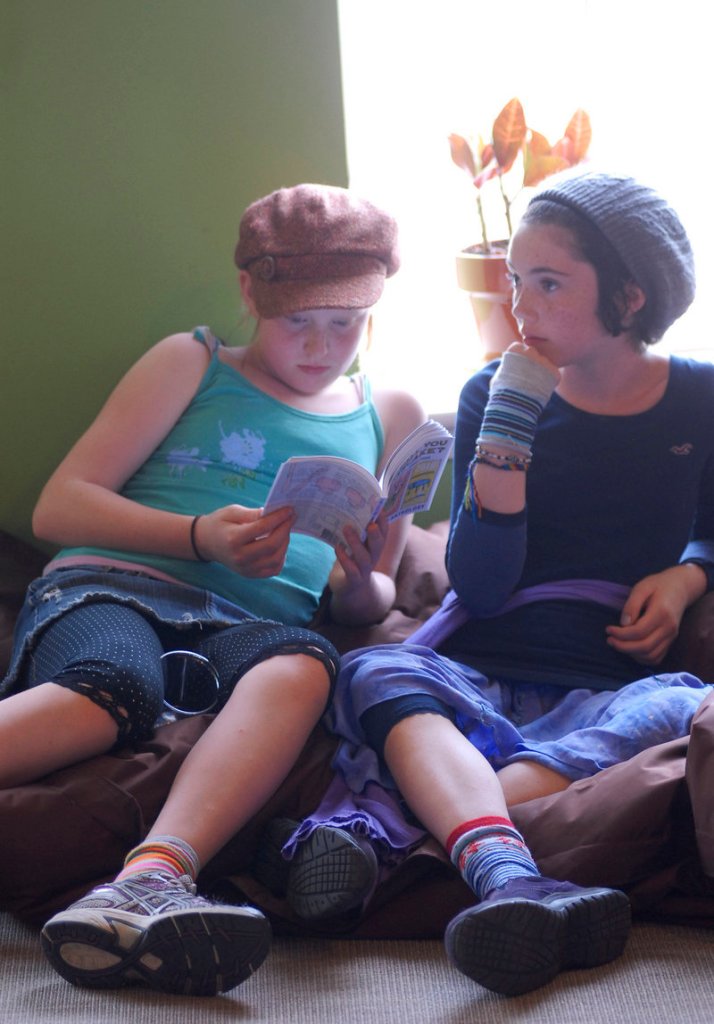
Violet Sulka-Hewes, 10, and Madeline Curtis, 12, both students at the Friends School in Portland, listen to a reading at the Telling Room from “Can I Call You Cheesecake?” Shawn Patrick Ouellette/Staff Photographer |
![]() click image to enlarge
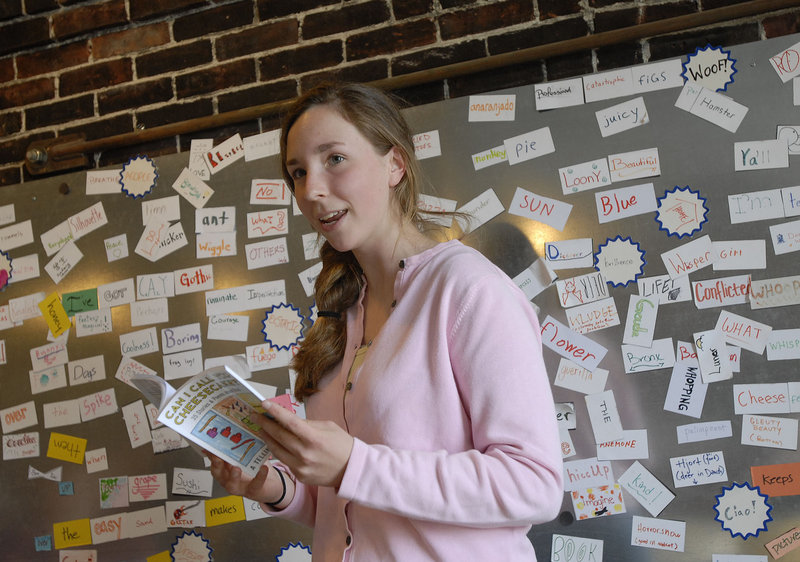
Emily Hollyday, 17, of Cape Elizabeth, above, reads her piece, “Cantaloupe,” at the Telling Room. Below, Lee Reh, 20, of Portland High School reads “Bamboo and Rattan.” Shawn Patrick Ouellette/Staff Photographer |
|||||||||||||
Further Discussion
Here at PressHerald.com we value our readers and are committed to growing our community by encouraging you to add to the discussion. To ensure conscientious dialogue we have implemented a strict no-bullying policy. To participate, you must follow our Terms of Use.Questions about the article? Add them below and we’ll try to answer them or do a follow-up post as soon as we can. Technical problems? Email them to us with an exact description of the problem. Make sure to include: