



Craig Gladstone found himself in a blueberry bind. As the president of the Gladstone’s Under the Sun blueberry processing plant in Bar Harbor, he had lined up a new wholesale customer for his frozen Caviar of Maine. But at the last minute the customer asked for the company’s kosher certification, which was something Gladstone didn’t have.
That’s when he placed a call to Rabbi Akiva Herzfeld of Congregation Shaarey Tphiloh in Portland.
Additional Photos
“Long story short, I talked to him and he was at my place the next morning at 6 a.m.,” Gladstone said. “He went out of his way to try and help me.”
The result is that the Caviar of Maine blueberries now have the stamp of approval from the state’s only kosher-certifying organization, known as the Maine Kosher Vaad.
Composed at present of Rabbi Herzfeld, Rabbi Carolyn Braun of Temple Beth El in Portland and Rabbi Alice Goldfinger of Beit Haam in South Portland, the Vaad is slowly forming again after being inactive for a number of years. The Vaad is not set-up to deal with meat, but it is available to certify plant-based foods and cheeses.
“I go to the site, I review the products, I review the ingredients and then get into the process by which it’s made,” Rabbi Herzfeld said.
For example, if the process involves pork fat (as some traditional maple syrup processing does) or insect-derived food coloring (a particular issue with red dye) these ingredients would prevent the product from achieving kosher certification. None of Maine’s cheesemakers have sought the Vaad’s certification, but Rabbi Herzfeld is hoping to work with any that don’t use animal-derived rennet in their process. Under kosher laws, milk and meat cannot be mixed.
Rabbi Herzfeld has also worked with local supermarkets to source more kosher products. Maine doesn’t have any kosher restaurants, but should any eateries want to obtain a certification the Vaad would work with them, too.
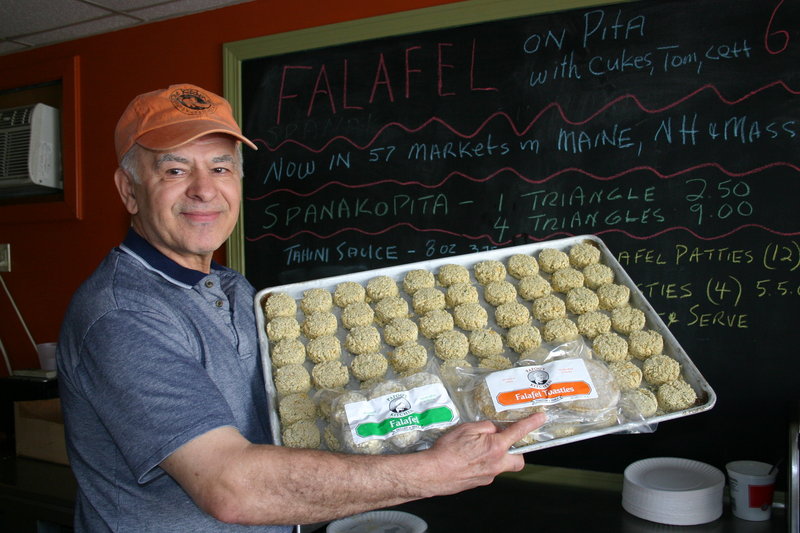
So far, a handful of Maine products have been approved to use the new Maine Kosher symbol. These include Spelt Right bagels and Papou’s Kitchen falafels.
Chris Zoulamis, who heads Papou’s Kitchen, said the company’s sales of frozen falafels are growing rapidly. He hopes to have the product in the New York City area within a year.
“In bigger markets, it’s a very helpful symbol to have,” Zoulamis said.
After a successful tasting event held at Temple Beth El, Zoulamis is confident his frozen falafels — which just need to be heated and served — will have wide appeal among Jewish customers.
“Falafel is very well-established in Israel,” Zoulamis said. “Every corner has a falafel stand. It’s like hot dogs here.”
Kosher supervision can be obtained from a number of national organizations. However, the Maine-based certification has the advantage of being close-to-home and costing less. There’s no set price for the service, instead Rabbi Herzfeld asks for donations. The Maine food producers I spoke with all said the local option was more affordable.
“There’s an estimate of 6,000 Jews in southern Maine,” Rabbi Herzfeld said. “Not all of these Jews are strictly observant of kosher laws.”
While the Jewish community in Maine is rather small, kosher food appeals to a wider audience, including Muslims, Hindus, vegetarians and the lactose-intolerant. In addition, many people are looking for kosher certifications as a way to distinguish safer, better quality food.
“The symbol opens up markets,” Gladstone said. “A lot of people look for it because they’re looking for natural and healthy.”
However, as a number of recent shut downs and fines at kosher slaughterhouses have shown, the certification is no guarantee of cleanliness or more humane slaughter techniques.
“Just because you keep Kosher doesn’t mean you’re eating healthy,” said Rabbi Herzfeld, who sticks to a primarily vegetarian diet himself. “But what Kosher does is gets you to think seriously about what you eat. One of the things about kosher is it’s a spiritual directive. When we eat, we try to be healthy in both mind and body.”
Which is sound advice, whether or not you keep kosher.
Staff Writer Avery Yale Kamila can be contacted at 791-6297 or at: akamila@pressherald.com
Send questions/comments to the editors.

Success. Please wait for the page to reload. If the page does not reload within 5 seconds, please refresh the page.
Enter your email and password to access comments.
Hi, to comment on stories you must . This profile is in addition to your subscription and website login.
Already have a commenting profile? .
Invalid username/password.
Please check your email to confirm and complete your registration.
Only subscribers are eligible to post comments. Please subscribe or login first for digital access. Here’s why.
Use the form below to reset your password. When you've submitted your account email, we will send an email with a reset code.