



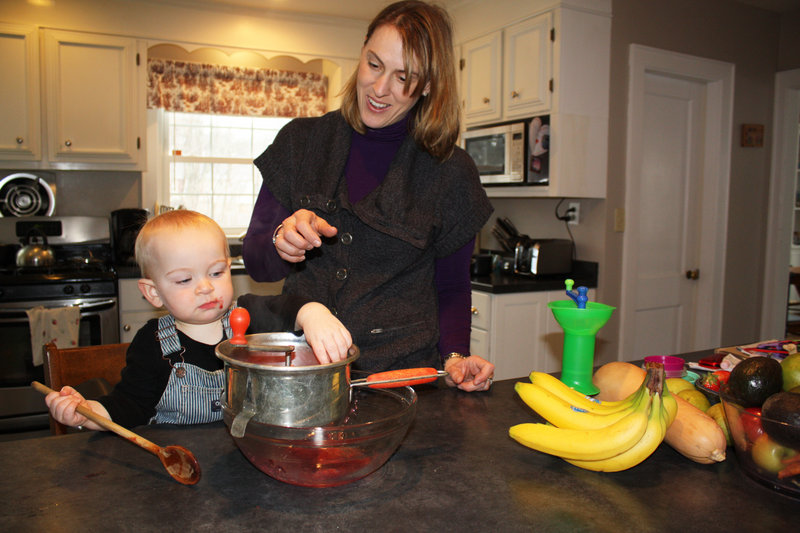
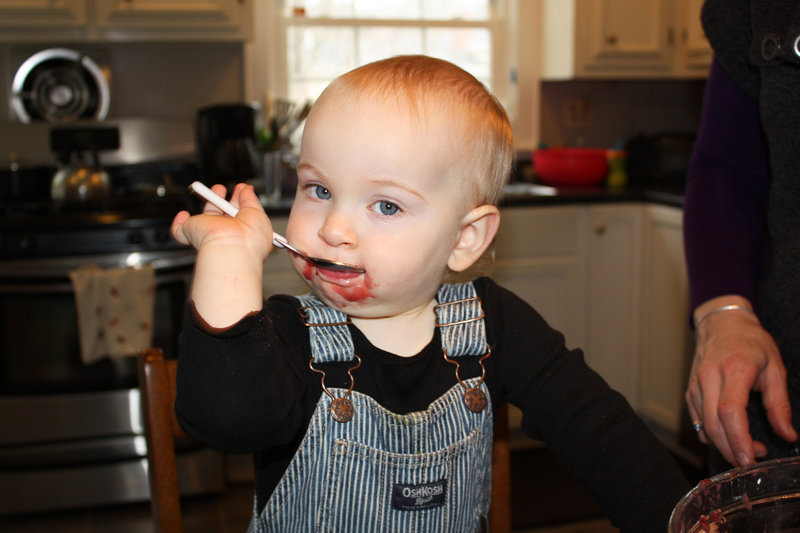
Fourteen-month-old Joseph Sullivan reaches into a glass bowl with a wooden spoon, scoops up a dripping heap of berry applesauce and mashes it into his mouth. Then he goes back for more.
His mom, Christine Wirth, made the applesauce by boiling peeled apples with frozen strawberries and raspberries. With Joseph’s help, she ground the mixture through a metal food mill, cutting up seeds and any other hard-to-swallow parts.
Additional Photos
Ever since Joseph was an infant, Wirth, of Portland, has made his food from scratch.
Although she did buy canned baby food on occasion, Wirth was motivated to create her own because she wanted to provide her son with better nutrition and allow him to experience a wide variety of foods and tastes.
“I wanted to introduce him to a lot of different flavors,” she said. “Also, I love to eat, so I don’t want to have a kid that’s a picky eater. I wanted him to be exposed to all kinds of different foods.”
Wirth started out with simple foods such as pureed apricots, sweet potatoes or avocado, and as Joseph has gotten older she’s moved to more complex dishes such as soups, stews and stir fries.
“He eats all kinds of spicy foods now,” Wirth said. “I pretty much mash up whatever we’re eating.”
Not only does making your own baby food offer the superior nutrition of minimally processed home-cooked meals, it also protects against the chemicals lurking in the store-bought variety.
Two weeks ago, a coalition of public health and environmental organizations in Maine released a study of BPA in baby food. It concluded that of 12 jars of baby food sampled, 11 contained BPA.
BPA, or bisphenol-A, is a chemical used in plastics that has been linked to learning disabilities, obesity, cancer, early puberty in girls and male infertility.
The study tested three baby food varieties from leading manufacturers Gerber, Beech-Nut, Earth’s Best Organics and Shaw’s Wild Harvest. One of the three Earth’s Best jars analyzed was the only one that didn’t test positive for BPA, according to the study.
The study also tested Campbell’s Disney Princess SpaghettiOs, Dora the Explorer Soup and Chef Boyardee macaroni and cheese, and reported that all three products contained BPA.
“I think people feel if there’s something on the shelf, someone decided it’s safe, and unfortunately that’s not the case,” said Amanda Sears, a mother of two and the associate director and co-founder of the Portland-based Environmental Health Strategy Center. “Currently, there’s no law in Maine that says you can’t use BPA in baby food, infant formula cans or any other food products.”
While Maine does not prohibit BPA in food, it has taken steps to force manufacturers to remove it from products used by children. Under the 2008 Kids Safe Product Act, the use of BPA in baby bottles and sippy cups was outlawed in the state as of Jan. 1.
The law also requires companies producing baby food and infant formula to report on their use of BPA.
Earth’s Best reported that it plans to eliminate BPA by October of this year. Gerber reported that it’s no longer using BPA. (According to Sears, Gerber attributed the positive BPA test results for its products to the fact that baby food can sit on store shelves for up to two years.)
Beech-Nut and Shaw’s Wild Harvest have so far failed to report on BPA use in their products.
As a result of the study, a group of mothers and environmental advocates are now gathering signatures to petition the Maine Board of Environmental Protection to require manufacturers to remove BPA from infant formula and baby food.
In addition to steering clear of BPA, parents who make their own baby food find that it comes with significant cost savings.
Kristie Green is the mother of two children – Violet Milliken, 2, and Oliver Milliken, 1 – and she’s made their own food since they were born.
“The cost savings is really the unbelievable thing,” said Green, owner of the artisinal gelato maker Maple’s Organics.
A price comparison conducted in New Hampshire in 2010 and posted on wholesomebabyfood.com found that on average, making your own baby food saves 23 to 27 cents per ounce. This may not seem like a lot, but over the course of a year, the savings can add up to more than $500.
Not only does Green want to save money, she wants to make sure her children get the best-quality food possible.
“I wanted to be able to use fresh, organic produce and know exactly what went into the food,” Green said.
She found that a combination of avocado, spinach and sweet potato was a favorite with her children, as was anything with banana in it.
Noting that many people seek out her company’s gelato and sorbetto because it’s made in small batches by local people, Green says she’s skeptical of how large food companies manufacture their wares.
“The reality is you don’t really have any idea what is in that food,” Green said. “It’s probably fine 99 percent of the time, but I’m much more likely even now to buy stuff to feed the kids from smaller manufacturers.”
But most days, she just feeds them homemade food.
Staff Writer Avery Yale Kamila can be contacted at 791-6297 or at: akamila@pressherald.com
Twitter: AveryYaleKamila
Copy the Story Link
Send questions/comments to the editors.

Success. Please wait for the page to reload. If the page does not reload within 5 seconds, please refresh the page.
Enter your email and password to access comments.
Hi, to comment on stories you must . This profile is in addition to your subscription and website login.
Already have a commenting profile? .
Invalid username/password.
Please check your email to confirm and complete your registration.
Only subscribers are eligible to post comments. Please subscribe or login first for digital access. Here’s why.
Use the form below to reset your password. When you've submitted your account email, we will send an email with a reset code.