




LEWISTON – Grab a hog intestine.
That’s what Marc Mailhot told me to do. Hog intestines are the natural casings for sausages at Mailhot Sausage Co., a 100-year-old family company. I told Mailhot I wanted to see how sausage was made, so here I was holding an intestine.
Additional Photos
It wasn’t that bad. It was basically like a long piece of rubber or plastic. The tricky part was finding the end and opening it, which I managed to do after a few minutes.
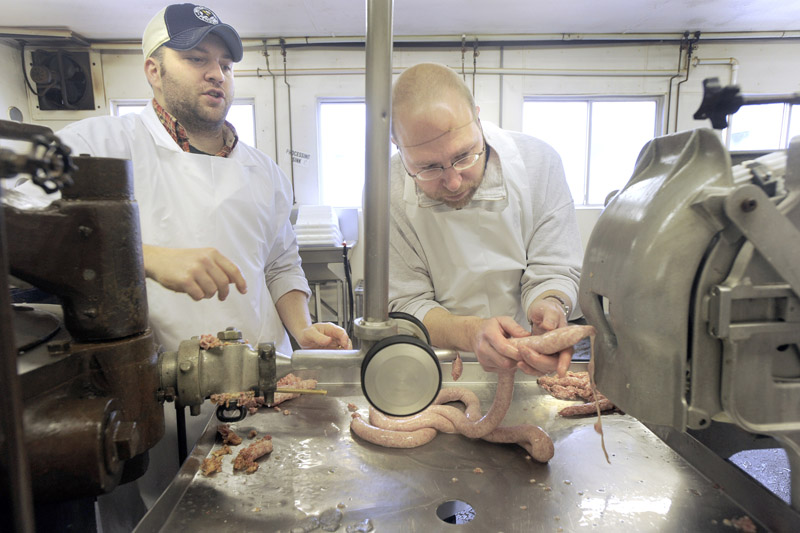
Then Mailhot told me to put the open end over the nozzle of the “stuffer,” a 100-year-old barrel-shaped mechanism. Using a spinning “threader,” I compressed the very long casing onto a one-foot-long nozzle.
I turned the lever of the stuffer on, and could hear the compressed air start to push the meat into the casing. At first, it was too slow and only a drop got into the casing. Then I pulled the lever too much, and a big glop of meat poured out, breaking the intestine and plopping onto the stainless steel counter in front of me.
“You want to put your hand under it to support it when the meat comes out, then you can have it come out pretty fast,” said Mailhot, 34, who has been in the family business about as long as he can remember. “It’s kind of an art.”
Mailhot laughed at his remark, but I found it to be fairly true.
First, there’s the art of cooking. The company started 100 years ago making French Canadian specialties like cretons (pork spread) and tourtiere (pork pie). It still makes those items using a special Mailhot family recipe that was not divulged to me.
The whole time I was there, a giant pot of seasoned ground pork was simmering for cretons. Mailhot and I occasionally stirred the pot with an oar-sized stirring implement, and Mailhot said he was going to let it simmer all day. That’s exactly how my Memere (a French term for grandmother) did it when I was a kid, I told Mailhot excitedly.
Then there’s the art of presentation. Mailhot and others who work the stuffer are skilled at filling the sausage casings with just the right amount, so the sausages don’t look unappetizingly skinny, or ridiculously fat.
After an intestine is filled with pork — and Mailhot’s sausages are just pork, loin and belly, with seasonings — it gets fed into the “linker.” The 5-foot-long machine pulls the length of sausage through while twisting the casing every few inches to make individual sausage links.
When I first tried to feed the linker, I was afraid of getting my hand caught, so I sort of threw the length of sausage at it, and missed. Later I learned there was nothing to fear, and fed the linker successfully.
At the other end of the linker, another worker pulled the linked sausages out. The job at that end, Mailhot told me, was to wrap 10 or so links around your hand and then cut those sausages off and hang them, in sort of a wreath shape, around a horizontal metal pole.
After doing some stuffing and linking, we went backward a little bit. Mailhot brought me to the meat grinder in the same small kitchen.
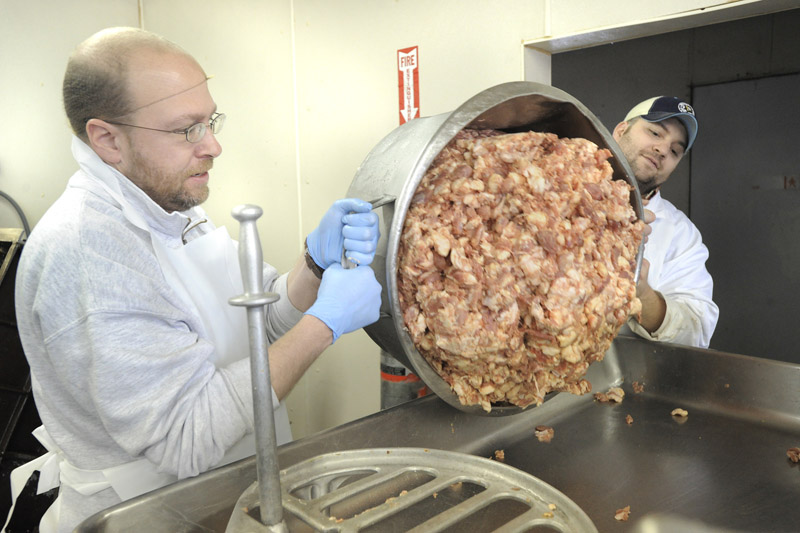
A large steel bucket with more than 100 pounds of chopped pork loin and fatty pork belly was sitting by the grinder. Mailhot carefully showed how to grip the handles on one side, with one hand facing up and one facing down, so I’d be ready for a quick flip of the heavy load onto the grinder’s table.
Then he told me to be sure to bend at the knees. We both bent, gripped, picked the bucket up and flipped the pork onto the table. No way I could have done that alone.
The day I was at Mailhot’s, just three people were working on making sausage and cretons; during the Christmas season there might be eight or 10. But there were other workers, including two or three making salmon pies (also a French Canadian favorite) and pork pies.
At the grinding station, I began shoving the mounds of pork into a giant hole in the table that led to the grinder. I then pushed the button to elicit the roar of the grinder. Every once in a while I had to use a metal plunger to shove the meat down the hole to the rotating blades just below.
Mailhot told me to be sure to keep meat in the hole at all times or the blades would grind each other and cause damage.
This was one of the few tasks I didn’t like, since I could not avoid getting slimy pork all over myself. Don’t get me wrong, as a proud descendent of French Canadians, I love all pork products. But being up to your elbows in raw pork is something different all together.
I was wearing an apron and hair net, so those parts of my body were pork free.
The floor of the kitchen became wet and slippery, so as Mailhot said, you have do some “dancing” to avoid falling sometimes.
I also got a nice dusting of flour on me when I helped cut some dough into round shapes to “cap” salmon pies.
“You definitely need an apron here,” said Mailhot of the messy work. “But the best part is just knowing we turn out a quality product.”
Just like Memere.
Staff Writer Ray Routhier can be contacted at 791-6454 or at: rrouthier@pressherald.com
Send questions/comments to the editors.

Success. Please wait for the page to reload. If the page does not reload within 5 seconds, please refresh the page.
Enter your email and password to access comments.
Hi, to comment on stories you must . This profile is in addition to your subscription and website login.
Already have a commenting profile? .
Invalid username/password.
Please check your email to confirm and complete your registration.
Only subscribers are eligible to post comments. Please subscribe or login first for digital access. Here’s why.
Use the form below to reset your password. When you've submitted your account email, we will send an email with a reset code.