



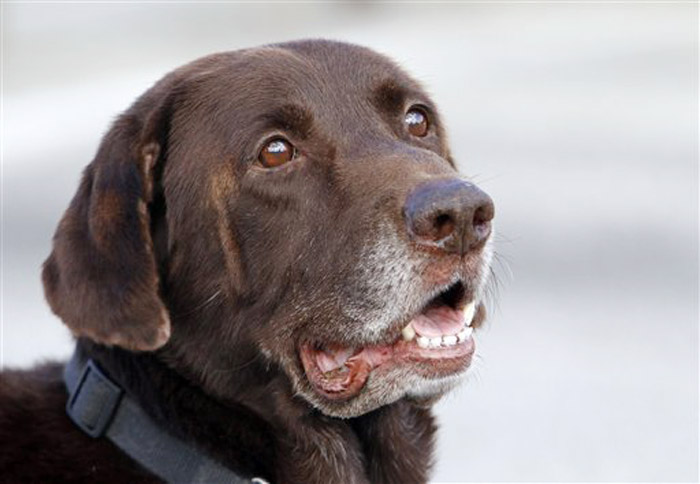
MIAMI — Franky the drug dog’s supersensitive nose is at the heart of a question being put to the U.S. Supreme Court: Does a police dog’s sniff outside a house give officers the right to get a search warrant for illegal drugs, or is the sniff an unconstitutional search?
Florida’s highest state court has said Franky’s ability to detect marijuana growing inside a Miami-area house from outside a closed front door crossed the constitutional line. The state’s attorney general wants the Supreme Court to reverse that ruling.
Additional Photos
The justices could decide this month whether to take the case, the latest dispute about whether the use of dogs to find drugs, explosives and other illegal or dangerous substances violates the Fourth Amendment protection against illegal search and seizure.
Many court watchers expect the justices will take up the case.
“The Florida Supreme Court adopted a very broad reading of the Fourth Amendment that is different from that applied by other courts. It’s an interpretation that a majority of the U.S. Supreme Court will question,” said Tom Goldstein, who publishes the widely read SCOTUSblog website and teaches at the Harvard and Stanford law schools.
The case, Florida v. Jardines, is being closely monitored by law enforcement agencies nationwide, which depend on dogs for a wide range of law enforcement duties.
“Dogs can be a police officer’s best friend because they detect everything from marijuana or meth labs to explosives,” said Kendall Coffey, a former U.S. attorney in Miami now in private practice.
The 8-year-old Franky retired in June after a seven-year career with the Miami-Dade Police Department. He’s responsible for the seizure of more than 2.5 tons of marijuana and $4.9 million in drug-contaminated money. And because he’s an amiable chocolate Labrador, he was used extensively in airports, sports arenas and other places where people congregate.
“He’s a friendly, happy dog,” said his former handler, Detective Douglas Bartelt, who kept Franky after he retired. “People don’t have fear because of his appearance.”
The U.S. Supreme Court has approved drug dog sniffs in several other major cases. Two of those involved dogs that detected drugs during routine traffic stops. In another, a dog found drugs in airport luggage. A fourth involved a drug-laden package in transit.
The Florida case is different because it involves a private residence. The high court has repeatedly emphasized that a home is entitled to greater privacy than cars on the road or a suitcase in an airport. In another major ruling, the justices decided in 2001 that police could not use thermal imaging technology to detect heat from marijuana grow operations from outside a home because the equipment could also detect lawful activity.
“We have said that the Fourth Amendment draws a firm line at the entrance to the house,” the court ruled in that case, known as Kyllo v. United States. The justices added that the thermal devices could detect such intimate details as “at what hour each night the lady of the house takes her daily sauna and bath.”
It’s well-settled that law enforcement officials can walk up to a home and knock on the front door, in hopes that someone will open up and talk. But if a person inside refuses, the officers must get a search warrant — and for that they need evidence of a crime.
On the morning of Dec. 5, 2006, Miami-Dade police detectives and U.S. Drug Enforcement Administration agents set up surveillance outside a house south of the city after getting an anonymous tip that it might contain a marijuana grow operation. Bartelt arrived with Franky. The dog quickly detected the odor of pot at the base of the front door and sat down as he was trained to do.
That sniff was used to get a search warrant from a judge. The house was searched and its lone occupant, Joelis Jardines, was arrested trying to escape out the back door. Officers pulled 179 live marijuana plants from the house, with an estimated street value of more than $700,000.
Jardines, now 39, was charged with marijuana trafficking and grand theft for stealing electricity needed to run the highly sophisticated operation. He pleaded not guilty and his attorney challenged the search, claiming Franky’s sniff outside the front door was an unconstitutional law enforcement intrusion into the home.
The trial judge agreed and threw out the evidence seized in the search, but that was reversed by an intermediate appeals court. In April a divided Florida Supreme Court sided with the original judge.
In its petition to the U.S. Supreme Court, state lawyers argue that the Florida Supreme Court’s decision conflicts with numerous previous rulings that a dog sniff is not a search.
“A dog sniff of a house reveals only that the house contains drugs, not any other private information about the house or the persons in it,” wrote Carolyn Snurkowski, Florida associate deputy attorney general. “A person has no reasonable expectation of privacy in illegal drugs.”
The criminal case against Jardines is on hold until the question involving Franky’s nose is settled. Meanwhile, Jardines is out on bail following a 2010 arrest for alleged armed robbery and aggravated assault. He pleaded not guilty in that one, as well, and trial is set for Feb. 21.
Send questions/comments to the editors.

Success. Please wait for the page to reload. If the page does not reload within 5 seconds, please refresh the page.
Enter your email and password to access comments.
Hi, to comment on stories you must . This profile is in addition to your subscription and website login.
Already have a commenting profile? .
Invalid username/password.
Please check your email to confirm and complete your registration.
Only subscribers are eligible to post comments. Please subscribe or login first for digital access. Here’s why.
Use the form below to reset your password. When you've submitted your account email, we will send an email with a reset code.