




Karin Anderson still has her husband’s cremated remains stashed in a box at her condo in downtown Portland. Steve Fisk, a math professor at Bowdoin College, died two and a half years ago after a decade-long fight with leukemia.
As Fisk lived out his remaining days in hospice care, the couple talked about what he wanted. First, his body would be donated to the University of New England’s medical school for research. Then, he would be cremated.
Additional Photos
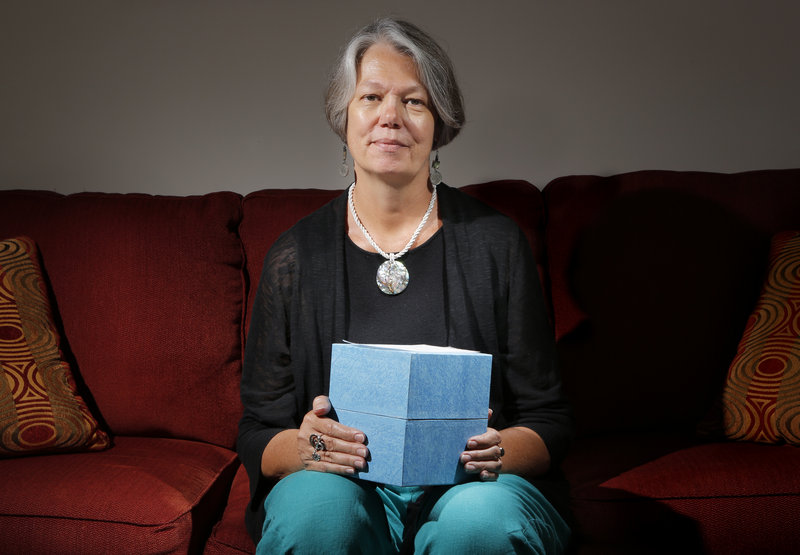
“Neither of us thought it was important to preserve the body,” said Anderson, 56. Next weekend, she and her daughter plan to scatter his remains.
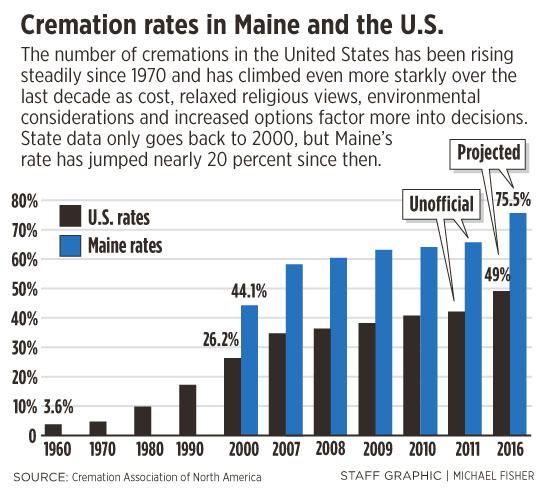
Mainers are cremating their loved ones at an extraordinary rate, and the numbers keep going up. In 2000, 44 percent of deceased Maine residents were cremated. In 2010, the rate was 64 percent — well above the national rate of 41 percent.
The cremation rate here is the sixth highest in the country and the highest in the eastern half of the United States. The Cremation Association of North America projects that more than half of Americans — and three-quarters of Mainers — will choose cremation within 10 years.
There is no one reason that explains the growing rate. There are a variety of factors: the lower cost of cremation, relaxed religious views and increased environmental awareness. Cremation also offers flexibility that traditional burial does not and fits into today’s transient lifestyle. People do any number of things with their loved ones’ remains, from burying them in the backyard to scattering them in woods or at sea.
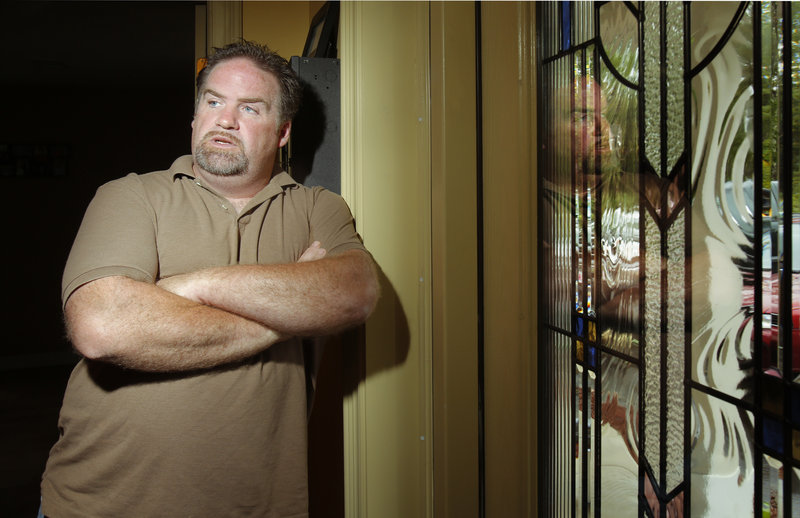
Peter Neal, a funeral director in Piscataquis County and a board member for the state’s funeral directors association, said the trend toward cremation has mirrored a broader societal shift.
“Fifty years ago, everyone went to church, everyone had a big wedding, no one moved in before marriage, and no one got divorced,” he said. “Now, all those traditions have eroded a little. Funerals are no different.”
Funerals are rarely solemn, black-clothing-and-dark-sunglasses occasions anymore. People don’t always want caskets or religious services. And more and more they don’t want to be buried beneath the ground.
For Anderson and Fisk, the decision had nothing to do with cost or religion. Cremation was a practical option that suited his lifestyle. They never talked about what to do with his remains. It took her a month to pick them up because she dreaded the finality of having them in her possession. She has hung on to them ever since, waiting for the right time to dispose of them.
“My daughter and I are going to sprinkle some at a few special places — there is a spot where we had our first date that comes to mind,” she said. “And I suspect we’ll get a little silly, too. He was a silly man sometimes.”
Besides, she likes the thought of knowing that there won’t be just one place where she can go visit her husband. There could be dozens.
COST IS THE BIGGEST DRIVER
Six years ago, there were only five crematories in Maine. Now, there are 12, ranging in size from the Lighthouse Crematory in Freeport, which logged 122 cremations last year, to Gracelawn Memorial Park in Auburn, where 2,391 cremations were performed.
From the road, you can’t see the Lighthouse Crematory. It’s set back in the woods, shielded by Burr Cemetery and its rows of gravestones, many blackened with age. The markers evoke a time when returning a body to the earth whole was a time-honored custom.
Chris Stilkey maintained that cemetery and ran a gravestone business for 30 years before he built the crematory in 2010.
“Personally, I’m not going to be cremated. I’ll be buried right out there next to my dad, unless my wife has other ideas,” Stilkey said. “But more and more people want to be cremated, and I’m in the business of making sure people get what they want.”
Cost is the biggest driver. A basic cremation runs about $1,000. A traditional funeral and burial often starts at $4,000 and can eclipse $10,000.
“For some, I think it’s their way of saying, ‘I’m gone. Don’t waste money on me,'” Stilkey said. “For others, it’s their only option.”
The cost difference allows loved ones to spend money on other things. Instead of a mahogany casket, families can use that money to have a life celebration, a party in the deceased’s honor.
Changing religious views have played a role as well. The national cremation rate was stuck around 4 percent in the 1940s, ’50s and ’60s but doubled by the end of the 1970s, shortly after the Roman Catholic Church relaxed its opposition to cremation.
Although most organized religions don’t ban cremation outright, it is not a regular practice. Some Christians believe that the resurrection cannot happen unless the body is whole. For some Jews, cremation is a painful reminder of the Holocaust, when Jews were burned by Nazis in makeshift crematoria.
But religion is no longer a major part of some people’s lives, even in death. That’s especially true in Maine, which is the most secular state in the country, according to a 2010 survey by the Association of Statisticians of American Religious Bodies. Bible Belt states such as Mississippi, Alabama and Kentucky have the lowest cremation rates.
Environmental considerations are a factor, too. People are less enthused about pumping bodies with chemicals or taking up space in cemeteries for eternity.
Anna Peplowski, 66, a retired teacher, midwife and artist from Portland, said she’s happy to see more people choosing cremation. Both her parents were cremated, and she plans to be as well.
“I’ve always sort of believed, ‘Ashes to ashes and dust to dust,'” she said.
Still, there will always be some for whom cremation is not an option.
Mark Hutchins, who owns A.T. Hutchins funeral home in Portland, sees more and more baby boomers like him choosing cremation, but that hasn’t changed his mind. He says he’ll stick with a standard Catholic Mass and burial when his time comes.
“It’s a comfort thing,” he said. “I guess I’m a little more traditional.”
THE ALLURE OF CREMATION
The cremation process is simple.
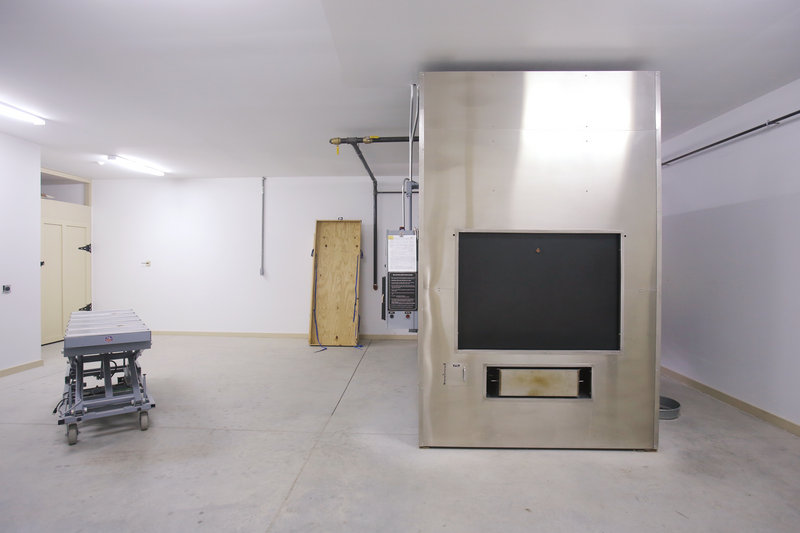
A body — sometimes in a casket, sometimes on a wooden rack — is rolled into a machine called a retort. Family members usually can stay in the cremation room long enough to push the start button.
The retort rises to a temperature of 1,600 degrees Fahrenheit. In about two hours, the body is reduced to bone fragments. Those fragments are cleaned from the retort and taken to a sorting table. Any metal, such as fillings or surgery screws, is removed with a magnet. The rest is pulverized by a processor into a fine powder that resembles ash. The remains are collected in a plastic bag, which is placed in a cardboard box and returned to families.
What happens to those remains is part of the allure of cremation. The options are endless. They can be buried in a cemetery or on private property. They can be placed in a columbarium, an above-ground memorial with individual lockers for each person. Some companies turn remains into jewelry or rocket them into space. Often they are scattered in the water or at scenic locations, even though most states have restrictions against scattering.
Maine law puts few limits on what people may do with remains, stating only that they “may be deposited in a niche of a columbarium or a crypt of a mausoleum, buried or disposed of in any manner not contrary to law.” People should get permission before scattering remains on private property or in a public park. Scattering them in national parks such as Acadia requires a permit.
Sam Eakin, 57, of Cape Elizabeth is not sure what he’ll do. He spent most of his life in Louisiana and moved to Maine 12 years ago. He imagines being buried beneath an oak tree on property he still owns in his home state, but he says he’s leaning toward cremation.
“Once you accept that we are now a transient population and you take down any religious barriers, what else is there?” he said. “I also think there is a hidden psychological feeling for some that they just don’t want to be in the cold ground for eternity.”
If he’s cremated, Eakin said, he doesn’t care too much what happens to his remains. His children are scattered throughout the country. Maybe that will be his fate, too.
“They can just pass me around,” he said.
Staff Writer Eric Russell can be contacted at 791-6344 or at:
erussell@mainetoday.com
Twitter: @PPHEricRussell
Send questions/comments to the editors.

Success. Please wait for the page to reload. If the page does not reload within 5 seconds, please refresh the page.
Enter your email and password to access comments.
Hi, to comment on stories you must . This profile is in addition to your subscription and website login.
Already have a commenting profile? .
Invalid username/password.
Please check your email to confirm and complete your registration.
Only subscribers are eligible to post comments. Please subscribe or login first for digital access. Here’s why.
Use the form below to reset your password. When you've submitted your account email, we will send an email with a reset code.