



Mainers are often described as being risk averse, conditioned by thin soils, frigid winters, Colonial-era Indian wars, and a century and a half of economic privation to work hard and stretch what little we’ve got as far as we can.
Not so Peter Vigue, 65, Maine native, chief executive of the Pittsfield-based engineering and construction giant Cianbro Corp., and tireless promoter of one of the boldest private-sector infrastructure proposals in the state’s history: a $2 billion, 220-mile closed-access toll highway sweeping through the forests of rural Washington, Penobscot, Piscataquis, Somerset and northern Franklin counties to create a direct link from southwestern New Brunswick to southern Quebec.
Additional Photos

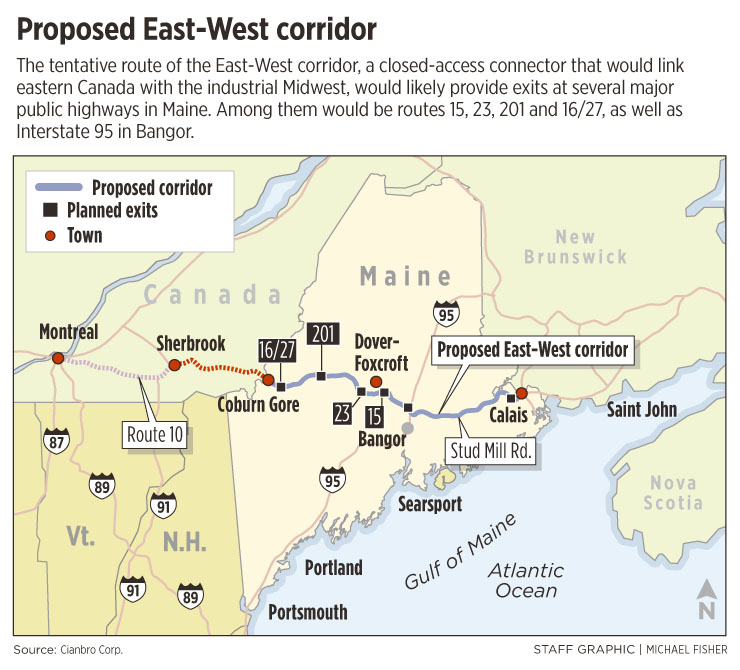
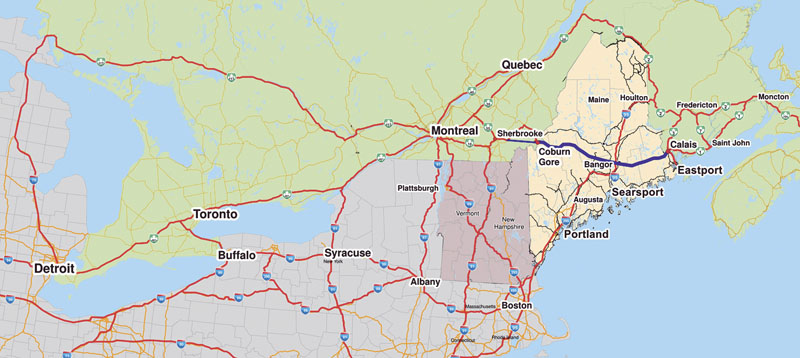
“We’re not just connecting Maine to Canada on two sides, we’re connecting the interior of Maine to the industrial Midwest,” Vigue said. “This isn’t about Canada, it’s about us. It’s about developing the economic strategy we’ve never had and asking ourselves as a state what we are going to be when we grow up.”
His East-West Highway proposal — which would have environmental impacts and transform the character of the isolated communities along its route — is polarizing, so much so that Vigue sometimes travels with bodyguards. But, setting those concerns aside, two big questions still hang over the proposal and the consultants who will soon be tasked by the Maine Department of Transportation to assess its feasibility:
Would the private highway attract enough paying traffic to pay for itself and, if so, would Maine really see a significant share of the benefits?
The Maine Sunday Telegram spoke with two dozen sources from Ottawa, Ontario, to Moncton, New Brunswick, and many Maine points in between, including experts on regional trade, railroad and port operators, truckers, transportation consultants, economists and elected officials.
Some were bullish on the project, others skeptical. What separates the camps are their basic assumptions about how the economic case for the project should best be tested. This suggests that the upfront choices MDOT makes about how the consultants should frame their research will have a significant effect on the conclusions they will reach.
A LIGHTLY USED ROAD FOR CANADIANS?
Those who think that the best way to evaluate the highway’s prospects and likely benefits to Maine is to look at current and projected demand and transportation flows in the region tend to be less certain of its value than Vigue is.
There’s a reason such a highway has never been built, this line of thinking suggests, and it hasn’t changed.
The proposed road runs through a very sparsely populated part of Maine and would compete for Canada-to-Canada freight traffic with an existing railway that could be upgraded for a fraction of the cost and environmental impact. Given border delays, the proposed route isn’t even a slam-dunk shortcut for most Atlantic Canadian truckers and motorists. Add in the steep tolls that may be necessary to pay for construction, maintenance and plowing, and many may think twice about using it.
“I think people are going to have to look at this very carefully and not just throw money at it,” said Bob Grindrod, president of the Hermon-based Montreal, Maine and Atlantic Railway, which runs three round-trip freight trains each week between Montreal and Brownville Junction in Piscataquis County, where they’re met by Irving-owned trains bound to and from the port of Saint John, New Brunswick.
“You have to look and ask what wants to move in or out of the Maritimes. If there isn’t enough volume to pay the tolls, you’d end up with a bankrupt road.”
The State Planning Office and MDOT evaluated traffic prospects along the general route of Vigue’s highway in 1999 when the economy was booming and northern border security was still lax.
“From the perspective of Maine’s economy alone, the substantially higher costs of constructing a four-lane divided highway on a new alignment” — including a theoretical $1.17 billion Calais to Coburn Gore route — “do not appear to be justified, based upon the resulting modest incremental increase in economic benefits they provide to the State,” the final report concluded. “When compared on a ‘cost efficiency’ basis, the four-lane divided highway options do not appear to generate sufficient additional economic growth to justify their higher costs.”
Craig Seymour, managing principal of the consultancy that produced the study, RKG Associates of Dover, N.H., said the route evaluated in 1999 is comparable to the one proposed by Vigue.
“The road is primarily to get goods from one part of Canada to another part of Canada, and the question now is if the forecasts of the Maritimes and Canadian economy would support this,” he said.
“At the end of the 1990s, when we were doing these forecasts, we were looking at the end of a relatively robust growth cycle, and that tends to push the (traffic) forecasts up,” said Charles Colgan, an economist at the University of Southern Maine who also worked on the 1999 study. “The 1999 forecasts would have been way off for 2015” because of the subsequent recession, 9/11 attacks, increased border security, and the 2008 financial meltdown, he added.
Both Seymour and Colgan said a new study would be required to re-evaluate future traffic.
In his public presentations, Vigue displays a map of controlled-access highways in the Northeast region with the caption “What is Missing?” which is intended to draw attention to an obvious missing east-west link across the waist of Maine.
But the map omits an existing key New Brunswick highway segment: Trans-Canada Highway 2, between Moncton and Fredericton, which provides a straight shot to Woodstock, New Brunswick, and access to Interstate 95 in Houlton, then boomerangs over the top of Maine and back toward Montreal.
The existence of this highway link dampens the appeal of the proposed East-West shortcut across Maine for anyone traveling between Montreal or Toronto and Prince Edward Island, much of Nova Scotia or Newfoundland. At Moncton, truckers and motorists would make a choice whether to take the Trans-Canada Highway to Fredericton and around Maine or New Brunswick Highway 1 to Calais and the East-West Highway.
Google Maps pegs the Trans-Canada Highway run from Moncton to Montreal at 10 hours, 48 minutes.
If you add Google estimates for the Canadian parts of the shortcut route to Cianbro’s rough estimate for the proposed road, a Moncton-Montreal trip still takes nine hours, 55 minutes, and that’s without accounting for border delays. If Quebec were to upgrade the two-lane road from Coburn Gore to Sherbrooke, it would likely shave an hour from this route, but it is unclear whether the province wishes to do so.
“If you can get to Montreal a little faster and can get loaded for the next day, there are lots of advantages,” said Jean Marc Picard of the Atlantic Canada Trucking Association, based in the Moncton suburb of Dieppe. “But we would have to see what the cost of the tolls are as well and look at the border delays.”
SAVING TIME AND FUEL, NOT TOLLS
A 2008 Cianbro study of the highway put forth three toll scenarios for the purposes of determining the project’s financial viability.
They ranged from $25 for a passenger car full trip and $50 for a truck to $100 for a car and $200 for a truck. The report said the latter scenario represented “the ‘ideal’ situation which would achieve an acceptable (internal rate of return) for the project and equity holders.” Vigue said actual tolls have yet to be determined, but that the car rate will be lower than $100.
The highway will clearly provide a shortcut for goods and people traveling east-west from Saint John, southwestern New Brunswick and eastern Maine.
“I think for our region of the province, it certainly is a great option for us to get to Quebec and the states and for some will cut four hours off that trip,” said Imelda Gilman, president of the Saint John Board of Trade. “For other parts of New Brunswick, PEI and Nova Scotia, it will really depend on where they are transporting the goods, and it might still be easier to do the traditional route over the northern part of Maine.”
Rail advocates say they will become more competitive with the road if fuel prices continue to rise over the long term.
“It’s like the Erie Canal — it was privately funded and just about the time it was done, the railroad sped past it,” said Anthony Donovan of the Maine Rail Transit Coalition. “About the time that highway gets built, the rail is going to zoom past because the trucks are not going to be able to afford the fuel.”
Not everyone agrees. Former MDOT Commissioner John Melrose, a transportation sector lobbyist, noted that trucks have a critical advantage.
“Our economies have moved in recent decades to a ‘just in time’ model, where there’s a lot of pressure to be able to call up a factory and have X number of widgets delivered in three days,” he said. “Rail can’t do that, at least as it is configured in Maine. Rail ends up with high volume, low-sensitivity cargos.”
Because it’s a private highway, Melrose and others noted, the Cianbro road could allow larger, heavier tandem truck rigs that are legal in Canada to travel the route, further improving the economics. “When you look at the time savings and efficiencies that are involved, it opens some whole new dimensions,” he added.
Northernmost Maine and northwestern New Brunswick fear they’d be harmed by the shortcut, which would encourage traffic to bypass their area.
“I understand that construction jobs are important to Maine, but if all we’re doing is building a road to get Canadians to and fro easier, I don’t see how it’s going to help my part of the state,” said Sen. Troy Jackson, D-Allagash, who represents the Madawaska area. “I see it cutting off northern Maine. There’s nobody in my district who sees it as a positive thing.”
Brian Lee Crowley, managing director of the Macdonald-Laurier Institute for Public Policy, an Ottawa think tank, said the road could offer significant benefits, but its costs must be taken into account. “The question would be whether the tolls could be set at a level so that the savings in time and fuel can be split between the people using the road and the people building it,” he said. “If the savings are large enough, then both parties benefit and you have a deal.”
A GAME CHANGER FOR MAINE?
Vigue and other supporters of the project come at it from a different vantage point. They say the project shouldn’t be seen as a response to current or projected demand in a world that currently lacks such a highway. Rather, the highway itself would completely transform the equation, facilitating an economic transformation in metro Bangor, the port of Eastport and a great swath of rural Maine. Take a step back, they urge, take a risk and dream big.
There’s no doubting Vigue’s passion about the project — this is personal for him. Despite having what he calls “one of the most qualified work forces in the country,” interior Maine has been suffering for decades, losing population and vitality, and something must be done to turn it around.
“So how do we capitalize on this strength?” he asked. “How will this state move forward? How will we not destroy the quality of life we enjoy? If we don’t change something and don’t improve, I don’t see things getting any better.”
In an increasingly globalized, just-in-time economy, interior Maine’s fundamental problem is its isolation generally, and its lack of road connections to the industrial Midwest in particular, he said.
Connect Maine to Montreal and Toronto, Detroit and Chicago, and you’re connecting current and future Maine companies to the supply chains of North America’s great manufacturing centers, he said, and those manufacturing centers not just to the Port of Saint John, but to Eastport, allegedly the deepest water port in the entire country. His argument invites one to see the highway not primarily as a way for Canadian goods to transit Maine, but as a way for American goods to transit eastern Canada to and from Maine.
The highway, Vigue said, will have interchanges at I-95 and routes 15, 23, 201 and 27, thus serving the Bangor, Dover-Foxcroft, Jackman and Eustis areas en route.
“We’re not just connecting Maine to Canada on two sides, we’re connecting the interior of Maine,” he said. “What’s the future going to look like? I believe in a very strong way that Maine has the potential of becoming a major gateway, and the true benefit is that we will have both north-south and east-west (highway) connections.”
Former Bangor Mayor Tim Woodcock, a longtime advocate of an east-west highway, thinks it would transform his part of the state.
“I think most people who live in this neck of the woods understand that we are remote and inaccessible, and if you want to compete on an even footing in sectors of the economy that are sensitive to transportation costs, being remote and inaccessible is a bad way to do it,” he said. “This project would go a long way in reversing that.”
The highway, Woodcock said, would make it as easy for someone in Bangor to get to Montreal as to get to Boston. It would connect the city with the St. Lawrence Seaway and “an international intermodal hub of hemispheric proportions.” Industry would follow, perhaps creating conditions that would reinvigorate rail as well.
“I don’t know if they build it, if they’ll come,” he said of the highway, “but I do know that if they don’t build it, they won’t come.”
MDOT STUDY COULD DETERMINE FATE
Perry Newman, president of the Atlantica Group, a Portland-based trade consultancy, said the potential benefits will be large.
“I don’t see how it can be the case that creating great access to markets for one’s own manufacturers can’t make you more competitive,” he said. “It gives the economic development folks a tangible asset to put in front of potential investors and say, you can be in the North Woods of Maine and create a beautiful product and not be so remote from the market that you are falling off the edge of the Earth.”
Vigue also said he’s “very confident” that Atlantic Canadians will choose his highway over the Trans-Canada Highway, and that it will attract Canadian tourists to Sugarloaf and other Maine destinations. He said he would never ask the state to use eminent domain to seize property en route, nor would he ask for public “handouts” of any kind for the private road which, he said, will pay property taxes.
“Let’s have the courage to invest here and to believe in the people,” he says. “We know the federal and state government don’t have the funds to make these investments.”
The new MDOT study — a $300,000 analysis paid for by taxpayers — is due to be released in January 2013, and will be eagerly awaited by elected officials.
“The trick will be to do the analysis and see what advantage the state of Maine will get from this business,” said Sen. Roger Sherman, R-Houlton. “We’ll have to look at it with an engineer’s eye and an economist’s pencil. What the study says will probably dictate if it happens.”
Staff Writer Colin Woodard can be contacted at 791-6317 or at:
cwoodard@mainetoday.com
Send questions/comments to the editors.

Success. Please wait for the page to reload. If the page does not reload within 5 seconds, please refresh the page.
Enter your email and password to access comments.
Hi, to comment on stories you must . This profile is in addition to your subscription and website login.
Already have a commenting profile? .
Invalid username/password.
Please check your email to confirm and complete your registration.
Only subscribers are eligible to post comments. Please subscribe or login first for digital access. Here’s why.
Use the form below to reset your password. When you've submitted your account email, we will send an email with a reset code.