Clear

High: 79°

Low: 65°


July 5

FEMA's new flood plain mapping could cost coastal Mainers dearly

Some communities in York and Cumberland counties hire a consultant to challenge the agency's findings.

By Tux Turkel tturkel@mainetoday.com
Staff Writer

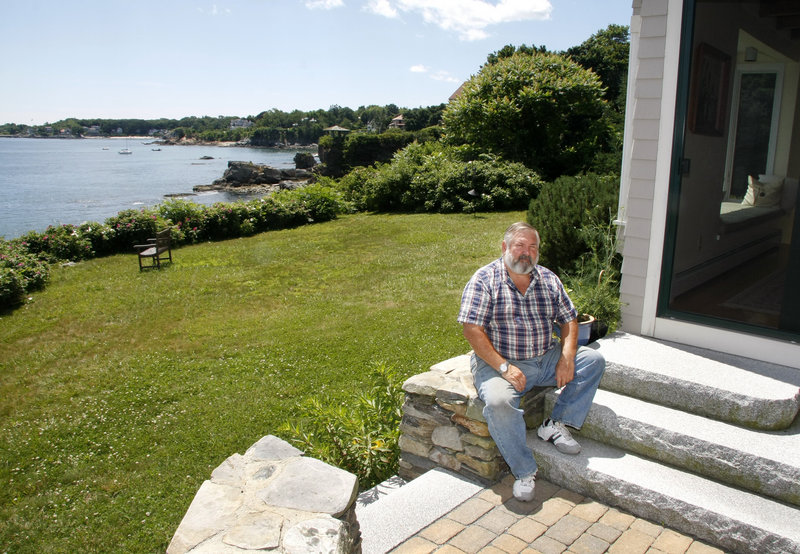
SOUTH PORTLAND - The seaside ledge where Bob Blackwood's house stands was first developed as a hotel and a cottage around 1885. It's only 65 feet from mean high tide, but set high enough that waves haven't damaged it through more than a century of hurricanes and winter storms.

click image to enlarge

Bob Blackwood's property, located on a cliffside high off the ocean on Cloyster Street in South Portland, is in a newly designated floodplain zone.

Jill Brady/Staff Photographer

The Federal Emergency Management Agency isn't impressed by that history.

The agency, in preparing new flood plain maps for five Maine counties, has placed Blackwood's home in a high-risk zone. During a 100-year storm, it's assumed, 3-foot waves could crash into the building and cause major damage.

Using FEMA's calculations, 17 or so homes in Blackwood's neighborhood are in the high-risk zone, including a house across the street that's higher and farther from the water. The designation could lead to more costly flood insurance, and prevent property owners from building or rebuilding, so Blackwood is upset.

"People have been living in these places for 125 years or so, and we haven't had the storm they're talking about yet," he said.

Determining flood zones isn't an exact science. The settlement reached last month between FEMA and the city of Portland over mapping around Portland Harbor shows how the agency's highly technical calculations are open to debate.

Similar disputes are happening across the country, and they're shaping up to be especially heated on the Maine coast. In Casco Bay, the dynamic seascape of islands, peninsulas and ledges is not well-suited to FEMA's baseline wind and wave measurements.

The agency, which has spent $3.2 million so far in southern Maine, says it doesn't have the budget to do a more detailed analysis.

Two dozen coastal communities in York and Cumberland counties are having flood plains remapped. Several have followed Portland's lead and hired a consultant to challenge the changes.

The challenges come as FEMA prepares to resume an appeals period this summer. Property owners in or near the updated hazard zones are being advised to pay attention.

The maps are the basis for federal flood insurance, which is required on mortgages for property in flood zones. With millions of dollars and future development at stake, the outcome of the early appeals may be instructive, as more flood plain maps are updated across Maine in the years ahead.

The federal government began a program to map flood plains in 1969. In 2003, Congress authorized updating the maps and putting them into a digital format. That process is under way in Maine, which still lacks detailed coastal elevation data east of Brunswick. Federal stimulus money will close that gap this fall, paying for aircraft with laser technology to finish the job.

But topography and water depths are only part of the picture. On the coast, FEMA also collects data for wind speeds and waves, calculating how high they could get at the peak of a storm that, statistically, happens only once in a century.

In Portland Harbor, the initial calculations led FEMA last year to put much of the waterfront in a high-hazard zone. That would have stopped construction on Portland's piers, and rebuilding of structures more than half destroyed by storms.

To challenge the designation, Portland hired Robert Gerber, an engineer for Sebago Technics in Westbrook, who specializes in computer modeling of environmental systems.

Gerber used sophisticated modeling, and data from the Portland International Jetport and a weather buoy, to recalculate the effect of waves and wind on Portland Harbor. He determined that the peak, sustained wind speed in a 100-year storm would be 52 mph, not 71 mph, as FEMA had assumed. That lowered the projected wave height from 5 feet to less than 3 feet.

Gerber also calculated how islands, underwater ledges and varying water depths in Casco Bay would reduce the height of waves striking the harbor. The modeling cost the city $10,000, but helped persuade FEMA to take most of the waterfront out of the high-hazard zone.

Gerber has since used the Casco Bay modeling to work with other communities and with property owners.

In Harpswell, which has 80 islands and 218 miles of coastline that traces long, narrow coves, Gerber found the greatest difference between his modeling and FEMA's data.

He also was hired by Dolphin Marina, a boatyard and restaurant in Potts Harbor. FEMA had put the entire property in a high-hazard zone, threatening an expansion. Gerber used three-dimensional wave modeling to show how the topography and varying water depths would dissipate energy from ocean storms, leading FEMA to revise the initial flood map.

The level of coastal analysis that FEMA is doing works well in areas with flat, sandy beaches, such as Florida, Gerber said. But it's not adequate for Maine, notably for the shoreline east of Portland.

"A lot of the rest of Maine is going to look like Casco Bay," he said. "Probably half of the coast needs the kind of analysis I do."

FEMA doesn't really disagree with Gerber. But Congress authorized $1 billion for FEMA to modernize flood plain maps, and that money doesn't pay for the level of computer modeling that Gerber is doing in Casco Bay.

"Our mapping process is scientifically sound, but it may not be as accurate as some would like," said Dennis Pinkham, a FEMA spokesman in Boston.

FEMA will consider more accurate data, Pinkham said, but it's up to communities and property owners to provide it. They'll have that opportunity during a 90-day appeal period, possibly this summer. Notice will be published in newspapers, and FEMA may hold informational meetings.

Property owners in new or revised flood hazard areas can take advantage of a grandfathering provision to buy flood insurance or maintain their existing policies. Rates will change when risk designations are updated, FEMA is warning, and could increase from hundreds to thousands of dollars a year for some property owners.

The angst over flood plain mapping is being heard by Maine's congressional delegation.

Sen. Susan Collins said Portland's experience shows how FEMA can work with communities to produce accurate maps using the best science. As ranking member of FEMA's oversight committee in the Senate, Collins said she will work to ensure that the agency updates the maps in a collaborative manner.

Rep. Chellie Pingree has expressed her opinion to FEMA's administrator that the agency -- not communities and property owners -- should bear the cost of improving the maps' accuracy. "Developing the most accurate flood maps is FEMA's job, and communities should not have to pay for them," she wrote in a letter.

A member of Pingree's staff was at a meeting last week with South Portland officials. They're frustrated that FEMA hasn't acted on their request to shrink the flood plain areas in their city, based on the revised wind and wave projections for Portland. That may happen, but FEMA says it will consider each community separately, during the appeals process.

That leaves homeowners such as Bob Blackwood in limbo.

Blackwood stood on his lawn last week, looking over FEMA's proposed map with Steve Puleo, the city's community planner. Puleo explained how the shading on the map corresponds with the proposed hazard zone, and both men puzzled over how Blackwood's neighbor's home could be threatened by waves.

"The fact that, historically, it has never happened, doesn't mean anything?" Blackwood asked.

"That's correct," Puleo said. "They've never stood here and looked at this."

But as the issue heats up, one key part of the debate is missing -- the impact of climate change and sea level. A majority of experts, including Gerber, say they expect storms be more intense, and expect sea level to rise in the coming decades.

That's bound to put more property at risk of flooding. But because no one can agree on the rate of sea level rise, there are no legally accepted numbers that engineers can plug into computer models for mapping flood plains.

Thus Gerber warns that the analysis he did for Casco Bay won't be valid in 20 years, which may put parts of Portland Harbor back into the hazard zone.

"They're just buying time," Gerber said. "I won't be able to help them then."

Staff Writer Tux Turkel can be contacted at 791-6462 or at:

tturkel@pressherald.com


Were you interviewed for this story? If so, please fill out our accuracy form

Send Question/Comment to the Publisher

29 COMMENTS

ThorEau said...

I'm sorry - just where is the ocean rise?

July 5, 2010 at 5:55 AM Report abuse

BenMatlock said...

Why is the government wasting money on flawed studies? Why not hire this local engineer INSTEAD to do the entire Maine coast??? Gee, that would make too much sense...

July 5, 2010 at 6:48 AM Report abuse

Bole said...

They cry when the government doesn't do something. They cry when they do do something. I think they just want to cry.

July 5, 2010 at 7:38 AM Report abuse

yardbird said...

i'm sick of paying taxes to repair the rich's buildings , that we get run off from , kick them all out

July 5, 2010 at 7:41 AM Report abuse

UofA said...

Tear down these houses so more smelly lobster boats can tie up!

July 5, 2010 at 8:01 AM Report abuse

Biddy said...

If people want GOVERNMENT flood insurance they need to play by the GOVERNMENT's rules. No one mentioned anything about them checking out private insurers or self insuring their own properties. I guess personal responsibilty is only for the poor.

July 5, 2010 at 8:03 AM Report abuse

mghmaine said...

If the person really believes there is no need for flood insurance he might well stand with that belief and go without it.

July 5, 2010 at 8:11 AM Report abuse

mcacho said...

time and again tax-payer money is used to rebuild homes nearly all of us could never afford - this is true for both flood and fire plains. I have no problem paying taxes for schools, medicare, roads, however, I'm tired of subsidizing wealthy people's ocean views.

July 5, 2010 at 8:29 AM Report abuse

homeboy said...

The engineer in this story is a well-known "gun for hire", and will pretty much say what those who are paying him want him to say. Anywhere else it is known as prostitutition. I was at a marina in South Portland when Hurricane Hugo hit in 1985. We clocked 85 mph winds at the outer edge of the marina. We were lucky it did not hit at high tide, as the marina floats would have breeched the pilings and taken off with the remaining boats! Painting government officials as the bad guys is this is nothing short of ludicrous.

July 5, 2010 at 8:45 AM Report abuse

Chew said...

If FEMA does not have the budget to perform a more detailed analysis, perhaps their numbers should not be accepted as a "standard" upon which insurance companies can base rates?

July 5, 2010 at 8:45 AM Report abuse

TT said...

Come on, where are all the cry baby liberals this morning, too much partying last night with your tax rebate money? Let's start blaming this on George Bush too! And if you have a bad hangover, don't worry, you can get all the free medical care you want in Portland. Then go back to bed and rest up before you all have to go to the Freedom for all Wood Frogs rally on Congress St tomorrow.

July 5, 2010 at 8:51 AM Report abuse

nikonwilly said...

Our system never gets better only worse.

July 5, 2010 at 8:53 AM Report abuse

LadyHawk said...

Something seems a bit fishy here on both sides. It appears that some mid ground or water level could be reached. The mapping levels could less than what the government sees and more than what coastal Mainers view as correct. Side note I live in an apartment and I have always had renters insurance. Why because I need to share in the responsibility if something happens. I am accountable not just my landlord. The same is true with people who own property on the coast - the risk even if it is small needs to be shared. I cannot stand when I read about people who cry out for what reason saying they lost everything in a fire or flood but then say they have no insurance of any type. I would rather help out the person is responsible enough to have bought insurance.

July 5, 2010 at 8:53 AM Report abuse

Coolfusion said...

Obama promised you no new taxes, but he didn't mention end-around means to re-fund the federal flood insurance act. You may not see a tax increase or decrease .. but you will see federal mandated higher energy costs, insurance costs, consumer goods costs, permit costs, banking costs, fees and other extraction to fund his agenda. The federal and state governments will be the future war-lords with force-taking a piece of the action.

July 5, 2010 at 8:55 AM Report abuse

JMY1 said...

Flood insurance is a government mandate. My house is a almost 900ft above sea level and I have to pay for flood insurance. So, re-arrange the maps on the coast to drive insurance up with will be yet another revenue source for Augusta & Washington. And I agree with the others, if you choose to not buy flood insurance and you lose your house to a flood, thats your fault. I would also like to see a remittance of these insurances to those who never file claims. If I never file a claim in ten years or so.....I want my money BACK!

July 5, 2010 at 9:35 AM Report abuse

nativebloke said...

Subsidies for the well-to-do are long overdo for an overhaul. I was waiting for a reference to sea level change which finally came at the end of the article. There are actually two kinds around here; potential rise due to climate change, which could be anywhere from very little to quite a bit (3 feet?), depending on how much climate changes. The other overlooked change is due to the gradual sinking of the land relative to the ocean. For Casco Bay, this has amounted to about 1-1/2 to 2 feet over 200 years. So in the next 100 years, we will lose another 9 to 12 inches. I don't believe this is included in the FEMA mapping as it is gradual. So, no matter what mapping is done, or what buildings are built at or near present sea level, the future will look more like the FEMA maps.

July 5, 2010 at 10:44 AM Report abuse

nativebloke said...

It should also be noted that the numbers I have mentioned (1-1/2 to 3 feet) are near to the wave height decrease from 5 feet to 3 feet in the Portland study.

July 5, 2010 at 10:53 AM Report abuse

mdenis46 said...

ThorEau, try the old Dunstan Road in Scarboro -- when I was a kid, one could drive down that road to Pine Point; now it's often under water. Years ago, US Route 1 near Anjons was raised by 6 feet because during astronomical high tides, the road was under water. The Maine coast apparently is sinking, AND the ocean levels are rising.

July 5, 2010 at 12:04 PM Report abuse

common_cents said...

The ocean off the coast of Maine has been rising slowly since the Portland Head Light was built in the early 1800's and accurate measurements taken from fixed gauges. The rise is so slow that the State Geologist has estimated the total rise over the next 100 years to be between 7 and 9 inches. I believe the annual rate is .07mm, yup mm. GLOBAL WARMING hysteria produced distortions of this fact; and the Media loved the fear generated by tidal waves flooding the coast. In turn, FEMA and others manipulated arcane models and sat. photos to come up with the dire predictions made by the Natural Resources council and used to pass the Regional Greenhouse Gas Initiative. Now the crunch...property owners get the bill for higher flood insurance based on these 'dire' predictions and the results is a predictable outrage, esp. from multigenerational family homes that have a long history of ocean watching. The policy implications are profound, like NO MONEY for port improvements!

July 5, 2010 at 2:22 PM Report abuse

jack33 said...

Who the eff is dumb enough to vote for someone who supports people who want to build or buy in a flood zone? Voters - vote only for people who will NOT spend your tax dollars to pay idiots to live in flood-prone areas.

July 5, 2010 at 3:15 PM Report abuse

common_cents said...

I wonder if the ocean conditions predicted by off shore wind developers match those of FEMA? You all still buying into the global warming hysteria? Florida is now underwriting the AllSTATE and other home owner policies, or else coastal construction & rebuilding would come to a halt if it required bank loans and mortgages. Think Maine would do the same...elect Cutler and watch how fast he rallies the CAPE E. shore dwellers to a combo govt. health and homeowner policy.

July 5, 2010 at 3:47 PM Report abuse

truckmen said...

This is very interesting. Would anyone here know when and where I can get a copy of this new flood plain mapping report?

July 5, 2010 at 4:07 PM Report abuse

Chew said...

The part that orks me is there is no budget for detailed substanciation of the numbers arrived at by FEMA. I'm all for flood insurance when it is prudent, but basing a change in insurance recommendations un a study that contracticts a century of contrary data based on numbers that may be questional simply does not make sense to me...

July 5, 2010 at 4:48 PM Report abuse

cnVtZm9yZE9taW5l said...

time and time again SED is is such a jerk! the wind cries, sedsucks!!!

July 5, 2010 at 6:37 PM Report abuse

Chris said...

For properties directly exposed to the open ocean in a northeasterly direction, wave heights can easily reach 30-feet in a major storm and FEMA’s maps seemed quite accurate. In these rare storms, waves can literally break over the tops of small islands only 10-15 above sea level. However for properties further back from the open ocean, waves tend to gradually dissipate and that’s where everyone was frankly scratching their head over FEMA's flood map.

July 5, 2010 at 7:55 PM Report abuse

CEMan said...

It would have been nice for the PPH to give us a link to the new maps. Too much to ask for I guess.

July 6, 2010 at 7:27 AM Report abuse

locavore said...

Turkell, again, shows his inability to write a balanced story. After I read his articles, I feel like I need to look for other sources of information to find out the REAL story. Why does the paper keep using this reporter? Ugh. Make. It. Stop.

July 6, 2010 at 3:44 PM Report abuse

nativebloke said...

Here is a computer generated series of maps which allows one to pick a flood height. Move the map to Maine and enlarge to any area. Then, input your selected flood height. http://flood.firetree.net/

July 7, 2010 at 9:50 AM Report abuse

nativebloke said...

And here is another one: http://www.nrcm.org/sea_level_rise.asp

July 7, 2010 at 9:53 AM Report abuse

Most...