




It will be some months before the drought and heat battering the Midwest show up in the form of higher food prices, but Kevin Cunningham, executive chef at The Inn at Brunswick Station, says he’s already thinking about how dramatic increases in the cost of meat, corn and dairy might affect his fall menu.
He said he plans to begin meeting with his staff next week to think about ways he can compensate besides raising prices across the board.
Additional Photos
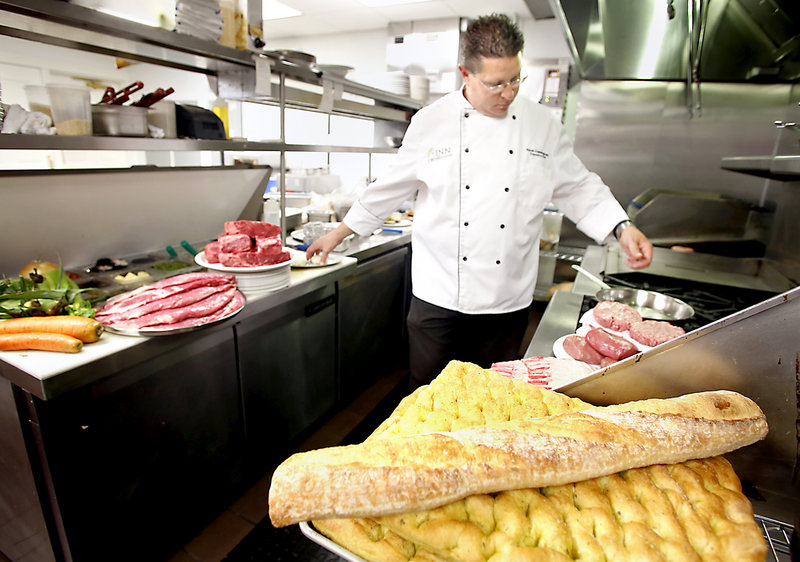
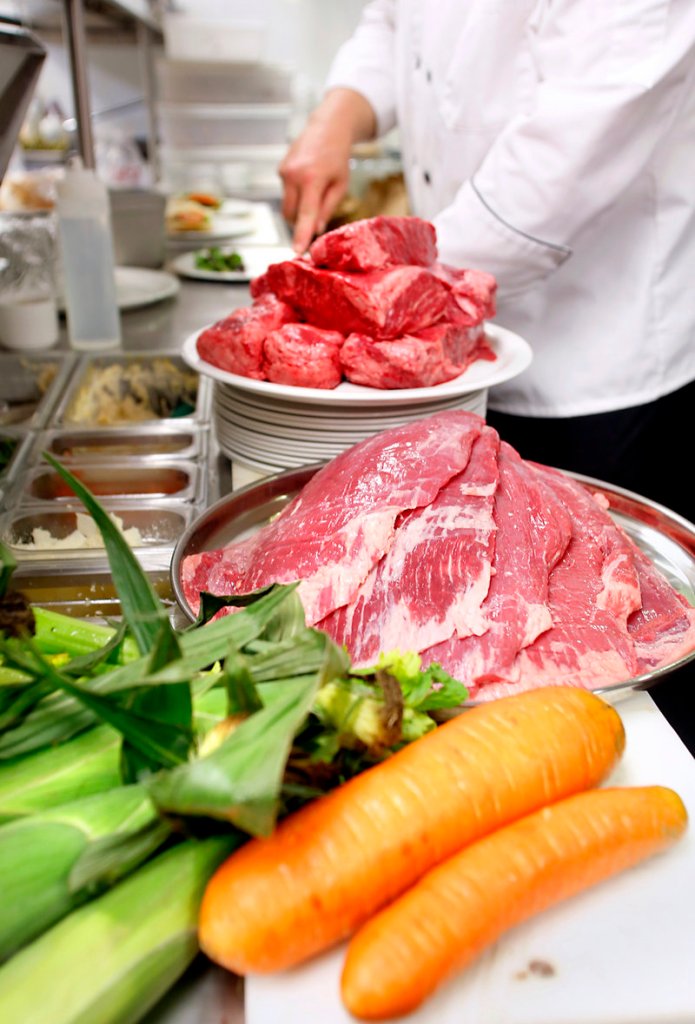
“Because we’re a new property and we are just starting to establish a fairly decent following, raising prices becomes very problematic,” Cunningham said. “On our end, to raise prices it either has to happen in high season now, or you have to start looking at different products to run on your menu for the fall, when the prices are really going to hit.”
That means finding more creative things to do with cheaper ingredients like pork belly, chicken breasts and pasta.
Even at a destination restaurant like the Black Point Inn in Scarborough, where customers come to dine as much for the view as the food, the business will have to get creative or “eat” the increased costs, said manager Philip Kronenthal.
“You’d be hard-pressed to take steak off the menu,” Kronenthal said. “Some of it we just have to absorb, and tighten our belts in other areas to make up for it.”
Restaurant owners are “loath to raise prices,” said Dick Grotton, head of the Maine Restaurant Association. “It’s the last thing they want to do,” he said, but many may have no choice come this fall.
Grotton said restaurant owners are eyeing reports of a wilting corn crop, which could have a broad impact on food prices, given the extent of corn’s reach into the nation’s food chain and the fact that it is used as feed for animals.
“So much of what we purchase is based on corn and wheat — it’s in everything,” Grotton said, explaining why consumers are likely to feel the pinch of higher prices even if they’re not ordering a steamed ear of corn with their meal.
And the effects of the drought covering two-thirds of the continental United States are not likely to be over quickly. A new report released Thursday warned that its intensity is increasing.
The heat and drought in the Midwest led the U.S. Department of Agriculture to cut its forecast for the corn crop earlier this month, saying it expected an acre of corn to yield 146 bushels, down from a forecast of 166 bushels earlier this year. That forecast is pushing corn prices higher, although the corn in the food stream now is from last year’s crop, with this year’s harvest still several weeks off.
Still, the drought is already having some ripple effects. Kronenthal said the drought affected the produce coming into the kitchen at the Black Point Inn “nearly immediately.”
“You started to see an increase in price, and then there were some quality issues that arose,” he said.
Cunningham said that the lack of lamb on some restaurant menus right now is related to a major drought in New Zealand in 2009. It took the country three years to recover from the drought, he said, and there was major flooding the following year that washed away topsoil, making things worse.
“Lamb prices worldwide went through the roof,” Cunningham said. “You can go to your major cities and find lamb on one in three nice restaurants, and the pricing is bad.”
Texas, the leading lamb-producing state, was already experiencing drought in January this year, Cunningham noted. While U.S. markets for beef, chicken and pork may turn out to be more resilient, an increase in lamb pricing can be a good indicator of what is coming down the road.
Grotton said restaurant owners don’t have a lot of room to absorb price increases. He said the rule of thumb in the industry is that the food on the plate should cost about a third of the price of the meal. The rest of the price goes toward labor, utilities, rent and other overhead, with 3 to 5 percent for the profit margin.
The higher prices caused by increasing costs for corn will probably show up after Labor Day, Grotton said. But restaurant owners may hold off on raising prices as long as they can because it’s an expensive move to make — requiring new menus and reprogrammed computers, for instance — and could drive away customers.
Ron Stephan, owner of Ricetta’s Brick Oven Ristorante in Falmouth, said he is “quite concerned” about rising prices because grains, meat and dairy “are the very foundation of our product mix.”
“Not only will (rising prices) increase food cost for operators,” he said, “but it will further impact revenues for us by depleting the already slim amount of expendable income people have to dine out.”
But Tom Barr, one of the owners of Nosh Kitchen Bar and Taco Escobarr in Portland, noted that food prices have already been fluctuating a lot over the past couple of years, for a variety of reasons. He and his partners monitor rising prices, and just charge what they need to in order for the restaurants to survive.
“Basically the philosophy we take is you have to achieve certain margins to keep working,” Barr said, “and as long as we keep putting out quality (food), people keep coming.”
Fred Forsley, owner of the Sea Dog Brewing restaurants, the Inn on Peaks Island, Federal Jack’s in Kennebunk and several other restaurants, said he does worry about keeping customers if prices go up, but with costs also rising at the grocery store, “it’s expensive to eat at home, to be honest with you.”
“If you’re two people, and you’re not cooking for a whole family, the restaurants are a great value, really,” he said. “When you look at waste and how active peoples’ schedules are, I think Maine restaurants, especially, have remained real competitive to what it costs to eat at home.”
Alex Romanoff, who works for the Portland Pirates, stopped in the Public Market House in Monument Square on Friday for a green smoothie. He said he eats lunch out every day.
Romanoff isn’t sure how rising food prices will affect him personally — it depends, he says, on how much prices go up and which places are directly affected. “Buy local,” he said. “Avoid it.”
Marilyn Taylor of Scarborough said she eats out about twice a month, so higher prices probably won’t affect how frequently she goes to restaurants. But she does like going to a local bakery where she has noticed some hidden price increases.
“Even as the cost of wheat and other products has gone up,” she said, “what I’ve noticed is the size of their loaf of bread. The price stays the same, but it’s a little bit smaller.”
Taylor said she hopes the effects of the drought will encourage Maine wheat producers to grow a bigger market for locally grown grains.
It’s not clear how much of an impact the drought will have on food prices for those who choose to cook at home, although it is expected to lead to higher tabs in supermarkets.
In the short run, prices for meat, particularly beef, might fall, as cattle ranchers choose to take their animals to market rather than feed them expensive grains on the farm, leading to a more plentiful supply of meat. But that’s likely to lead to higher prices for meat and dairy products next year, experts said.
Eric Blom, a spokesman for Hannaford Bros., declined to speculate on what prices might do, but Joe Fournier, the manager of Rosemont Market’s Munjoy Hill store, said he thinks the impact will be minimal for his store’s customers.
He said most of the products that Rosemont buys are sourced locally, where farms have not experienced the weather extremes that are being seen in the Midwest. While a local farmer might face higher feed prices for his or her animals, the impact is likely to be much less than for a chain store that buys its meat from larger operations out West, Fournier said.
“It’s going to be less significant for us than it is for the commodity pork chop” bought by a chain, he said.
For the Good Shepherd Food Bank, rising food prices are a piece of a “perfect storm” that’s been brewing for a while, said Clara McConnell, the organization’s communications manager.
Rising food prices, on top of high gas prices and continued high unemployment, are likely to lead even more people to turn to food banks, McConnell said. But those higher prices could also lead to a drop in donations and will pinch the food bank’s purchases of food to supplement donated goods, she said.
“It’s going to come at us from a few different angles,” she said.
Staff Writer Edward D. Murphy can be contacted at 791-6465 or at:
emurphy@pressherald.com
Staff Writer Meredith Goad can be contacted at 791-6332 or at:
mgoad@pressherald.com
Send questions/comments to the editors.

Success. Please wait for the page to reload. If the page does not reload within 5 seconds, please refresh the page.
Enter your email and password to access comments.
Hi, to comment on stories you must . This profile is in addition to your subscription and website login.
Already have a commenting profile? .
Invalid username/password.
Please check your email to confirm and complete your registration.
Only subscribers are eligible to post comments. Please subscribe or login first for digital access. Here’s why.
Use the form below to reset your password. When you've submitted your account email, we will send an email with a reset code.