




President Obama’s proposal to provide quality early-childhood education to all children, including preschool for all 4-year-olds, would mean a significant expansion of those programs in Maine, where only about 60 percent of public school districts now offer pre-kindergarten classes.
Under the president’s plan, the federal government would partner with states to fund public preschool for any child whose family income is at or below 200 percent of the poverty level, $47,100 a year for a family of four.
Additional Photos
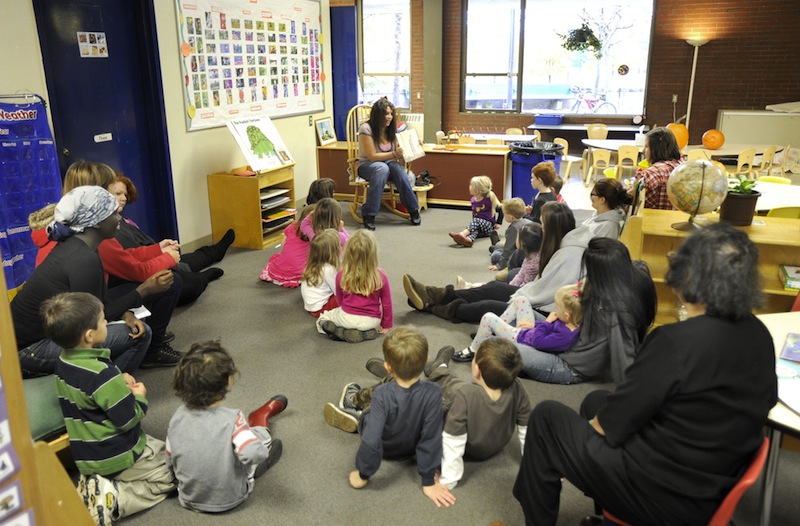
Obama also is proposing to let communities and child care providers compete for grants to serve children 3 and younger, starting from birth. Once a state had a program for 4-year-olds, it could use funds from the program to offer full-day kindergarten.
“Study after study shows that the earlier a child begins learning, the better he or she does down the road. But here’s the thing: We are not doing enough to give all of our kids that chance,” Obama said Thursday at a childhood education center in Decatur, Ga., where he unveiled details of his plan.
Nationwide, less than 30 percent of 4-year-olds are in high-quality preschool programs, he said.
In Maine, about one in three children who are due to enter kindergarten attend public school pre-kindergarten programs. For the 2012-13 school year, there are 4,769 pre-kindergarten students in Maine public schools, and 13,699 kindergartners.
Many other children attend private pre-kindergarten programs before entering the public school system.
Maine’s biggest public pre-kindergarten program is in the Lewiston School District, which has 217 pre-kindergarten students.
“I’m a strong advocate of pre-K programs in public schools,” Superintendent Bill Webster said. In addition to providing a learning environment, it gives kids a chance to play and learn from each other.
“There seem to be fewer chances for socialization these days,” Webster said. “We’re having more children coming in with less experience in knowing how to interact with other children, not understanding why they can’t just have the truck. Pre-K is filled with a whole slew of social norm training. Our kindergarten teachers really see the difference in those children who have had that experience.”
Webster said he hopes to add classes over the next two years.
“No matter what happens in Washington, my goal is to have universal preschool in Lewiston in two years,” he said.
Portland is in the first year of its pre-kindergarten program, which serves 83 children at five sites.
“I was incredibly excited to hear (Obama’s) commitment to early-childhood education,” said Longfellow Elementary School Principal Dawn Carrigan, who shepherded the pre-kindergarten launch for the district.
“(Pre-kindergarten) has had the most significantly positive impact on student progress that I’ve seen in my 32 years in education,” Carrigan said. “I think 4-year-old programming should be the priority of every elementary school in the nation.”
However, even as Portland plans to eventually offer universal pre-kindergarten, the school board is looking to slash as much as $3.8 million in spending from the 2013-14 budget.
“It’s about funding,” Carrigan said. “It’s about educating the public and education leadership about the value and importance of (pre-kindergarten) and the need to find the money to fund expansion.”
No budget figures were in the president’s proposal, which he first raised in his State of the Union address Tuesday, although it said the pre-kindergarten funding would be distributed to school districts and partner providers, while grants would be direct to communities and providers.
Obama will outline details about the plan’s cost when he sends his 2014 budget proposal to Congress next month, administration officials said Thursday.
Republicans are already lining up against the proposals, according to the Associated Press.
House Speaker John Boehner said that involving the federal government in early childhood education is “a good way to screw it up.”
The Republican chairman of the House committee that oversees education policy, Rep. John Kline, R-Minn., was cool toward the proposal and unlikely to support new spending on it.
Maine Gov. Paul LePage’s office did not respond to calls for comment.
Head Start providers in Maine praised Obama’s plan for increased investment in early Head Start programs, which serve children from birth through age 3, and the new competitive grants for providers.
“Assuming the money comes, it would be a great investment,” said Doug Orville, chairman of the Maine Head Start Directors Association.
About 3,000 children are in Maine Head Start programs, and there is a waiting list of about 1,400 children as of a few weeks ago, Orville said.
Head Start in Maine serves children from birth to age 5 whose family income is at or below 100 percent of the poverty level, $19,538 for a family of three.
One million children are served by Head Start programs every year nationwide, and receive services including dental and health screenings, home visits to help families, and as many as two full meals a day.
Last year, the state cut Head Start funds by $2 million, prompting some programs to lay off child care providers and close classrooms.
That was the case at Educare Central Maine in Waterville, where the president’s plan was welcome news Thursday.
“I am very excited to hear that (early-childhood education) is on the top of his agenda,” said site manager Rhonda Kaiser.
That program serves about 200 children and has a waiting list of more than 50 infants and toddlers. The state cutbacks forced the program to cut its staff, leaving three classrooms empty at the state-of-the-art facility, despite the demand.
The empty rooms show how difficult funding an ambitious early-education program can be, officials say.
The demand is there, the facilities exist, and trained workers are available, but finding the money is hard, Kaiser said.
“The bottom line is the funding,” she said.
Noel K. Gallagher can be contacted at 791-6387 or at:
ngallagher@pressherald.com
Send questions/comments to the editors.

Success. Please wait for the page to reload. If the page does not reload within 5 seconds, please refresh the page.
Enter your email and password to access comments.
Hi, to comment on stories you must . This profile is in addition to your subscription and website login.
Already have a commenting profile? .
Invalid username/password.
Please check your email to confirm and complete your registration.
Only subscribers are eligible to post comments. Please subscribe or login first for digital access. Here’s why.
Use the form below to reset your password. When you've submitted your account email, we will send an email with a reset code.