



Lobsterman Dana Black watches the sunrise on his boat off the coast of Orland … and rushes home to see the sunset more than 140 miles away in Beaver Cove, where he works his second job running a camp with his wife.
Black and his wife, Christine Howe, each work two jobs while also being landlords to tenants at a rental property in coastal Brooksville. His wife telecommutes to a large out-of-state bank from their nearly off-the-grid Moosehead Lake camp, 14 miles away from their closest neighbor.
Additional Photos


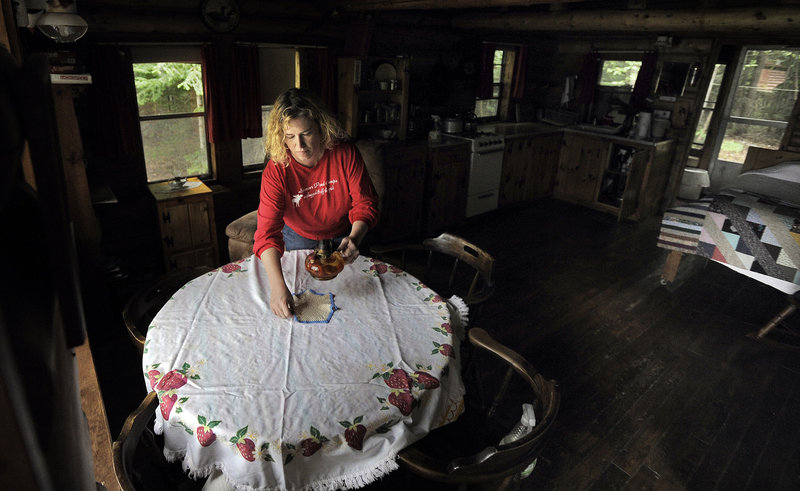
On Labor Day, the idea of juggling two or three jobs is nothing unusual in Maine, where about 45,000 people, or 7 percent of workers, have more than one job at a time, compared with 4.9 percent nationally, according to the Bureau of Labor Statistics. Maine had the second-highest rate of job jugglers in New England, after Vermont.
“It’s largely reflective of our tourism economy — people taking on extra jobs in the summer, especially along the coast,” said Glenn Mills, a director of economic research for the Maine Department of Labor’s Center for Workforce Research and Information.
With corporate America’s presence lacking in Maine, the notion of job juggling stems from the state’s history and geography.
“From the very beginning, from exploration and settlement, Maine was viewed as a frontier area where people would improvise, innovate and carve one or more livelihoods out of the land and sea. The whole tradition of holding multiple jobs goes right back to the beginning,” said state historian Earle Shettleworth.
“There have always been professionals like doctors and lawyers, but when you go into the middle class and working class, you find people improvising to make ends meet,” Shettleworth said. “You travel any secondary road in rural Maine and you encounter signs on the lawns of different services offered. It’s a very diverse, active work force that has learned to be self-reliant.”
In Maine, the median household income totals $46,933, which is below the U.S. average of $51.914, according to the 2010 data from the U.S. Census Bureau. More than 12 percent of the state is below poverty level, compared with 13.8 percent for the nation.
“Maine is not a wealthy state and yet it’s expensive to live there because of the cost of heating,” said Carl Van Horn, professor of public policy and director of the John J. Heldrich Center for Workforce Development at Rutgers.
“Some people romanticize the idea of a second job, but most people are doing it out of necessity or desperation. A lot of people work two full-time jobs and work 12 to 16 hours a day and still don’t have enough. If you’re making minimum wage, you’re still below the poverty level for a family of three,” Van Horn said.
Of the people with more than one job, four out of 10 did so to meet regular household expenses or to pay off debt, according to the Bureau of Labor Statistics. Other common reasons included enjoying working at the second job, wanting to save for the future, wanting to get experience or build up a business, and wanting to save money to buy something special, the bureau said.
Having multiple jobs creates some stressors such as financial instability, difficulty scheduling and many masters to please, but it also creates some safety net in case one aspect of the economy tanks — such as this summer’s lobster catch fetching the lowest prices in 30 years.
“Having other sources of income gives you more security against problems. When things go bad, when one source of income disappears, you have some cushion to re-grow that arm,” said Kirk Snyder, professor of management communications at the Marshall School of Business at the University of Southern California.
In addition to geography and weather dictating seasonal work, personality also plays a role in multiple job holdings.
“Having more than one job means more autonomy and not feeling boxed in. For people who are wanting to be more in control and autonomous, or those who feel a great need to leave their footprint in their own way, working on their own or piecing a life is appealing,” Snyder said.
“There are life skills that one has to acquire when you have more than one job. There’s the understanding that the company isn’t going to provide for me — I have to provide for me,” Snyder said.
Staff Writer Jessica Hall can be contacted at 791-6316 or at:
jhall@mainetoday.com
Send questions/comments to the editors.

Success. Please wait for the page to reload. If the page does not reload within 5 seconds, please refresh the page.
Enter your email and password to access comments.
Hi, to comment on stories you must . This profile is in addition to your subscription and website login.
Already have a commenting profile? .
Invalid username/password.
Please check your email to confirm and complete your registration.
Only subscribers are eligible to post comments. Please subscribe or login first for digital access. Here’s why.
Use the form below to reset your password. When you've submitted your account email, we will send an email with a reset code.