




After nearly 87 years at 390 Congress St., The Portland Press Herald/Maine Sunday Telegram begins its first full day of operations today at its new headquarters at One City Center.
Plans for the move were set in motion last June, after MaineToday Media purchased the state’s largest media company from Blethen Maine Newspapers and sold the downtown Portland real estate to reduce debt.
Additional Photos
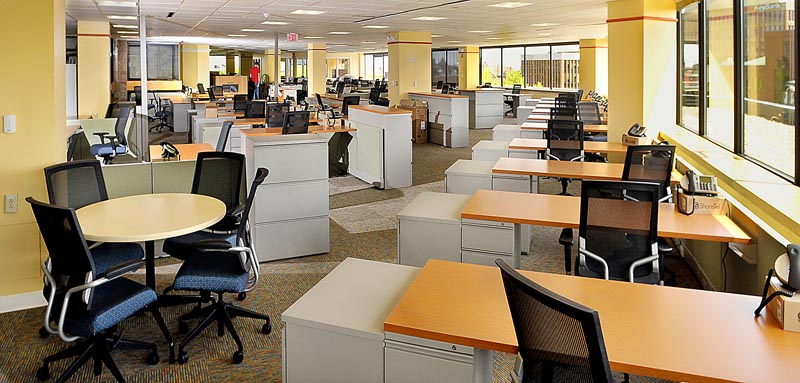
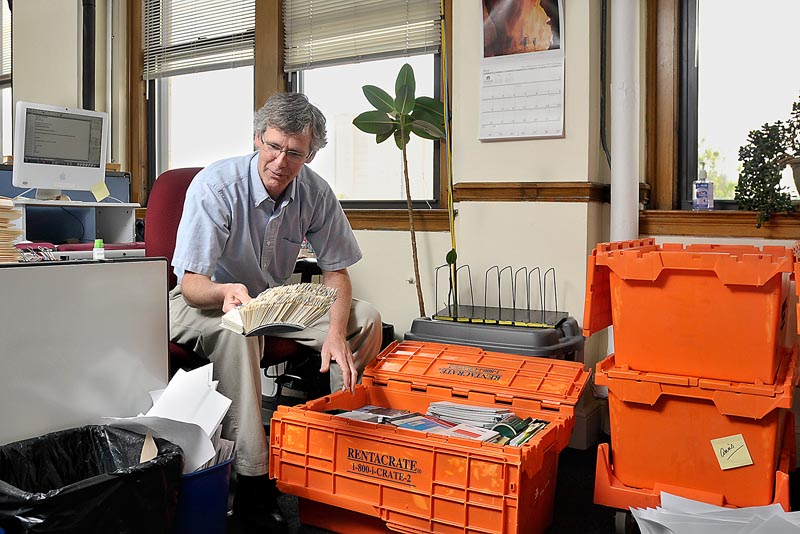
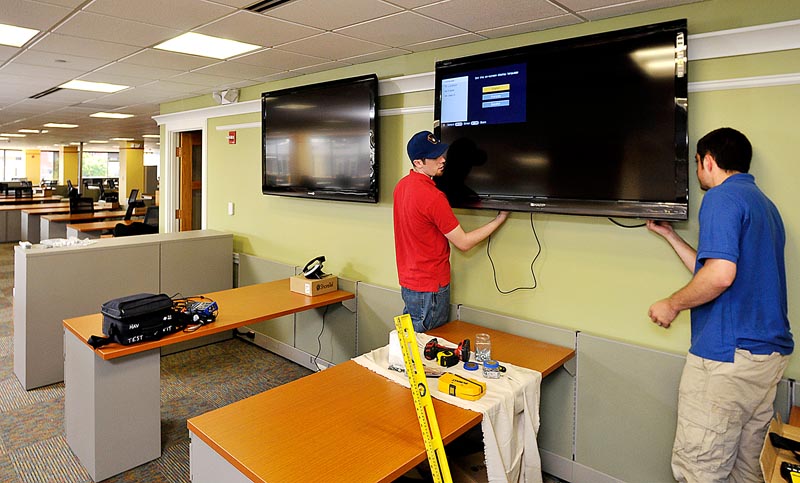
Since then, circulation and production departments have been joined at MaineToday Media’s printing plant in South Portland, while functions that include news, advertising and administration have relocated to leased space at One City Center.
The Sunday and Monday newspapers were put together in South Portland this weekend during the move.
Although the downtown operations now are only one block away, observers say the relocation removes a historic, physical presence of newspapering in the community, as well as the remnants of a culture that has largely faded in the age of the Internet and media consolidation.
The initial Portland Press Herald building opened in 1923, the vision of Guy P. Gannett, who bought newspapers in Portland, Augusta and Waterville and went on to form the Guy Gannett Publishing Co. The first building, at the corner of Federal and Exchange streets, cost $250,000 and was considered the most modern newspaper plant in New England. The seven-story building featured a printing plant in the basement that could produce 36,000 papers an hour.
The headquarters was expanded in 1948, with an addition on Congress Street that became the architectural face of the newspaper. It included new presses and a floor that housed the studios of WGAN radio and, later, television. Also inside were the now-defunct Portland Evening Express and a bureau of The Associated Press. In its heyday, the building featured a lighted bulletin board on the Congress Street entrance that displayed daily headlines – a place the community turned to for breaking news in an earlier era.
A printing plant and distribution center was built across the street in 1965, at 385 Congress St., and connected by a tunnel under the road.
That sense of the newspaper as a physical, community resource is recalled by Eddie Fitzpatrick, who served as features editor for the Sunday Telegram from 1964 to 1990.
The newspaper was generally open to the public, day or night, Fitzpatrick remembers, and it served as a magnet for a colorful cast of hangers-on. One editor paid a friend $8 a week to come in and provide news tips he picked up on the street. A sports editor knew a baseball promoter who arrived daily and sat by him to answer questions.
“What I remember is how open and free it was,” Fitzpatrick said. “People would come in off the street and it was their home.”
That policy changed a bit in the early 1970s, after a bomb scare ushered in some locked doors and the first wave of security measures that are now standard in corporate offices. But the newspaper remained a community resource that was remarkably accessible, said Bill Barry, a reference assistant at the Maine Historical Society in Portland and a longtime book reviewer for the newspapers.
“It had a focus, it was a physical place you could go to,” Barry said.
Barry said he would come in to search information in the newspaper’s archives or stop by a reporter’s desk to talk. People who wanted to know something, or had a complaint about a story or issue, felt they could walk into the building and talk to a person.
“Now everything is spread through the ether,” Barry said of the Internet. “You don’t get to see people as much.”
The trend to shrink and relocate also reflects the financial pressure media companies have been under since the recession. To cut expenses and cope with falling revenues from advertising and circulation, they’ve been looking for ways to trim overhead.
In one of the most stark examples, The Atlanta Journal-Constitution moved this year from its longtime downtown home to a former Macy’s distribution center at a mall in Dunwoody, Ga., a suburb just outside the city’s freeway loop. Recent news coverage about the move invoked the nostalgia of the paper’s former headquarters, which served as a stop for candidates on election nights and a place where the Rev. Dr. Martin Luther King had come to persuade editorial boards.
In a larger sense, newspapers leaving their home bases reflects a tension today between tradition and innovation, according to Kelly McBride, a faculty member at The Poynter Institute, the Florida-based school and resource center for journalism.
The prime real estate that many newspapers occupy in a city signified their role as a center of power in the community, McBride said. That dynamic changed a bit 20 years or so ago, when companies – including Guy Gannett – began building modern printing plants outside the city center.
oday’s ongoing transformation of media is giving owners new reasons to shed expensive real estate.
“The overhead of the old way of doing things is expensive,” McBride said. “It makes newspapers less competitive.”
But a certain degree of nostalgia exists in Portland for its leading newspaper, and that sense is recognized by the new owner.
“Much of the legacy of The Portland Press Herald and Maine Sunday Telegram will always remain at 390 and 385 Congress St.,” said Richard L. Connor, MaineToday Media’s chief executive officer. “Our employees have worked there since the early 1920s and we leave with a sense of deep respect for the men and women who worked there, their personal and professional histories and for the work they produced.”
Visitors to One City Center during business hours will now find a reception area for the Press Herald on the fifth floor. The advertising department is located on the second floor.
Staff Writer Tux Turkel can be contacted at 791-6462 or at: tturkel@pressherald.com
Send questions/comments to the editors.

Success. Please wait for the page to reload. If the page does not reload within 5 seconds, please refresh the page.
Enter your email and password to access comments.
Hi, to comment on stories you must . This profile is in addition to your subscription and website login.
Already have a commenting profile? .
Invalid username/password.
Please check your email to confirm and complete your registration.
Only subscribers are eligible to post comments. Please subscribe or login first for digital access. Here’s why.
Use the form below to reset your password. When you've submitted your account email, we will send an email with a reset code.