



The nonpartisan Tax Policy Center bent over backward to make Republican presidential candidate Mitt Romney’s promises add up.
They assumed a Romney administration wouldn’t cut a dollar of tax preferences for anyone making less than $200,000 until they had cut every dollar of tax preferences for everyone making over $200,000.
Additional Photos
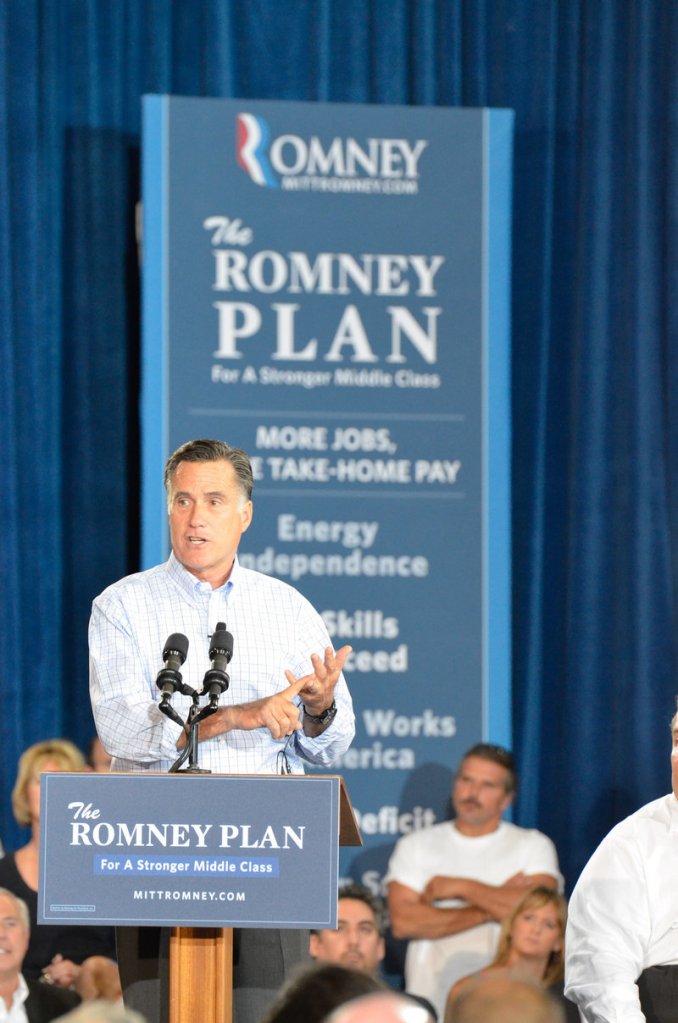
They left all preferences for savings and investment untouched, as Romney has promised. They even tested the plan under a model developed, in part, by Greg Mankiw, one of Romney’s economic advisers, that promises “implausibly large growth effects” from tax cuts.
The fact that they couldn’t make Romney’s numbers work even when they stacked all these scenarios on top of one another shows just how impossible Romney’s promises are.
The reason Romney’s plan doesn’t work is very simple. The size of the tax cut he’s proposing for the rich is larger than all of the tax expenditures that go to the rich put together. As such, it is mathematically impossible for him to keep his promise to make sure the top 1 percent keeps paying the same or more.
This is going to be a huge problem for the Romney campaign.
The Romney team has tried to paper over the fact that its policy promises don’t add up by withholding the crucial details that independent analysts need to do the math. But now independent analysts are filling in those details for them (the Tax Policy Center’s look at Romney’s tax plan should be read in tandem with the Center on Budget and Policy Priorities (CBPP) effort to flesh out his spending promises). And, ultimately, that’s worse, as actors with more credibility than the Romney campaign are showing what the Romney campaign was trying to hide.
Evidence the Romney campaign does not have a good counterargument, part one: If they thought releasing more details would make the plan look better rather than worse, they would have released them rather than letting outside organizations fill in the blanks. It’s essentially the same theory as refusing to release the tax returns. But now the Romney campaign is receiving pressure — including from conservatives — to release those details, which they know they can’t do. And unlike on the tax returns, no one can say that the details of Romney’s plans for governing the country are irrelevant to this campaign.
Evidence the Romney campaign does not have a good counterargument, part two: They tried to brush the Tax Policy Center’s analysis off as “just another biased study from a former Obama staffer.”
That former Obama staffer is Adam Looney, one of the study’s three co-authors, who was a staff economist on the Council of Economic Advisers from 2009 to 2010. But William Gale, one of Looney’s coauthors on this study, was a staff economist on George H.W. Bush’s Council of Economic Advisers.
Plus, the Tax Policy Center is directed by Donald Marron, who was actually a principal on George W. Bush’s Council of Economic Advisers. Calling the Tax Policy Center biased is ridiculous. Just ask … the Romney campaign, which referred to the center’s work as “objective, third-party analysis” during the primary.
If Romney tries to pay for tax reform by cutting spending, it becomes much more regressive.
The Tax Policy Center says it is likely that “cutting spending would make the plan even more regressive because government spending tends to benefit low- and middle-income households more than tax preferences do.”
In fact, it is almost a sure thing, as Romney has promised to increase defense spending and keep the promised benefit levels for this generation of seniors, which removes almost all the spending cuts that wouldn’t particularly harm the poor.
Again, this CBPP study, which assumes Romney’s pays for half his tax plan with spending cuts, is illustrative.
“Broadening the base and lowering the rates” is anti-family tax reform. This is interesting: “Families with children currently receive 57 percent of the available tax expenditures examined in this exercise but 23 percent of the revenue reductions. Thus a reform that imposed an across-the-board reduction in tax expenditures would increase taxes much more on families with children than on childless adults.”
Passing any major tax reform plan is going to be much harder than people think.
One reason tax reform in which you cut “tax expenditures” in order to lower rates sounds so good is that people don’t know what the words “tax expenditures” mean.
Here’s what they mean: “employer provided health insurance and fringe benefits; the partial exclusion of social security benefits; above-the-line deductions like moving expenses; education-related benefits and tax credits; the deductions for medical expenses, state and local taxes, mortgage interest, and charitable contributions; child- and dependent-related tax credits like the child care credit, earned income tax credit and child tax credit.”
Be honest: How many of those do you really think we’ll cut, much less eliminate? If the answer is “not many,” we’re not doing much tax reform.
Dynamic scoring of the sort many Republicans think they want is impossible, and probably wouldn’t return the results they hope.
The common Republican response to estimates like the Tax Policy Center’s is that they ignore the growth-accelerating effects of tax cuts. To estimate those effects “would require a full analysis of the entire federal budget, the budget deficit, and the anticipated response of monetary policy to changes in the budget. Furthermore, estimates indicate that the effects of tax rate reductions on the macroeconomy are likely to be small or even negative, at least, over the typical 10-year budget window.”
Ezra Klein is a columnist and the editor of Wonkblog at the Washington Post, as well as a contributor to MSNBC and Bloomberg. His work focuses on domestic and economic policymaking.
Send questions/comments to the editors.

Success. Please wait for the page to reload. If the page does not reload within 5 seconds, please refresh the page.
Enter your email and password to access comments.
Hi, to comment on stories you must . This profile is in addition to your subscription and website login.
Already have a commenting profile? .
Invalid username/password.
Please check your email to confirm and complete your registration.
Only subscribers are eligible to post comments. Please subscribe or login first for digital access. Here’s why.
Use the form below to reset your password. When you've submitted your account email, we will send an email with a reset code.