



WASHINGTON – Uneasy allies, President Barack Obama and Afghan President Hamid Karzai demonstrated Friday they could agree on one big idea: After 11 years of war, the time is right for U.S. forces to let Afghans do their own fighting.
U.S. and coalition forces will take a battlefield back seat by spring and, by implication, go home in larger numbers soon thereafter.
Additional Photos
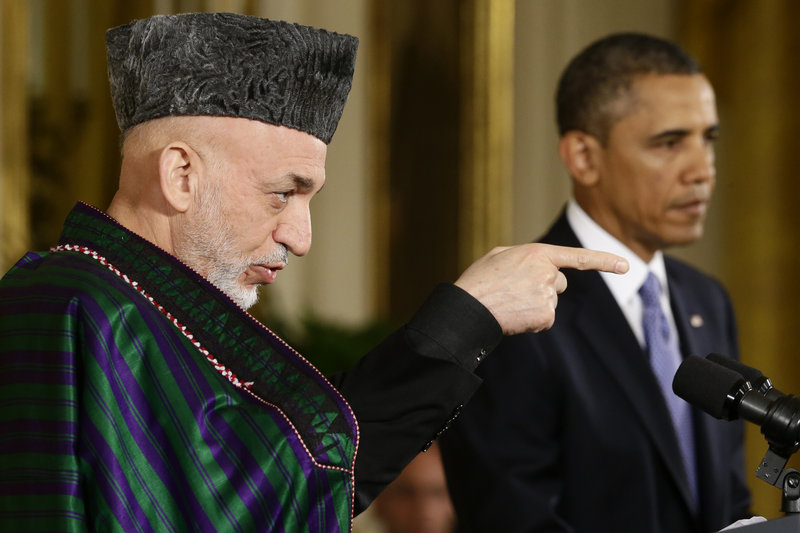
“It will be a historic moment,” Obama declared.
In a White House meeting billed as a chance to take stock of a war that now ranks as America’s longest, Obama and Karzai agreed to accelerate their timetable for putting the Afghanistan army in the lead combat role nationwide.
It will happen this spring instead of summer — a shift that looks small but looms larger in the debate over how quickly to bring U.S. troops home and whether some should stay after combat ends in 2014.
The two leaders also agreed that the Afghan government would be given full control of detention centers and detainees.
They did not reach agreement on an equally sticky issue: whether any U.S. troops remaining after 2014 would be granted immunity from prosecution under Afghan law. Immunity is a U.S. demand that the Afghans have resisted, saying they first want assurances on other things — like authority over detainees.
At a joint news conference with Karzai in the White House East Room, Obama said he was not yet ready to decide the pace of U.S. troop withdrawals between now and December 2014. That is the target date set by NATO and the Afghan government for the international combat mission to end. There are now 66,000 U.S. troops there.
Obama’s message was clear: Afghans must now show they are capable of standing on their own.
“By the end of next year, 2014, the transition will be complete . . . and this war will come to a responsible end,” he said.
However, some private security analysts — and some in the Pentagon — worry that pulling out to quickly will leave Afghanistan vulnerable to collapse.
In a worst-case scenario, that could allow the Taliban to regain power and revert to the role they played in the years before the Sept. 11, 2001, attacks as protectors of al-Qaida terrorists bent on striking the U.S.
Send questions/comments to the editors.

Success. Please wait for the page to reload. If the page does not reload within 5 seconds, please refresh the page.
Enter your email and password to access comments.
Hi, to comment on stories you must . This profile is in addition to your subscription and website login.
Already have a commenting profile? .
Invalid username/password.
Please check your email to confirm and complete your registration.
Only subscribers are eligible to post comments. Please subscribe or login first for digital access. Here’s why.
Use the form below to reset your password. When you've submitted your account email, we will send an email with a reset code.