



WASHINGTON — Tens of thousands of walruses have come ashore in northwest Alaska because the sea ice they normally rest on has melted.
Federal scientists say this massive move to shore by walruses is unusual in the United States. But it has happened at least twice before, in 2007 and 2009. In those years Arctic sea ice also was at or near record low levels.
Additional Photos
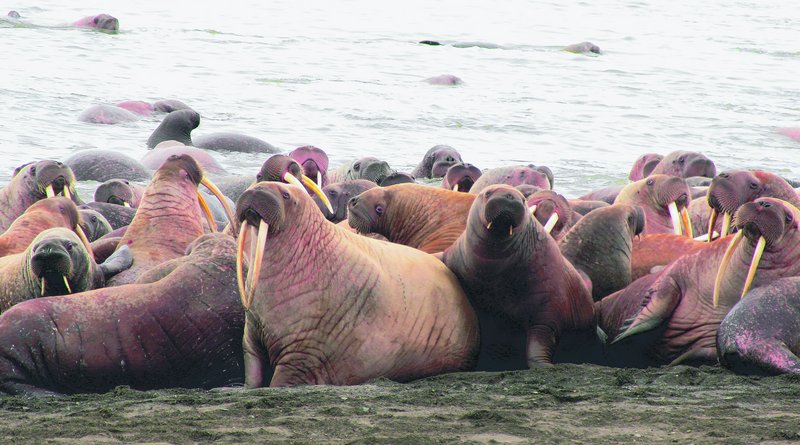
The walruses “stretch out for one mile or more. This is just packed shoulder-to-shoulder,” U.S. Geological Survey biologist Anthony Fischbach said in a telephone interview from Alaska. He estimated their number at tens of thousands.
Scientists with two federal agencies are most concerned about the one-ton female walruses stampeding and crushing each other and their smaller calves near Point Lay, Alaska, on the Chukchi Sea.
The U.S. Fish and Wildlife Service is trying to change airplane flight patterns to avoid spooking the animals. Officials have also asked locals to be judicious about hunting, said agency spokesman Bruce Woods.
The federal government is in a year-long process to determine if walruses should be put on the endangered species list.
During normal summers, the males go off to play in the Bering Sea, while the females raise their young in the Chukchi. The females rest on sea ice and dive from it to the sea floor for clams and worms.
“When they no longer have a place to rest, they need to go someplace and it’s a long commute,” Fischbach said. “This is directly related to the lack of sea ice.”
Loss of sea ice in the Chukchi this summer has surprised scientists because last winter lots of old established sea ice floated into the region, said Mark Serreze, director of the National Snow and Ice Data Center in Boulder, Colo. But that has disappeared.
Although last year was a slight improvement over previous years, Serreze says there’s been a long-term decline that he blames on global warming.
“We’ll likely see more summers like this,” he said. “There is no sign of Arctic recovery.”
Send questions/comments to the editors.

Success. Please wait for the page to reload. If the page does not reload within 5 seconds, please refresh the page.
Enter your email and password to access comments.
Hi, to comment on stories you must . This profile is in addition to your subscription and website login.
Already have a commenting profile? .
Invalid username/password.
Please check your email to confirm and complete your registration.
Only subscribers are eligible to post comments. Please subscribe or login first for digital access. Here’s why.
Use the form below to reset your password. When you've submitted your account email, we will send an email with a reset code.