



Nancy and Mike Heath went into panic mode about a year ago when they tried to refinance their Westbrook home and were told they lived in a flood zone and had to pay $1,700 a year for federal flood insurance.
That would total $25,500 over a 15-year mortgage, just as the couple — Nancy is a paralegal and Mike a teacher — is trying to save for their two sons’ college educations.
Additional Photos
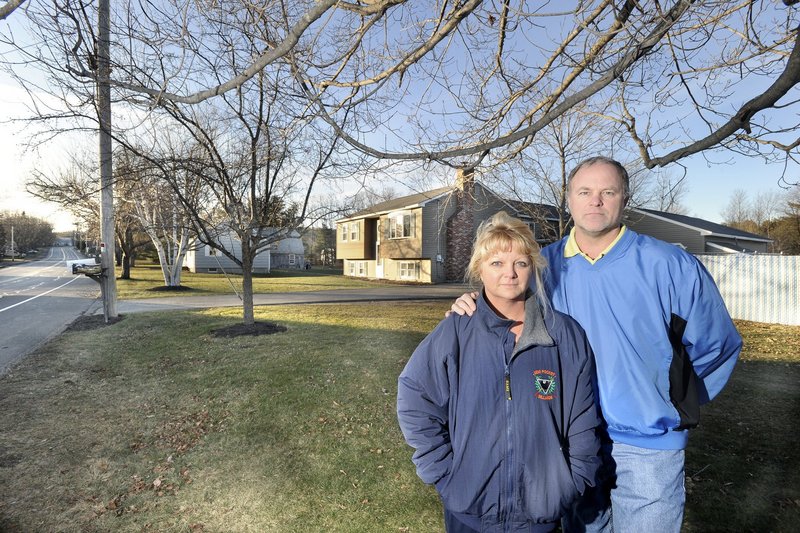
“I was like, ‘Are you kidding me?’ ” said Nancy Heath, whose home sits high and dry on a hill 18 feet above a drainage swale.
“The map was totally wrong.”
But proving that their split-level home didn’t belong in a flood zone cost the Heaths about $700 and delayed their refinancing.
The Heaths are not alone.
Last year, 370 Maine property owners appealed to the Federal Emergency Management Agency to remove their homes or businesses from flood plain status, according to the Maine State Planning Office. Most of them had to hire surveyors at an average cost of $750 to prove they didn’t need to pay for costly flood insurance policies required to obtain a mortgage.
Maine’s rate of flood plain appeal applications is three times the national average, according to the office’s Maine Floodplain Management Program. One reason is because the federal government has put more effort into improving maps in states with higher populations. Maine’s maps tend to be older than the national average, according to Joseph Young, the state program’s mapping coordinator.
Even though new federal maps are issued every few years, that doesn’t mean they are produced using new and improved technology, Young says. Often, old map data is simply overlaid with new digital photographs that don’t correct old mistakes, he said.
That is why some lawmakers are pushing for property owners to be reimbursed for the cost of a successful map appeal.
But Congress is divided over the reimbursement proposal.
REIMBURSEMENT, OR BETTER MAPS?
The House last year approved a bill that would require the Federal Emergency Management Agency, which oversees the national flood insurance program, to reimburse property owners. But the Senate’s bill focuses on spending more money to improve the maps.
While the actual flood zone appeal is free, it usually requires hiring a surveyor or engineer to prove that a house should be removed from a flood zone.
Since 1983, the earliest date with available data, there have been more than 3,400 flood plain map appeals in Maine, costing property owners more than $2.6 million, according to the State Planning Office.
The office doesn’t break down approvals versus denials but says most applications are approved because they aren’t made unless an owner is pretty certain of his or her case.
There has been a steady increase in appeals over the past decade. Young attributes that to increased awareness among banks that they are required to check flood plain maps before granting a mortgage or risk a federal fine.
Appeals averaged nearly 300 a year for much of the past decade, compared to fewer than 100 cases a year during the 1990s and fewer than 50 cases a year during the 1980s.
“It is a big burden in Maine,” said Sue Baker, the planning office’s National Flood Insurance Program coordinator. “It costs people money to prove they are not in a flood plain when their homes are mapped inaccurately.”
Both of Maine’s U.S. House members, Chellie Pingree, D-1st District, and Mike Michaud, D-2nd District, support reimbursing homeowners who prove their case. The state’s two U.S. senators, however, are not convinced, saying they want to make sure there is enough money available to produce better maps in the first place.
But Michaud maintains that the House bill addresses a “serious problem in our state.”
And Pingree said homeowners should not be “on the hook for the cost of fixing mistakes FEMA might make with the mapping of their property.”
Despite Maine’s high appeal rate, neither Pingree nor Michaud led the effort to pass the reimbursement provision as part of a wider flood insurance program overhaul.
Rep. Maxine Waters, D-Calif., spearheaded the reimbursement idea in the House two years ago after she was contacted by a number of California homeowners upset about a new FEMA map that wrongly placed homes in a flood zone.
But Maine has a much higher map appeal rate per capita than California. In Maine, there is an appeal for every 3,763 people, versus one for every 14,208 people in California. The national average is 10,209, according to FEMA data.
‘WHY DO WE HAVE TO PAY FOR THAT?’
After the Heaths joined the multitude of Mainers who have successfully fought the maps, the Westbrook couple finally did refinance their house in December, a year after they first tried.
Nancy Health says it’s only fair for the government to reimburse the $700 the couple paid to a surveyor to document that their house was too elevated to be in a flood zone.
“If someone is erroneously placed in a flood zone and they have to appeal and go through this crazy song and dance, they should be reimbursed,” Heath said.
The Heaths’ case was relatively straightforward. But winning an appeal in a more complicated case can cost several thousand dollars, said James Nadeau, the Portland surveyor and certified flood plain manager who did the job for the Heaths.
FEMA “knows the maps aren’t perfect and they allow you to challenge them,” Nadeau said. “The question is, who pays for that? People chew on me when it is clear the maps are in error. They say, ‘Why do we have to pay for that?’ “
Baker of the Maine State Planning Office said she understands the frustration of having to pay out of pocket to correct a federal flood plain map. But she isn’t sure reimbursing home-owners is the best solution to the problem.
There is no specific money set aside in the House bill to cover the costs of reimbursing homeowners who file successful map appeals. That would have to be allocated separately each year by Congress.
“I don’t see how FEMA will have the money to do that,” Baker said. “The bottom line is making the maps more accurate in the first place.”
That’s the idea behind the flood insurance program overhaul on which the Senate is working. The House bill would spend about $92 million to improve maps nationwide, while the Senate bill ups that ante to $400 million.
Opponents of the House reimbursement provision fear money for improving maps would get eaten up by the requirement to reimburse homeowners who file flood plain appeals.
In 2009, FEMA came out with new flood maps for York and Cumberland counties, only to have to withdraw them in 2010 for more work after acknowledging numerous errors.
“I would rather see the FEMA money spent on making the map better up front,” said Larry Larson, executive director of the national Association of State Flood Plain Managers, based in Wisconsin.
FEMA declined comment on the pending flood insurance legislation and the issue of reimbursing property owners for a successful appeal.
Maine’s two Republican senators, Olympia Snowe and Susan Collins, say they would like to see homeowners reimbursed if possible — but not at the expense of producing more accurate maps.
“Homeowners should be reimbursed for reasonable costs if there was a bona fide error by FEMA,” Snowe said. “But even more importantly, we must ensure that the maps of our nation’s flood plains are not only up-to-date but also accurate.”
Collins says she wants more information about how much reimbursing individual home-owners would cost nationwide — and whether enough money would be available for improved maps — before she agrees to the House proposal. But there has been no estimate of how much money the House reimbursement proposal would cost nationwide.
“The best way to avoid unnecessary and costly mistakes is for FEMA to produce accurate maps in the first place,” Collins said.
“While it may indeed be appropriate to hold FEMA accountable for the costs incurred by property owners and communities in proving FEMA’s mistakes, taxpayers should not have to pay twice for FEMA to produce accurate maps.”
But Lisa Duffy, a Massachusetts woman whose family owns a second home in Naples on a small lake called Brandy Pond, was frustrated and out $500 after she won her flood zone appeal in 2010.
Duffy said their home sits up on a hill and is in no danger of flooding even in the fiercest storm.
“The FEMA maps are outdated, and the burden of proof basically was on us to show that the house was not in a flood zone,” Duffy said. “It cost us money for something that clearly was not the case. I wouldn’t mind getting the money back.”
MaineToday Media Washington Bureau Chief Jonathan Riskind can be contacted at 791-6280 or at:
jriskind@mainetoday.com
Twitter: Twitter.com/MaineTodayDC
Send questions/comments to the editors.

Success. Please wait for the page to reload. If the page does not reload within 5 seconds, please refresh the page.
Enter your email and password to access comments.
Hi, to comment on stories you must . This profile is in addition to your subscription and website login.
Already have a commenting profile? .
Invalid username/password.
Please check your email to confirm and complete your registration.
Only subscribers are eligible to post comments. Please subscribe or login first for digital access. Here’s why.
Use the form below to reset your password. When you've submitted your account email, we will send an email with a reset code.