



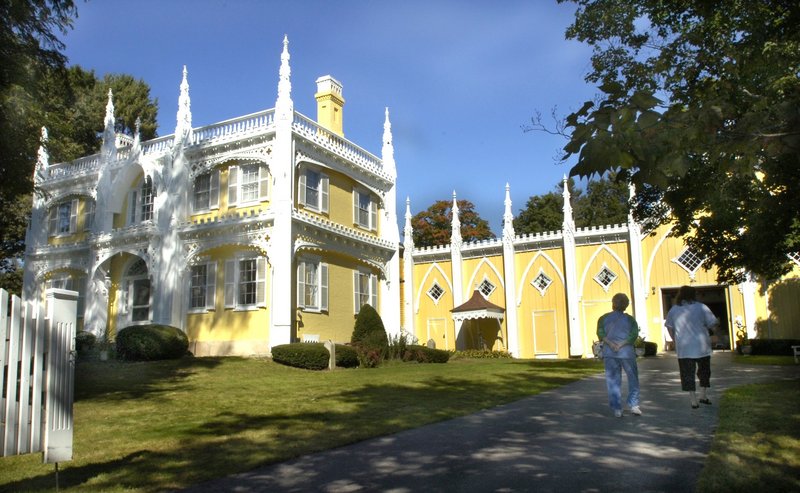
The deeply worn roadside shoulder directly across from the Wedding Cake House on Summer Street is testament to the dozens of people daily who stop to photograph the ornately trimmed dwelling.
Doubtless, many of those passers-by have wondered if the fancifully bedecked home’s interior is as grand as its outer facade.
Additional Photos
Beginning Saturday, the curious are welcome to come and find out — for a fee.
That’s when the oft-photographed Wedding Cake House will be opened for daily tours running through Oct. 15.
The home’s owner, James Hunt Barker, has joined with the Focus on Hunger Committee of the First Parish Unitarian Universalist Church of Kennebunk to raise funds benefiting hunger relief in York County.
According to tour coordinator Frank DeSarro, Barker, 84, a retired art dealer, offered tours of the house in 2005, raising nearly $80,000 to benefit Hurricane Katrina victims, and in 2010, raising $37,000 for local hunger initiatives.
“Jimmy absolutely loves to show off the house, especially for good causes,” said DeSarro. “When he learned that funding for many York County food pantries had been cut from the York County commissioners’ budget, he decided to open his home to visitors again.”
Barker previously conducted the tours himself, including for former first lady Laura Bush.
This time, a team of four or five tour guides will conduct the bulk of the near 45-minute tours, with Barker providing occasional historic narrative.
Constructed around 1825, the Wedding Cake House originally was known as the George Washington Bourne home and housed three generations of the Bourne family, through 1983.
Bourne was a prominent 19th-century shipbuilder who constructed his vessels on the Kennebunk River directly behind the home.
Shipbuilding was once a booming industry in the area, with shipbuilders often living in opulent homes where they entertained prominent guests and potential clients.
When the area shipbuilding trade declined in the mid-1800s, merchants once again turned to the sea and those grand residences as a means to generate income through tourism.
DeSarro said occasional bits of folklore, dropped in conversation, also serve to fuel the intrigue.
“There are a lot of romantic tales about how the Wedding Cake House came into being,” said DeSarro. “The most famous of the stories is that on George and Jane Bourne’s wedding day he was suddenly sent to China to save the family fortune and was gone for 25 years. While he was away, George felt guilty for abandoning his new bride. So he spent his free time fashioning these fancy turrets, vowing to decorate the home for her when he returned.”
The truth?
“George added the fancy Carpenter Gothic-style trim work after he retired in 1850,” said DeSarro. “He focused his woodworking skills on creating spires, turrets, balusters and other molding work to trim his home, using sketches of a cathedral in Milan, Italy, as his inspiration. “
Bourne’s filigreed embellishments transformed the former two-story red brick Federal-style home, now yellow with white trim, into a structure more closely resembling a wedding cake.
The several-years-long project was completed before Bourne’s death in 1856.
Apparently, not all of Bourne’s family members shared his taste for the architecture or the crowds his handiwork attracted.
“It is rumored that one of the later family members to occupy the house deliberately allowed the decorative trim work to fall into disrepair because they were tired of the constant crowds of onlookers,” said DeSarro.
Following Jane Bourne’s death in 1890, the home was occupied by the couple’s daughter Lucy and then grandson George Bourne Lord.
In 1983, the mansion was sold to artist Mary Burnett, who restored it to its former glory, along with daughter Anne.
Modern touches were added, including a few bathrooms in former closet spaces. And a massive mural, painted by Burnett, ascends the walls surrounding a spiral staircase in the front hall. The artwork includes images of the house, the Kennebunk River and the First Universalist Unitarian Church where Bourne is buried and once served as Sunday school superintendent.
Barker, a New York native, first viewed the house during a visit to Maine in 1953.
“Jimmy fell in love with the house and vowed to own it one day,” said DeSarro.
That day came in 1998, when the fully restored home went on the market.
Barker bought the home with partner Kenneth Douglas Jr., and added many original artworks and antiques that helped to enhance the space and interpret its history from the 1850s.
Many pieces original to the home remain — including a blue settee in the library and an 1834 square back Chickering grand piano in the front parlor that was delivered by Boston via ox cart.
“George and a beloved niece named Lizzie used to play duets on that piano for their guests,” said DeSarro. “There are lots of wonderful little stories and treats like that to discover in the house.”
Staff Writer Deborah Sayer can be contacted at 791-6308 or at:
dsayer@pressherald.com
Send questions/comments to the editors.

Success. Please wait for the page to reload. If the page does not reload within 5 seconds, please refresh the page.
Enter your email and password to access comments.
Hi, to comment on stories you must . This profile is in addition to your subscription and website login.
Already have a commenting profile? .
Invalid username/password.
Please check your email to confirm and complete your registration.
Only subscribers are eligible to post comments. Please subscribe or login first for digital access. Here’s why.
Use the form below to reset your password. When you've submitted your account email, we will send an email with a reset code.