



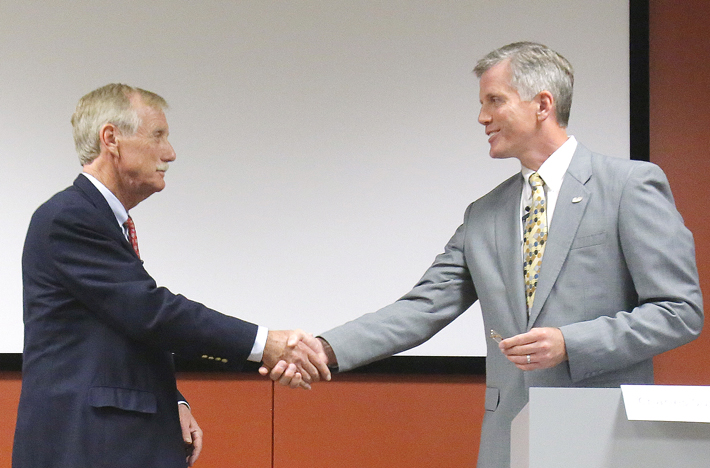
SOUTH PORTLAND — Angus King and Charlie Summers faced off Wednesday in the first debate of Maine’s U.S. Senate campaign.
King, a former two-term governor, and Summers, Maine’s secretary of state, traded opinions on taxes, health care, energy and regulation in front of an invitation-only audience of about 200 people at a Texas Instruments plant here.
Additional Photos
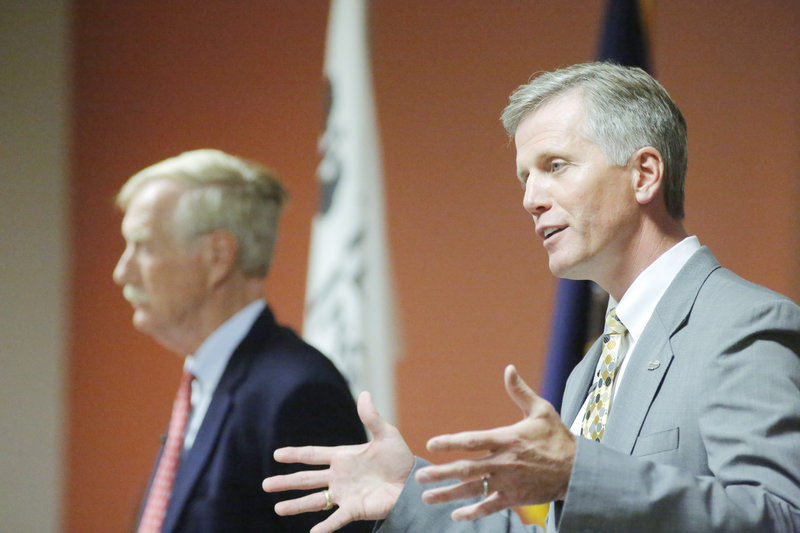
The 90-minute event, focused on issues facing manufacturers, was sponsored by the Maine Manufacturers Association and other business groups. Summers, a Republican, said he stands for keeping taxes low and reducing regulation to free up businesses to expand and hire workers. “I think if we do those things, this economy will begin to move,” he said.
King, an independent, said the country has to be smarter when writing regulations and negotiating trade agreements, but he’s optimistic about manufacturing growth largely because of the availability of cheap natural gas. “I think we are going to see a resurgence,” he said.
The Democratic nominee, state Sen. Cynthia Dill, was invited but missed the event because she was teaching her government class at Southern Maine Community College.
All three leading candidates plan to attend a forum Thursday in Portland focusing on energy and the environment, the second of more than a dozen events scheduled before the election Nov. 6.
The start of face-to-face policy debates marks a new phase of the race, which is being watched closely around the country because it could determine which party controls the Senate. The winner will replace Sen. Olympia Snowe, R-Maine, who did not seek re-election.
King and Summers were respectful of each other Wednesday and answered a series of questions without engaging in any back-and-forth arguments. Neither mentioned the more heated campaigning going on in television ads and news releases, which have included steady criticism of King, the front-runner in the race.
King said he is running to help break down the hyper-partisanship that drove Snowe to leave the Senate and is preventing solutions to problems such as the federal deficit and health care costs. “Washington is just completely locked up,” he said.
Summers disagreed that the race is about bipartisanship and trying to fix the Senate. “The process is not broken; it’s rudderless,” he said. “It’s about direction. What is needed is someone who stands for something.”
The two candidates generally agreed on many of the issues facing manufacturers, although they differed on details.
King and Summers agreed on the need for better training to prepare high-skilled workers, for example.
King said he wants to get younger students thinking about math and science careers, and would like to bring manufacturers and educators to a “skills summit” to find new ways to close the skills gap.
“My sense is there is not a lot of two-way communication,” he said.
Summers said schools must focus more on practical knowledge. He criticized the Obama administration for ending the space shuttle program and sending a message that the country is giving up its leadership in science and technology.
“Now if we want to get into space, we have to hitch a ride with the Russians,” he said.
Both agreed on the need for federal investment in research, although Summers was more reserved.
“We need to get back to making sure our country is first and not second,” Summers said, while warning that the federal government cannot continue spending $1 trillion a year that it doesn’t take in.
King said he increased research investment as governor, and joked that it is one reason why Republicans call him a big spender.
“I felt at the time, and I believe now, that research and development is the best path to economic growth,” he said.
On immigration, King said more foreign workers should be allowed to come and stay in the U.S. if they provide needed skills or start businesses and create jobs. “We should be welcoming smart people instead of making it hard for them to come,” he said.
Summers said more visas for foreign workers may be needed in the short run to fill high-skill jobs, but he favors better training for U.S. workers in the long run.
“We ought to be focused more on what we can do for our workers here in this state — so we don’t have to look beyond our borders,” he said.
The candidates disagreed on health care.
Summers wants to overturn the Affordable Care Act and wants to open interstate insurance competition to bring the cost of health insurance down.
King said he supports the federal law because it will keep people from going to emergency rooms for routine care, but more work is needed to drive down medical costs.
Summers said he favors deregulation to free up business activity, while King said he wants to make sure regulations stay simple and don’t go beyond the intent of Congress.
Summers expressed more skepticism than King about free trade agreements, saying he supports opening markets, but “not at the expense of working families here in Maine.”
King said free trade agreements are needed to open up foreign markets, but they have to protect U.S. companies better. “I just don’t think our negotiators have been tough enough,” he said.
Staff Writer John Richardson can be contacted at 791-6324 or at:
jrichardson@pressherald.com
Send questions/comments to the editors.

Success. Please wait for the page to reload. If the page does not reload within 5 seconds, please refresh the page.
Enter your email and password to access comments.
Hi, to comment on stories you must . This profile is in addition to your subscription and website login.
Already have a commenting profile? .
Invalid username/password.
Please check your email to confirm and complete your registration.
Only subscribers are eligible to post comments. Please subscribe or login first for digital access. Here’s why.
Use the form below to reset your password. When you've submitted your account email, we will send an email with a reset code.