




WASHINGTON – It took Chris Kotch years to recover physically from the injuries he suffered when an improvised explosive device hit his Army patrol vehicle in the early days of the war in Iraq.
Now, a decade later, the Brunswick resident is in another years-long struggle, against a bureaucratic technicality that he believes is costing him thousands of dollars in educational benefits intended for injured veterans.
Additional Photos
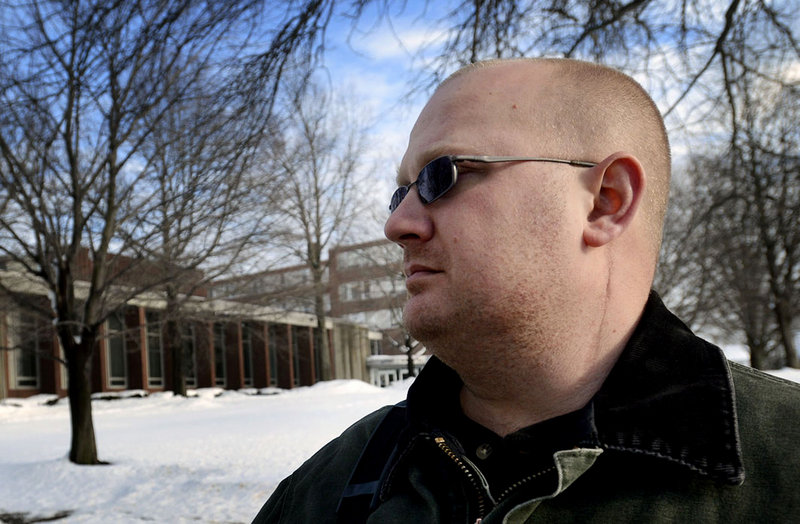
“It’s been three years. I had to take out loans … which I should not have had to do,” said Kotch, a husband and father who is pursuing a bachelor’s degree at the University of Southern Maine.
By all accounts, Kotch appears to be a textbook example of someone qualified for full benefits made available to injured veterans under the Post-9/11 GI Bill. But he and U.S. Rep. Chellie Pingree, D-Maine, say a loophole in the law has left Kotch — and likely other reservists — with only partial benefits.
By his own estimate, Kotch says the reduced stipend alone is costing him $600 a month — money he was counting on to pay for school expenses as well as gas and household bills as he attended school full-time.
“It’s not just me that this has happened to,” said Kotch, his voice still affected by the injury that severed his carotid artery. “I know there are a lot of people like me, and a lot of people who are worse off than me who can’t put up with the BS and the bureaucratic stuff to get something done.”
The issue, which Pingree hopes to fix with a bill she introduced this month, appears to be with the manner and timing of Kotch’s medical retirement from the military because of his injuries.
Under the Post-9/11 GI Bill, veterans can receive full in-state tuition and a monthly stipend if they served at least three years of active duty or were medically discharged because of a service-related disability after at least 30 days of continuous active-duty service.
Veterans who don’t meet those requirements are entitled to benefits at reduced levels.
As a member of the U.S. Army Reserve 94th Military Police Company, Kotch had been on active-duty deployment in Iraq for five months when the IED struck his vehicle in 2003. The injuries to his throat, shoulder and other areas were so severe that he was sent stateside to recover.
Despite his desire to stay in the reserves, Kotch was honorably released because of his wounds. He waited several years before leaving his job to attend college full-time under the GI Bill, with the goal of receiving a master’s degree in social work.
That’s when the paperwork issue emerged.
Kotch was “medically retired” after being officially transferred back to his reserve unit, so he was no longer considered on active duty at the time. To receive the full Post-9/11 GI Bill benefits, a veteran must receive a “medical discharge” from active duty.
Pingree has introduced a bill that would ensure that anyone who is medically separated or medically retired from the “armed forces” — rather than simply from active duty — would qualify for the full benefits. Her bill would allow Kotch and other affected veterans to receive the full benefits retroactively.
“Since looking into the issue, I’ve heard about other Reservists who’ve fallen into the same trap,” Pingree said in a prepared statement. “It’s sad to see that many have gone into student loan debt when their education should have been paid for. I hope we can make this fix so they can get the full benefits that their service and sacrifice have earned them.”
Pingree is married to S. Donald Sussman, majority share owner of the Portland Press Herald.
A representative for the Department of Veterans Affairs, reached late last week, said benefits cases are highly individual and could not comment on Kotch’s specific situation because of privacy laws.
Michael Dakduk, executive director of the advocacy organization Student Veterans of America, said the Post-9/11 GI Bill is so complex and nuanced that he frequently hears from veterans who are struggling with the system.
“There are many things that need to be fixed with the Post-9/11 GI Bill, and this may be one of them,” said Dakduk, a recent veteran who deployed to Iraq and Afghanistan.
Dakduk said his organization, which is active on Capitol Hill, also wants to see the Department of Veterans Affairs address the backlog of claims under the GI Bill that causes long delays for some veterans.
“As frustrating as it is, it is the best program that we have ever had,” he said.
Kotch said he is frustrated after three years of trying to get full benefits, as he believes the law intended. And he is hoping to receive those benefits retroactively.
Kevin Miller can be contacted at 317-6256 or at:
kmiller@pressherald.com
On Twitter: @KevinMillerDC
Send questions/comments to the editors.

Success. Please wait for the page to reload. If the page does not reload within 5 seconds, please refresh the page.
Enter your email and password to access comments.
Hi, to comment on stories you must . This profile is in addition to your subscription and website login.
Already have a commenting profile? .
Invalid username/password.
Please check your email to confirm and complete your registration.
Only subscribers are eligible to post comments. Please subscribe or login first for digital access. Here’s why.
Use the form below to reset your password. When you've submitted your account email, we will send an email with a reset code.