
FREEPORT – If all goes as planned, between 60 and 70 percent of the 1 million baby clams – now only one-tenth of an inch in size – stored in barrels in the mouth of the Harraseeket River will be harvested by clammers next summer.
In an experimental method sponsored by a company called Stewards of the Sea and the University of Maine at Machias, the clams will be protected from predators, eat the plankton in the sea water and grow to perhaps half an inch this summer. Then they will be planted in Freeport mud flats, covered with screening and protected through the winter, a time when the destructive green crabs head for deeper water.
Brian Beal, a University of Maine marine ecologist, transported the clams from a hatchery in the Down East town of Beals to the barrels, known as upwellers. Beal and his team have placed 50,000 baby clams in each of the 20 upwellers. They seeded five barrels in a trial run two weeks ago, and completed the transplants on June 10 at the South Freeport dock, outside Harraseeket Lunch and Lobster.
“They were planted last Thursday and I think they’ve almost doubled,” clammer Clint Goodenow told Beal on June 10. “Boy, I’ll tell you, they cover a lot more of the bottom.”
State Sen. Stan Gerzovsky of Brunswick joined Chad Coffin, president of the Maine Clammers Association, scientific coordinator Sara Randall and local clammers for the June 10 plantings. Instead of seeding the tiny clams in the mud right off, they are using the upwellers in this experimental effort that will allow them to grow before they are seeded. Beal, who is working with a $200,000 University of Maine grant, brought the baby clams from the Downeast Institute in Beals.
“This whole thing is called a nursery – a bivalve upweller nursery,” Beal said. “The idea is to get them to half an inch or more, so they can be planted. No one’s done this down here, ever.”
Coffin said the idea is to allow the clams to be eventually harvested. Green crabs are wiping out the clam populations up and down the Maine coast.
“It’s a great educational tool,” Coffin said. “We know that invasive species have a dramatic impact on the resource.”
Randall said that the clams could be transferred from the upwellers to the clam flats as soon as two months from now.
“They’re protected in here from predation by green crabs,” she said. “That’s why we’re doing it.”
Beal said that it will be up to the town of Freeport to decide where the clams will be planted. Coffin said that Staples Cove, Collins Cove and Wolfe’s Neck State Park are possibilities.
“We’ll protect them with netting,” Coffin said. “We’d put the nets on just before the ice forms, or when scientific evidence shows that the green crabs are back in the deep water.”
Beal worked last year on a $100,000 grant from the town. He and volunteers trapped green crabs, and used netting and fencing in an experimental effort to ward off the crabs. The fencing method was not effective, as the tides compromised many of the fences.
This year, Beal arrived during the second week of April. He and his crew have fenced Staples Cove.
Randall, working as a consultant for the Maine Clammers Association, completed a proposal this past spring, outlining the need for a regional shellfish coordinator whose job would be resource protection, mostly from green crabs. The Freeport Shellfish Conservation Commission later decided the position should be funded by the town, rather than shared by local communities such as Brunswick and Harpswell.
The Town Council was scheduled to adopt a municipal budget on June 17, and asked the commission to rewrite its proposal in order to consider the new request. Randall told the council two weeks ago that a Freeport-only position could cost around $20,000 instead of the $90,000 requested for a regional coordinator.
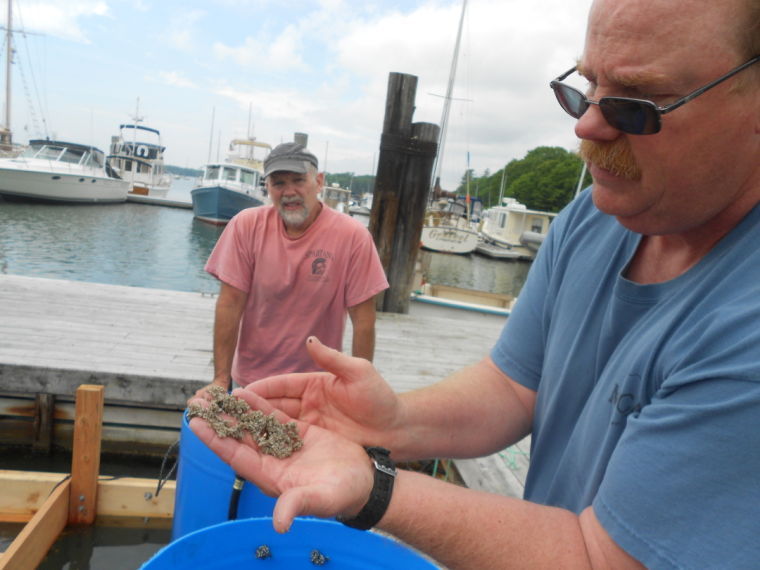 Marine ecologist Brian Beal, right, shows the size of the baby clams that are being stored for growth in buckets at the South Freeport dock as part of the Freeport Soft-Shell Clam Experiment. At left is clammer Brian Goodenow.
  Chad Coffin, left, president of the Maine Clammers Association, with state Sen. Stan Gerzofsky of Brunswick at the South Freeport wharf, where baby clams were planted into barrels on June 10.
  Sara Randall, scientific coordinator for the Freeport Soft-Shell Clam Experiment, was on hand on June 10 as industry experts placed baby clams into barrels, where they will mature and eventually be planted into mud flats along Freeport’s shore lines.
Comments are no longer available on this story