
After delays because of bad weather, work is continuing along Marion Jordan Road, where residents have complained about slow progress of the road’s reconstruction.
The problems have caused tension with the developer and have led some residents to conclude that town officials are powerless to control developers working on projects that have gained town approval.
And though the problems with this project appear as though they will be addressed, there may be lessons for other residents who encounter problems with developers on other projects in the future, about what residents can expect from town officials – and what they should not.
Developer Paul Hollis is creating several “estate-size lots” for homes on the former Rev. Franklin Cole farm, between Higgins Beach and Prouts Neck.
Residents of the quiet, dead-end-road neighborhood objected in July to the widening of Marion Jordan Road from 16 feet with grassy shoulders to a town-minimum 20 feet of pavement plus several feet of shoulder and drainage swales, for a total width of 50 feet, according to project plans.
Hollis said Tuesday he thought a 20-foot road width was “overbuilding,” but did what was required.
Now some neighbors are saying the town is unable to force developers to finish projects in a timely manner.
Quick response
Marie Demicco was happy Tuesday when a temporary mailbox was put up, replacing the rain-filled bucket she had been using to receive her mail.
“My mailbox has been on the ground since May,” she said.
And problems with the stormwater drain system caused water to overflow a catch basin, turning several yards of road shoulder into quicksand, before flowing across the road into Mary Lello’s driveway, which became a muddy quagmire.
When Demicco and Lello spoke with Town Engineer Jim Wendel last week to ask him for help getting Hollis’s crews to fix the problems, “he told us he would call Paul – Mr. Hollis – and give him a nudge,” Lello said. “That’s all he can do.”
Hollis said he responded to Wendel’s call – and an inquiry from a reporter – with immediate action. He said he had not known of the problems before because “the neighbors never call me” about them. He said neighbors should call developers if there are problems, and said a responsible developer would respond right away.
On Tuesday, one of Hollis’s contractors dug a hole and put in a post to temporarily support Demicco’s mailbox. A large piece of construction equipment dug new ditches to improve water runoff, emptying the overflowing pond without sending water across the road, where neighbors feared it might turn to ice as temperatures drop.
Hollis also said he and his work crews would monitor other areas to ensure water was draining as it was supposed to, and would fix any areas where it was not.
He said some of the water problems were due to October’s heavy rains overwhelming ditches and detention ponds, though he said, “no matter how much rain you get, these things should work.”
And he admitted that “there’s some legitimate frustration” on the part of the neighbors: Some of the work was delayed longer than he would have liked, too, mainly because of the weather.
While the recent progress has heartened Demicco, she is still wary. After a meeting with Hollis Monday to discuss the landscaping that remains to be done on her property – at Hollis’s expense, in exchange for an easement for him to widen the road on a portion of her land – she said they had agreed to put in curbing and some other stonework soon, while waiting until the spring to put shrubs and other plants in the ground.
“I’ve heard this before. I asked to have it in writing,” she said.
‘No absolute control’
But Demicco and Lello are more frustrated with town officials than they are with Hollis, who they say has taken care of most of the things he said he would, and who has granted them deeded rights to walk to the ocean as part of the road-widening easements.
“The various agencies of the town are not there to serve us,” said Demicco, who is specifically worried that Wendel and Town Planner Joe Ziepniewski said they have no power to set deadlines for the work to be completed.
Wendel and Ziepniewski said Tuesday that town ordinances allow them to collect a “performance guarantee” – essentially an amount of money that it would cost the town to finish road and other basic work associated with a project – and set a final deadline for their construction of two and a half years, which can be extended to five years by the Planning Board.
“The town has no absolute control over when they do” particular elements of the project, Wendel said. “We can’t dictate when a contractor does certain portions of his work.”
“We can try to light a fire under them,” he said, but with no way to mandate that something happen on a particular timeline.
“We don’t have as much authority as they think we do,” Wendel said, noting that his main job is to ensure that what is designed is in compliance with local and state rules, and that what was designed is what gets built.
While some types of Planning Board approvals expire after one year, such as general site plan proposals, that wouldn’t work for subdivision project approvals, he said.
“The issue is, how do you enforce it?” Wendel asked.
He said there are times when projects “drag on,” but this is not one of them, though “there has been a lag between when the contractor got his seeding work done and the curb work,” which Hollis said is now slated to start Thursday.
‘A real stand-up guy’
Those statements don’t reassure Demicco. “There’s certainly not much consideration being given to us,” she said. “We feel like we’re at the bottom of the pecking order. … The town offices are there to serve the developer.”
Lello echoed those concerns: “The town doesn’t seem to be on our side,” she said. “Who are they there for? Aren’t they our representatives?”
After the drainage work Tuesday, there remained a large pool on Lello’s property, which she calls “the mosquito hatchery.”
Hollis said the work already done should be enough to prevent more runoff from collecting there, and said he would do more work if the water did not eventually dissipate on its own.
Some of the water appearing in various pools is “coming up through the ground,” he said. Wendel said that was possible, because there was a lot of blasting done to build the roadbed, and that may have fractured some of the bedrock and changed underground water flows.
“All in all, it’s gone pretty smooth,” said Hollis. “I try to do the best I can.”
Mike Orr, a Scarborough resident who owns a lot in Hollis’s development but has not yet begun construction on a home, said he is pleased with how things have gone.
“I think Paul Hollis is a real stand-up guy,” Orr said. “I think it’s going to be one of the premier properties in Scarborough.”
He, too, noted that the weather may be to blame for some of the delays. “People just have to have a little bit of patience,” he said.
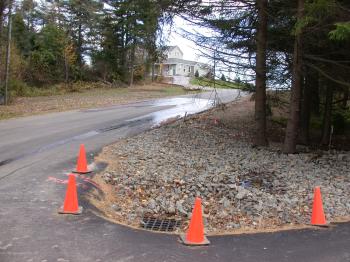 Before repair work was done Tuesday, water overflowing from a stormwater drainage system ran across the road and pooled near this drain on Marion Jordan Road.
Comments are no longer available on this story