
Tucked away in the Alaskan wilderness, Windham native John Branson lives in a cabin among mountains and tundra near Port Alsworth (pop. 100), 150 miles southwest of Anchorage.
The port town, which sits on Lake Clark National Park and Preserve, is so remote that the only way to get there is by plane or boat. Although there are few roads, this is no trouble for Branson who lives only a seven-minute walk from the park’s field headquarters where he works as a historian.
Lake Clark National Park and Preserve encompasses four million acres, Branson said, and is one of the most diverse parks in the United States. There are mountains, tundra, volcanoes, forests and the park’s namesake, Lake Clark that stretches 45 miles long and 900 feet deep.
Much of Branson’s job as park historian however revolves around the social history of the native people, the Euro Americans who came to stay, and, recently, folk hero Richard Proenneke who extensively documented his experiences living alone in the Alaskan wilderness.
“It’s always been a remote area off the beaten track,” Branson said of Port Alsworth. “It’s a great place with really welcoming people, if you show respect for them.”
Branson, son of the late Dr. Sidney Branson, said Lake Clark and towns like Port Alsworth are known for “the world’s greatest salmon fisheries.” Five types of salmon – the most common of which is the “sockeye salmon” – swim up through rivers from the Bering Sea to Lake Clark and other neighboring lakes to spawn.
As park historian, Branson tracks down and collects historic photographs, many of which include pictures of people catching salmon, smoking them to eat and pictures of the old salmon canneries on the lake.
“The pictures document the social history of the area and the salmon canning industry,” Branson said.
Branson also acts as a guide for visiting archeologists and takes them to sites like Kaijik National Historic Landmark. The landmark, like many mountains and streams of the preserve, are not marked on any map. At the Kaijik landmark, he and the archeologists look for “depressions” in the ground that might have been campsites for the Paleo-Indians who lived there 11,000 years ago.
Branson has written and edited four books for the park service on the history of the area. Branson said there were few Euro Americans in Alaska before 1930 when the first plane landed in Anchorage. Yup’ik Eskimos and Deni’ina Native Americans hunted and fished on the land and lakes and still do today. During the gold rush, some American prospectors ventured to Alaska hoping to strike it rich.
“They never found much gold around there, but some stayed and married the native people,” Branson said.
Branson himself arrived in Alaska in 1969 inspired by a trip to Alaska he took with his father ten years earlier. During those early years in Alaska, Branson came to know Proenneke who lived alone in the wilderness near Twin Lake.
Proenneke, who Branson refers to as “the modern day Henry David Thoreau,” later became famous for his book, “One Man’s Wilderness,” about how, at age 50, he ventured into the heart of Alaska, built himself a log cabin home with just a few tools and documented the experience both on film and on paper.
The book, and a film documentary that is shown frequently on Maine Public Broadcasting, inspired many to come to Alaska, Branson said.
“Proenneke was a person who represented the old-fashioned virtues of American culture,” Branson said. “He inspired people then and still inspires people today to live a simple life.”
Branson describes Proenneke as “soft-spoken and humble,” a wildlife photographer and a prolific writer.
Because of his close connection to the author, Branson has been assigned to compile Proenneke’ journals, donated to the park after his death in 2003, into a book.
The journals are so numerous that the bulk of them weigh 100 pounds, Branson said. And Branson has nearly completed the task of editing those 100 pounds down to a 250,000 words.
The book includes excerpts from Proenneke’s journal entries between 1974 and 1980; a time when Lake Clark National Park and Preserve was first being established and Branson and Proenneke became friends. Proenneke’s journals document the creation of the park by the “comings and goings” of people who visited Proenneke at his remote cabin, Branson said.
Proenneke, a conservationist and preservationist, was influential in helping the park come to fruition, Branson said.
And Branson said he feels privileged to be compiling Proenneke’s journals about his life in the wilderness, a life that mirrors Branson’s own, having now lived in Alaska for more than 30 years.
“I feel very strongly about preserving this land for future generations,” Branson said, “and trying to illuminate (people) to its fascinating history.”
 John Branson prepares to wade across a river that runs through Lake Clark National Park and Preserve, Alaska. Branson, a Windham native, is a historian for the park.
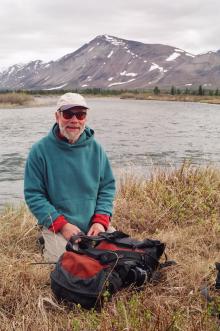 John Branson prepares to wade across a river that runs through Lake Clark National Park and Preserve, Alaska. Branson, a Windham native, is a historian for the park.
Comments are no longer available on this story