
FREEPORT – Local clammers say they are encouraged that Gov. Paul LePage has established a task force to study the devastating impact that the European green crab is having on the shellfish fishery.
But, said Sara Randall, a consultant for the Freeport-based Maine Clammers Association, studies such as the ongoing effort in Freeport are fine, but the time for action is at hand. The Maine Clammers Association wants a regional shellfish commissioner to lead the fight head-on in Casco Bay communities, and soon.
The Freeport Shellfish Commission will meet with the clammers at 6:30 p.m. Thursday, March 13, at the Freeport Community Center, and the topic of a regional commissioner will be front and center. Randall said that she will present to the commission the advantages of having a regional officer, who would be paid by each participating community.
Randall said that Chad Coffin, president of the clammers association, has contacted clammers in surrounding towns such as Brunswick, Yarmouth and Harpswell.
“Hopefully, there’s going to be some marshaling of resources,” Randall said. “We’re still trying to find out the best way of netting and fencing (the crabs). That’s what it’s going to have to take. It’s not going to be enough to just say, ‘Let’s study it.’ We have to get on this problem. We’ve already lost our biodiversity. The green crabs have eaten their way through our ecosystem.”
Nora Healy, chairwoman of the Freeport Shellfish Commission, cautioned last Friday that the commission is in the “exploratory phase” of the quest for a regional commissioner.
“However, I expect that if we did move forward, the shellfish commission would vote on a recommendation to the Town Council, and Town Council approval would be required to move forward,” Healy said.
Randall said that she and members of the clammers association were present on Feb. 28 at the Maine Fishermen’s Forum in Rockland, when LePage announced his executive order to review and consider the impact of the green crab. The governor said that green crabs are threatening Maine’s $25 million bivalve fishing industry.
“It was a surprise,” she said. “The clammers feel that it’s a good first step, but there’s much more to be done.”
Freeport commissioned a $100,000 study of the green crabs problem last year, a study led by University of Maine ecology professor Brian Beal that included fencing and trapping. The state is following it up this year with a $200,000 University of Maine grant, and Beal will return with volunteers to the shores of the Harraseeket River in late April.
Last year, workers brought in six metric tons of green crabs from various spots around the river, and 11,715 crabs were measured and sexed. There was no indication that the haul made any dent in the crab population.
The new attention and press coverage can only help, Randall said.
“A year ago, no one was talking about it,” she said.
Randall said that the green crabs have virtually wiped out the blue mussel population, which lies closer to the surface. They are digging down to get clams, burrowing into the eel grass, which they also eat, she said.
“They’re eroding the eel grass, which other species use for habitat,” Randall said. “The worry now is for lobster. They move into deeper water in the winter, and they’re going after lobster.”
Randall said that a recent dredging of Portland Harbor netted fewer than 100 lobsters, but nearly 30,000 green crabs.
Clammers, meanwhile, are finding clams only near the shore. But the crabs are moving in that direction, she fears.
“The crabs have moved in from deep water,” she said. “The crabs are making their way.”
Randall said she is probably being too optimistic, but would hope to have a regional shellfish commissioner in place by this summer.
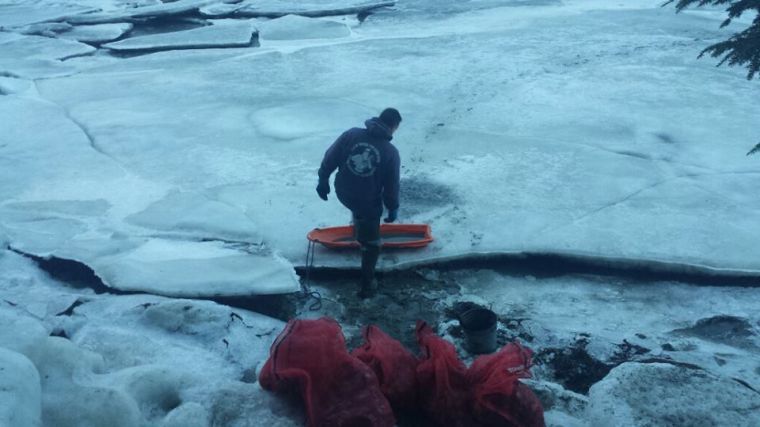 Freeport clammer Jimmy Calcutta earns his keep in the drudgery of winter.
Comments are no longer available on this story