

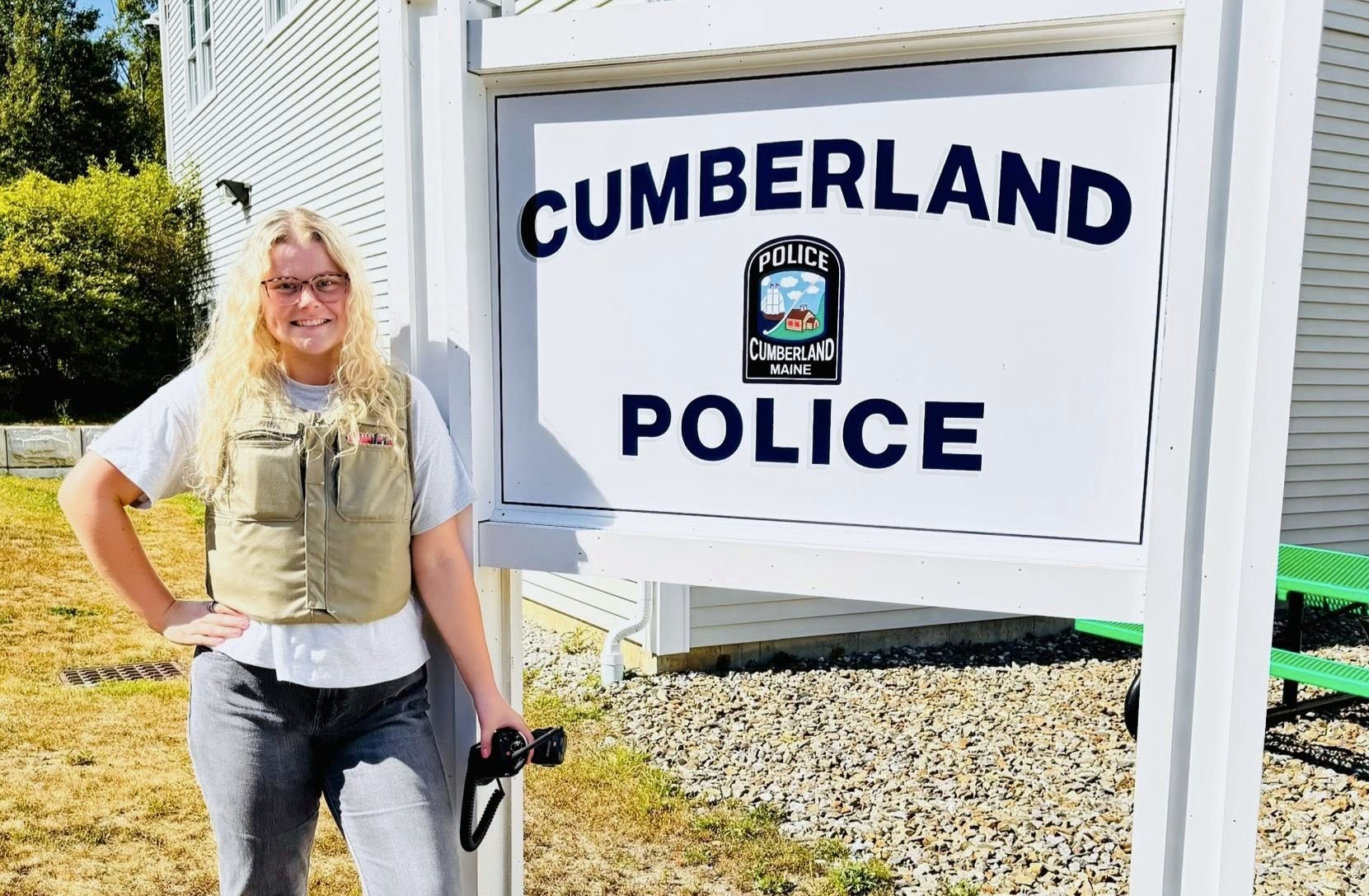
CUMBERLAND — A Cumberland resident struggling with substance use. Someone threatening self harm in a public place in Falmouth. A family unable to manage their elderly parent’s dementia in Yarmouth.
These are calls to the police departments of three neighboring towns. And this is where tri-community resource liaison Haylen Meader steps onto the scene, offering help.
Meader serves as the community resource liaison for Cumberland, Falmouth and Yarmouth, equally embedded with the three police departments. Her work bridges the gap between the police responding to the call and long-term care, connecting individuals with mental health and substance use disorder resources, counseling services or just a listening ear when she responds to emergency calls.
“If I think that I have a resource for that scenario, I try to go,” said Meader.
Meader might be radioed to respond to the incident from a police station, pull up in a police car while already doing a ride-along, or follow up with individuals the next day after going through the police logs from when she was off duty. In addition to her knowledge of local resources, she offers expertise in crisis intervention and as serves as someone out of uniform to talk to.
“When someone’s experiencing a crisis, and a law enforcement officer rolls up, that in and of itself can be stressful and add to the emotion,” said Amanda Jean Miller, a police officer in the Falmouth Police Department.
A confidential resource, a liaison on scene gives individuals in crisis another opportunity to connect with help.
“If there was a 15-year-old girl having a mental health crisis, sometimes I can be a little less scary than the police,” said Meader.
A NEW APPROACH
The idea for a police liaison in the towns started with Cumberland Police Chief Charles Rumsey, who was won over by an early model of co-response to crises in Maine. He started his policing career in Waterville around 1996, when a person experiencing a mental health crisis took lives and prompted the creation of the “Midnight Team,” which embedded crisis workers with patrol officers.
Coming to Cumberland in 2016, Rumsey wanted to continue a similar resource program that would allow the police department to assist people “beyond whatever Band-Aid (they) are able to put on a situation in a moment.”
After Rumsey organized with Cumberland town staff and the two neighboring communities, in 2022 the police chiefs of the three towns approached the Cumberland County manager about piloting the program. The project qualified to use ARPA funds that the county had already received, as it responded to pandemic-related behavioral health needs.
The project was ultimately a collaboration between the police departments, Cumberland County Public Health Department and Spurwink, a mental behavioral health nonprofit employs Meader, providing her with a clinical supervisor and support. Spurwink also employs liaisons in Auburn, Lewiston and Lisbon.
After the community resource liaison position was filled with someone else for the initial year and a half, Meader took on the role after working as a dispatcher for Cumberland County. She has a bachelors in mental health and human services from the University of Maine in Augusta and has certifications in mental health rehabilitation.
As the ARPA money tapered off, the three towns took on each funding a third of the position without hesitation.
“I suspected, and it’s borne out to be true, that the program, once it was stood up, and once the three police departments and their communities realized how valuable it was … there would not be concern about whether the program would continue,” said Rumsey.
In addition to providing resources to individuals, Meader engages with the schools, gives presentations in local retirement communities about scams targeting the elderly, and checks in on the mental wellness of the departments’ police officers.
Liaisons are increasing in popularity across police departments in Maine, as ideas of alternative police interactions and community health are expanding. Some roles are specific to types of police calls while other are more overarching, with positions such as “crisis liaisons,” “recovery” or “substance use disorder liaisons,” “behavioral” or “mental health liaisons,” “alternative response liaisons” and “social services navigators,” partnering with police departments.
In Cumberland County alone, 12 municipalities, including Portland, South Portland and Brunswick, have police liaisons, as well as the Cumberland County Sheriff’s Office and liaisons that serve county residents with substance use disorders. Falmouth, Yarmouth and Cumberland are the only towns in Cumberland County to share a specific community resource liaison, and is the only program coordinated by Cumberland County Public Health.
“Now that the liaison position is more widespread, throughout especially southern Maine, I’m finding some people are like, ‘Oh, I’ve talked to one of you before,’” said Meader.
MENTAL HEALTH NEEDS
A lot has changed in policing since Rumsey first worked alongside the Midnight Team, as both the awareness and severity of mental health needs has grown, particularly during and following the pandemic as isolation, stress and economic insecurity exacerbated issues of mental health and substance use. The stigma around mental health also decreased, while an awareness that calling for help was an option grew, said Rumsey.
During and following the pandemic, Yarmouth, Cumberland and Falmouth police departments saw an increase in mental health-related calls from individuals in a crisis or asking for them to check on wellness of neighbors.
“Mental health challenges touch every community, regardless of socioeconomic status or geographic location,” said Liz Blackwell-Moore, the public health director for Cumberland County, in an email. “While Cumberland, Yarmouth, and Falmouth are typically well resourced communities, they are not immune to the mental health crisis that has intensified during and after the pandemic,” said Blackwell-Moore.
To this day, a majority of calls Meader responds to are mental health-related, with substance abuse the second most common cause. Of the 188 calls she responded to last quarter across the three towns, 103 were related to mental health.
For mental health calls, Meader is most commonly responding to people in their early 20s, 40s, and children in middle school, she said.
Some of these calls are not one-off incidents. Families in Cumberland, Falmouth and Yarmouth are driven to make recurring 911 calls in moments of crisis for themselves or a family member for reasons including severe depression and suicidal ideation, older family members with dementia or Alzheimer’s, or substance use disorder. After initially getting connected with Meader, in the next moment of crisis they can reach out to her directly and work with her to potentially find a solution and avoid making an emergency call altogether.
“That’s a really big piece of value of the program, because we want to as much as possible, not only get people the help that they need, but we want to try to reduce repeated calls to the police that could be handled in a different way,” said Rumsey.
For officers responding to a mental health related call, having the community liaison shapes their work both when on scene and what they can learn and apply later.
“It gives us more credibility and trust within the community,” said Miller. “ Because obviously we have mental health training, but we’re not mental health professionals, or not even really experts.”
Miller described being dispatched to a call at which Meader offered to take a Falmouth resident in a mental crisis to Spurwink’s the Living Room, a crisis center in Portland that serves as an 24-hour alternative to hospitalization or jail.
Prior to working alongside Meader, Miller had no idea the Living Room existed. Now, she and fellow officers have presented the option to individuals in a crisis even when Meader is not on scene.
“Just to have that extra resource goes a long way, and quite a few people have taken us up on the offer,” said Miller.
‘VALUE IN THE OFFER‘
For Falmouth Police Department Detective Wade Beattie, a majority of the cases he works on illuminate a reason to connect a victim, witness or perpetrator with Meader.
“A lot of time I’ll find out there’s a little more going on in that person’s life, whether it’s mental health problems or addiction problems,” said Beattie. “A lot of people I’ve spoken with are very interested in seeking help.”
He recalled working a case that involved someone struggling with substance use disorder and who had made unsuccessful attempts to get long-term resources.
While Beattie and other police department members give out phone numbers for addiction resources, Meader was able to find the Falmouth resident an open bed in a sober living facility in New Hampshire. The immediacy of the offer led the individual successfully enroll in the program.
“Ultimately, this role contributes to safer, more resilient communities where residents experiencing behavioral health challenges are met with understanding, effective care, and long-term pathways to recovery, benefiting not just those individuals in crisis, but the overall well-being of Cumberland County as a whole,” said Blackwell-Moore.
Residents of the towns benefit from both utilizing the community liaison resource and know it is a 911 call away – even if they don’t need help today.
“You may not need it today. You might need it tomorrow, and you know that it’s here,” said Rumsey.
Rumsey compared having the community resource liaison as the Cumberland Police Department’s gun takeback event. While not widely used, providing residents with the option is a service in its own right, said Rumsey.
“If (Meader) does some outreach and somebody says, ‘Hey, nice to know you. I don’t need your help. Now, that’s quite fine, but we don’t know what things look like for you in six months,” said Rumsey.
“And now you know there is someone you can call,” he said. “There’s value in the offer.”
________________
IF YOU NEED HELP
IF YOU or someone you know is in immediate danger, dial 911.
FOR ASSISTANCE during a mental health crisis, call or text 888-568-1112. To call the Suicide and Crisis Lifeline, call 988 or chat online at 988lifeline.org.
FOR MORE SUPPORT, call the NAMI Maine Help Line at 800-464-5767 or email [email protected].
OTHER Maine resources for mental health can be found by calling 211.
________________

Comments are not available on this story. Read more about why we allow commenting on some stories and not on others.
We believe it's important to offer commenting on certain stories as a benefit to our readers. At its best, our comments sections can be a productive platform for readers to engage with our journalism, offer thoughts on coverage and issues, and drive conversation in a respectful, solutions-based way. It's a form of open discourse that can be useful to our community, public officials, journalists and others.
We do not enable comments on everything — exceptions include most crime stories, and coverage involving personal tragedy or sensitive issues that invite personal attacks instead of thoughtful discussion.
You can read more here about our commenting policy and terms of use. More information is also found on our FAQs.
Show less