
Perhaps, as a child, you had a favorite tree. One that you climbed for a sense of adventure and feeling “grown up.” Or as a place from which to watch the oddities of the world and the meanderings of its various animals. Or simply as a place to go when any or all of the human animals annoyed you.
My tree was a tall chestnut just outside our backyard. Every year it rained down a bounty of nuts, whose glossy skin looked perfect as each chestnut emerged, or was pried, from its prickly pod. Yes, the gloss soon waned, dulled by exposure to air and, at times, the life inside the pockets of a forgetful boy. But they shined like a gift each time I got one.
I took them everywhere, even planting some in neighbors’ yards, a sort of little Jonny Chestnut, even as mowers, and the blight I didn’t know about, undid my work.
I now realize how rare this tree was, and how imperiled, but before that awareness took hold, there was a recurring scene of a child and a tree. I didn’t have a name for this tree, but I knew, even a 9-year-old, that I was drawn to it, went there in all seasons and sometimes sat with my back to the trunk and looked out over all of the local world. A tree-backed view of the world seemed right.
Over time, I have become an older child, accomplished in some areas, naive in others. What has remained throughout is my attachment to trees, to being tree-backed. And then, in turn, backing trees.
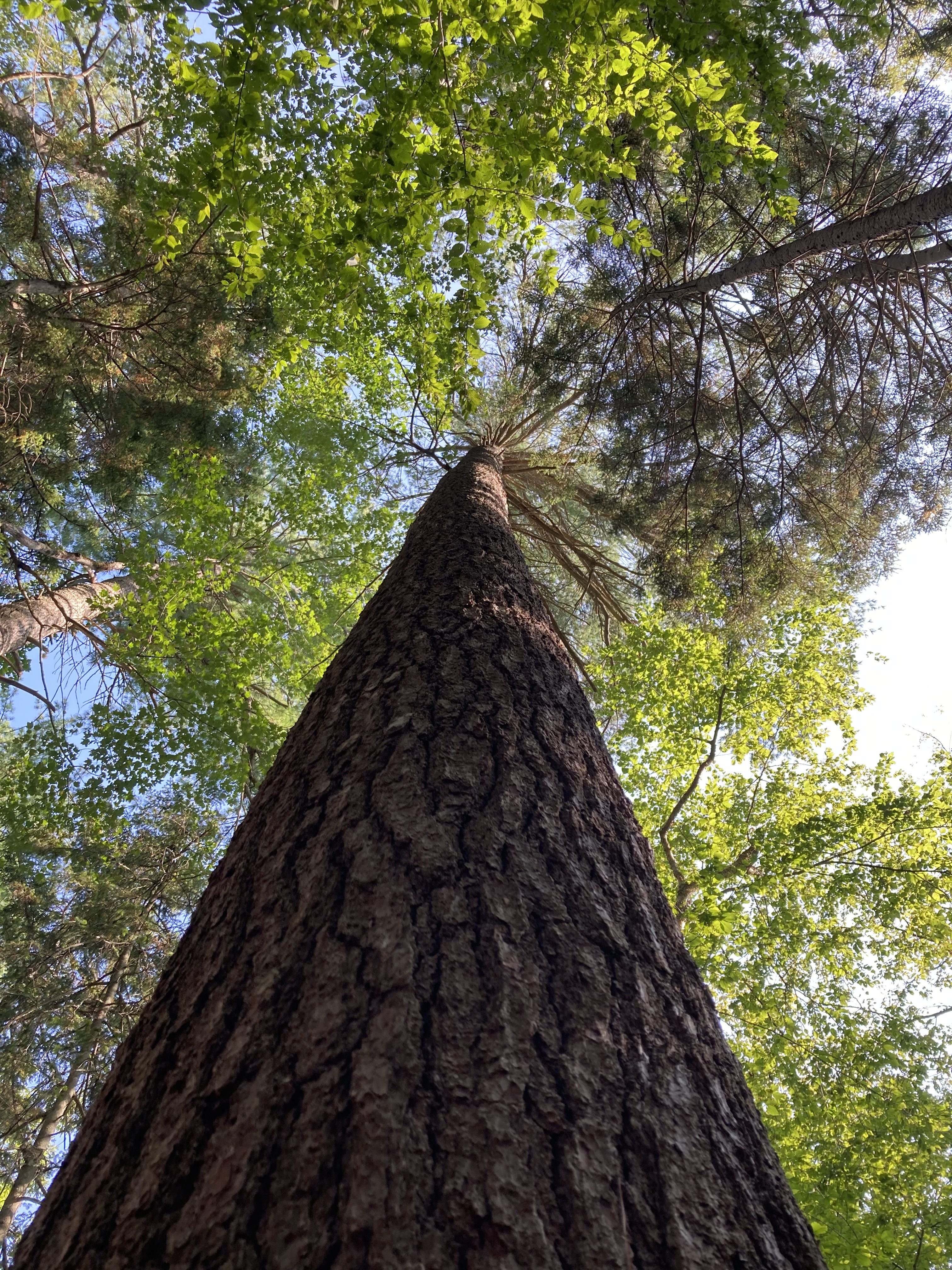
Every day, when I walk out, often into nearby woods, I find myself “visiting” one tree or another. For a while, I used to name the white pines — not Bob or Alice or Cam — but Big Fella or Rough Bark or Up There. That gave way to touching those trees, getting a feel for the bark and foliage; I left off imposing names.
One of our town walking trails works south toward the Town Commons, and for a few hundred feet it follows the outline of a small tributary that feeds into Coffin Ice Pond. Big-bodied white pines rise from this little wetland valley, and three of them are trailside presences. Always, in passing, I trail my palm across the vertical rough of the bark, and I say, “hello,” quietly. At other times, I pull over and settle in with one tree or another. On a hot, sunny day there may be shade; on a windy, cool day the pines are, as Thoreau once, wrote, “harps in the wind.”
The white pine was Thoreau’s favorite tree. I am, I realize, prone, perhaps too prone, to mentioning Thoreau, but after years of teaching (and so, rereading and rereading) his work, I find many passages and phrasings bending back and forth in my mind. They too have grown slowly, adding rings of meaning over time.
I wish to speak a word for trees, our town’s trees, the ones looking down or easing up among us. It’s timely, because we verge upon giving our town’s trees more standing by considering a tree ordinance and establishing a fund for their continued renewal. The ordinance is now scheduled to be introduced at the May 18 Brunswick Town Council meeting. Council will then set a date for a public consideration of and comment about the proposed ordinance.
At a recent conservation commission meeting, we heard from the town arborist, Dennis Wilson, and from two new commission members who recently transferred to our group from the former tree committee. For the past two years, Wilson and the tree committee have worked to write this ordinance that acknowledges the gifts we receive from trees and advances how we can help Brunswick trees thrive.
For Wilson and the tree committee, enumerating those tree-gifts was, as the following partial listing shows, easy to point to: protecting air quality, reducing excessive glare, creating cooling places when the heat is on, reducing noise nuisances, reducing topsoil erosion and stormwater runoff, preserving and enhancing habitat for wildlife, protecting and increasing property values, combating climate change through carbon sequestration, supporting privacy between neighboring properties, enhancing overall neighborhood aesthetics, and becoming culturally and historically significant over long lives.
Perhaps, as an adult, you too have a favorite tree, a tree you visit and whose slow pulse calms and connects you. The other day, near a walk’s end, I pulled over and sat backed by a huge white pine and watched Mere Brook ripple by. The wind called down from the pine; the brook offered its tinkling sound. I was among friends.
Sandy Stott is a Brunswick resident, chairperson of the town’s Conservation Commission and its Steering Committee for the Restoration of Mere Brook, and a member of Brunswick Topsham Land Trust’s board of directors. He writes for a variety of publications. He may be reached at [email protected].

The Times Record Sustaining Sponsor
We believe a community must be informed to thrive. bowdoin.edu
Comments are not available on this story. Read more about why we allow commenting on some stories and not on others.
We believe it's important to offer commenting on certain stories as a benefit to our readers. At its best, our comments sections can be a productive platform for readers to engage with our journalism, offer thoughts on coverage and issues, and drive conversation in a respectful, solutions-based way. It's a form of open discourse that can be useful to our community, public officials, journalists and others.
We do not enable comments on everything — exceptions include most crime stories, and coverage involving personal tragedy or sensitive issues that invite personal attacks instead of thoughtful discussion.
You can read more here about our commenting policy and terms of use. More information is also found on our FAQs.
Show less