


CUMBERLAND — In the big white church on Cumberland’s Main Street, nearly every member of the congregation raised a hand.
It was 2001, more than a decade before a referendum legalized same-sex marriage in Maine. The people filling the pews of the Congregational Church in Cumberland were voting to become “open and affirming,” a designation from the United Church of Christ for churches that vow to acknowledge and welcome LGBTQ+ individuals in all aspects of church life.
Cumberland was already the home of the first openly gay minister of any denomination in Maine. It became the seventh UCC congregation in Maine to make the declaration, a democratic choice that would reverberate in both the community and state for years to come.
Last month, nearly half of the congregation raised their hands again, identifying themselves as members who were present for that vote 25 years prior and still worship in the pews. The rest had joined since, some drawn to the church by its vocal acceptance.
“The change in a generation has been just breathtaking, that we would come as far as we have in this short of time, and in part thanks to leadership congregations like Cumberland UCC, who went out on a limb very early on and took a stand,” said Jane Field, executive director of the Maine Council of Churches.
‘OPEN AND AFFIRMING’
Churches and other religious communities have a long history of excluding LGBTQ+ people from their congregations and spiritual leadership roles, and, in many cases, causing them harm by promoting homophobia and their persecution.
Responding to political activism of the 1970s and 1980s by gay rights groups, many Christian denominations in the U.S. were forced to question their relationship with gay people, said Marvin Ellison, professor emeritus of Christian ethics at Bangor Theological Seminary.
“As long as there have been religious communities and faith leaders, queer folks have been there. But I think it’s been only relatively recently that they have been visible and vocal as LGBTQ+ people,” said Ellison.
The first openly gay minister in a mainstream denomination was ordained by the United Church of Christ in California in 1972. In 1985, the UCC national council urged its congregations to declare themselves “open and affirming” — a choice each church could make on its own.
Over the years, other Christian denominations changed their policies to be more welcoming to LGBTQ+ people, from the Episcopal Church in 1994 to the United Methodist Church in 2024.
In Maine, the first church of any denomination to be declared “open and affirming” was the Somesville Union Meeting House, UCC in Mount Desert in 1996.
Meanwhile, the push for LGBTQ+ rights swelled across the state. After rejecting it in an initial referendum in 2009, Maine voters legalized same-sex marriage in 2012.
Today, 73 of Maine’s 135 UCC churches have “open and affirming” declarations, and almost all are accepting of LGBTQ+ parishioners, said Marisa Laviola, the Maine conference minister for the United Church of Christ. Other Christian denominations and religious communities in the state have made similar affirmations.
Celebrating the anniversary of the 2001 vote at a service on May 17, parishioners in Cumberland rejoiced and told stories about what led to the decision decades ago. Scattered among the pews were dozens of pairs of rainbow socks and pens as keepsakes.
“It’s almost hard to reconstruct the mindset back 25-plus years ago when the church was thinking about it, because now it just seems like such an easy decision for the church to have made,” said Jim Bailinson, who has been a member of the Cumberland church for three decades.
“But it wasn’t at the time,” he said.
NOT THEM, US
Becoming “open and affirming” wasn’t the first time the Congregational Church in Cumberland made a choice about its relationship with the LGBTQ+ community.
In 1998, the congregation called Diane Bennekamper to serve as one of two ministers, making her Maine’s first openly gay minister.
After Bennekamper was ordained in 1974, she said, the Maine Conference of the UCC told her that she would not lead a church in the state because of her sexual orientation. Instead, she went to work at the Maine Human Rights Commission for 17 years and was involved in church life as an ordained layperson, serving as interim pastor at several churches in the 1990s.
When she saw that Cumberland was looking for two permanent co-ministers, she applied.
She made a promise to herself: She would only become a settled pastor if she was open about her orientation. She told the chair of the search committee, “you should know this about me.”
In UCC churches, which are non-hierarchical, the congregation makes all decisions for the church with a vote. After deliberations and some hesitancy, the people in the pews raised their hands to call her as one of Cumberland’s two new ministers. She went on to serve there for 21 years.
The outgoing minister, Dana Douglas, had encouraged the church to make an official “open and affirming” declaration. After calling Bennekamper to lead them, the congregation started to delve deeper into the process under the leadership of her co-minister Jack Bixby.
Parishioner John Chandler, who led a committee that discussed the designation, wasn’t sure about it at first. The church was already welcoming, he thought then, did it need to go through this process?
Some of the congregation were immediately in favor, while others were concerned how this statement would change the church. Chandler recalled someone asked him, “Are we going to have busloads of gays and lesbians from Portland and Boston?”
The congregants held a panel on who might be impacted. It changed the conversation, Chandler said.
“All of the sudden, ‘Woah, Nelly, wait a minute! We’re not talking about just the anonymous ‘they.’ We’re starting to talk about people from this church, kids who had grown up in the church, who went to Sunday school,'” said Chandler.
After crafting their statement, on April 1, 2001, the congregation voted “yes.”
OPEN DOORS
Over Bennekamper’s two decades as the church’s minister, she witnessed momentous progress for LGBTQ+ rights in Maine — after being together for over two decades, she and her wife could finally get legally married — and the long-term impact in the congregation.
“I look back at the number of families in the 21 years I was there who, at that time when that vote was taken, didn’t know that their families — their children — were going to be affected by that, in terms of being in a place that was open and accepting for them,” said Bennekamper.
Through the years, the congregation continued to expand what it means to foster LGBTQ+ acceptance and participation in the church, said Allison Smith, who took Bennekampers’ place as the church’s minister when she retired in 2019. Each June, Congregational Church in Cumberland holds a Pride worship service in partnership with Tuttle Road Community Church.
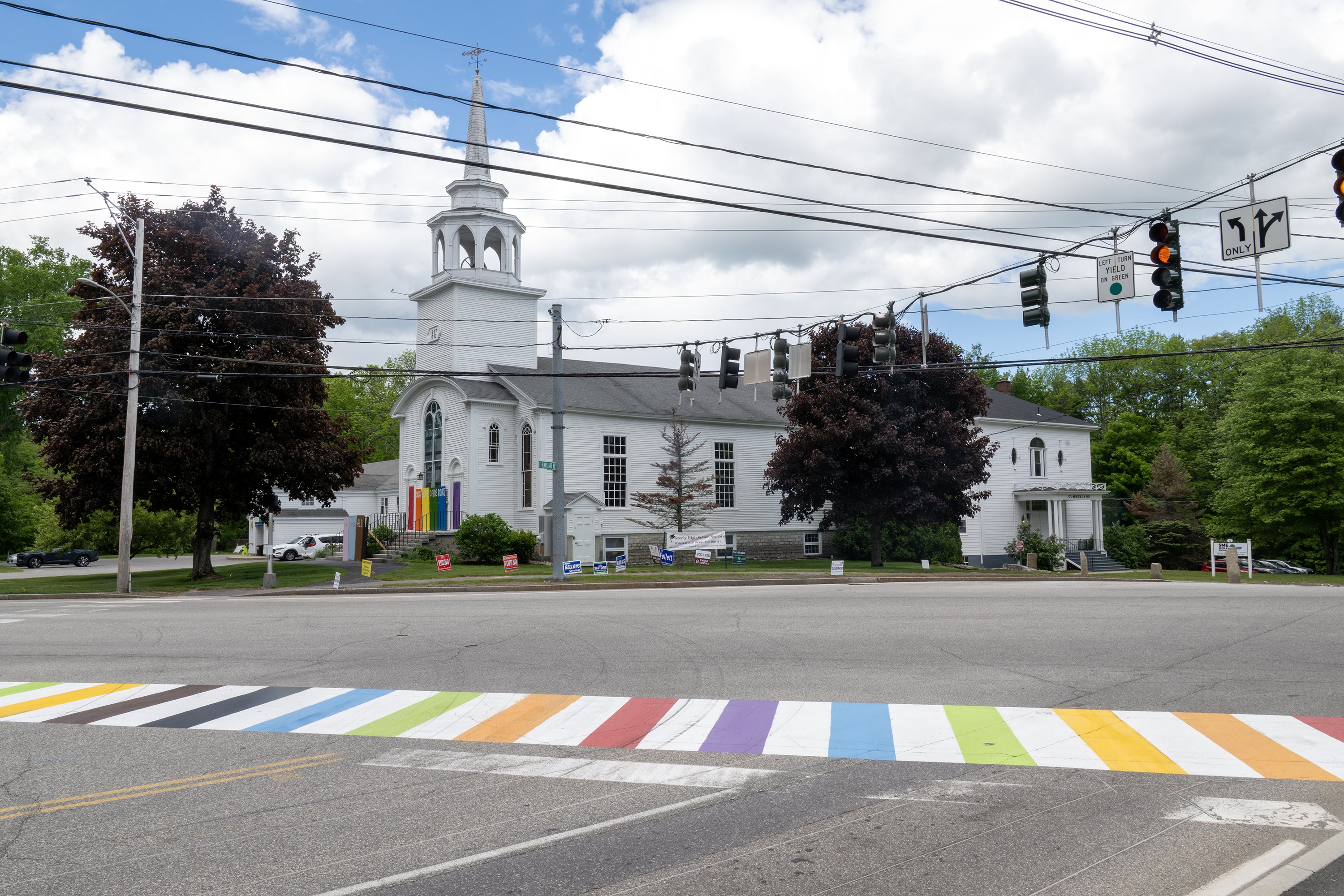
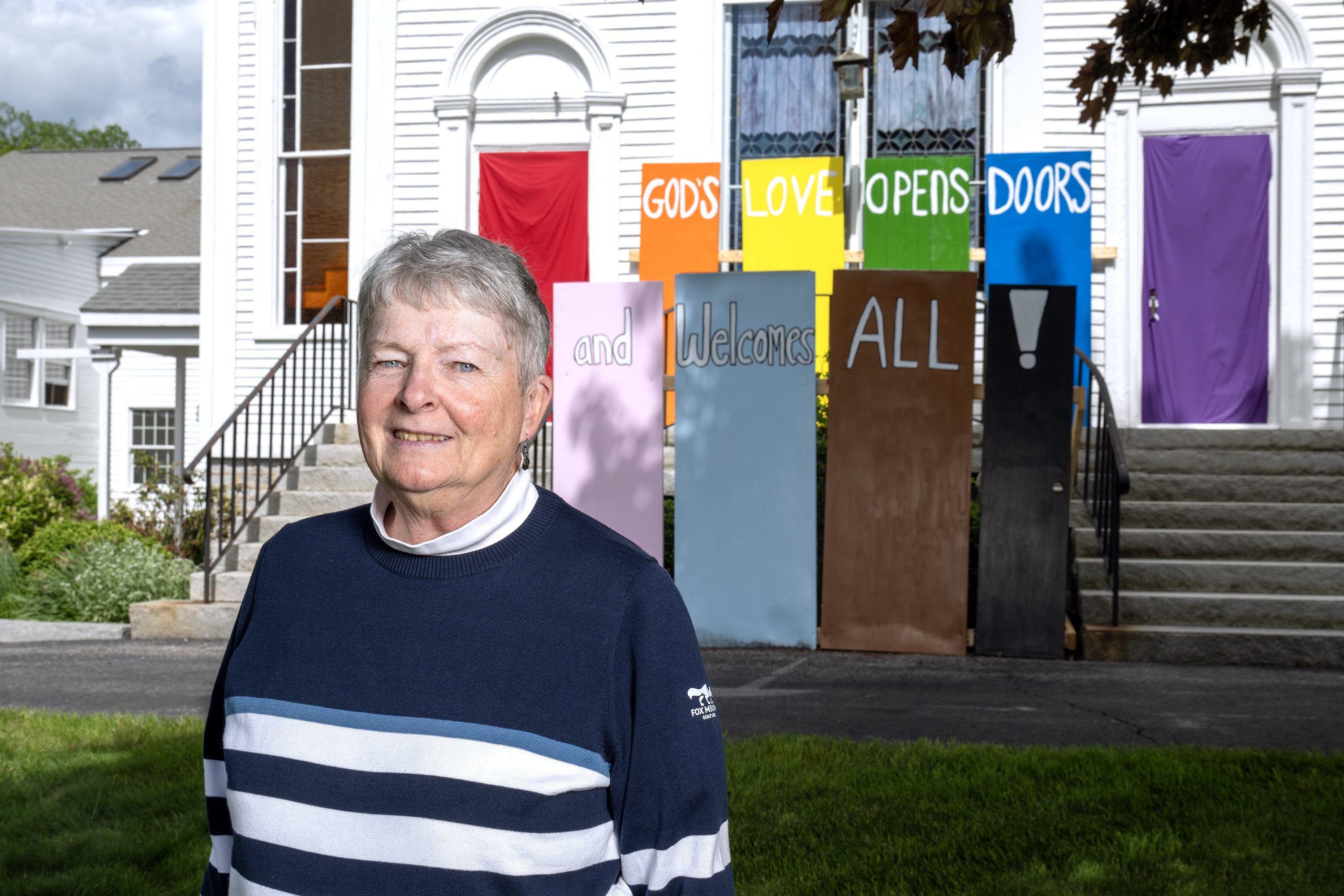
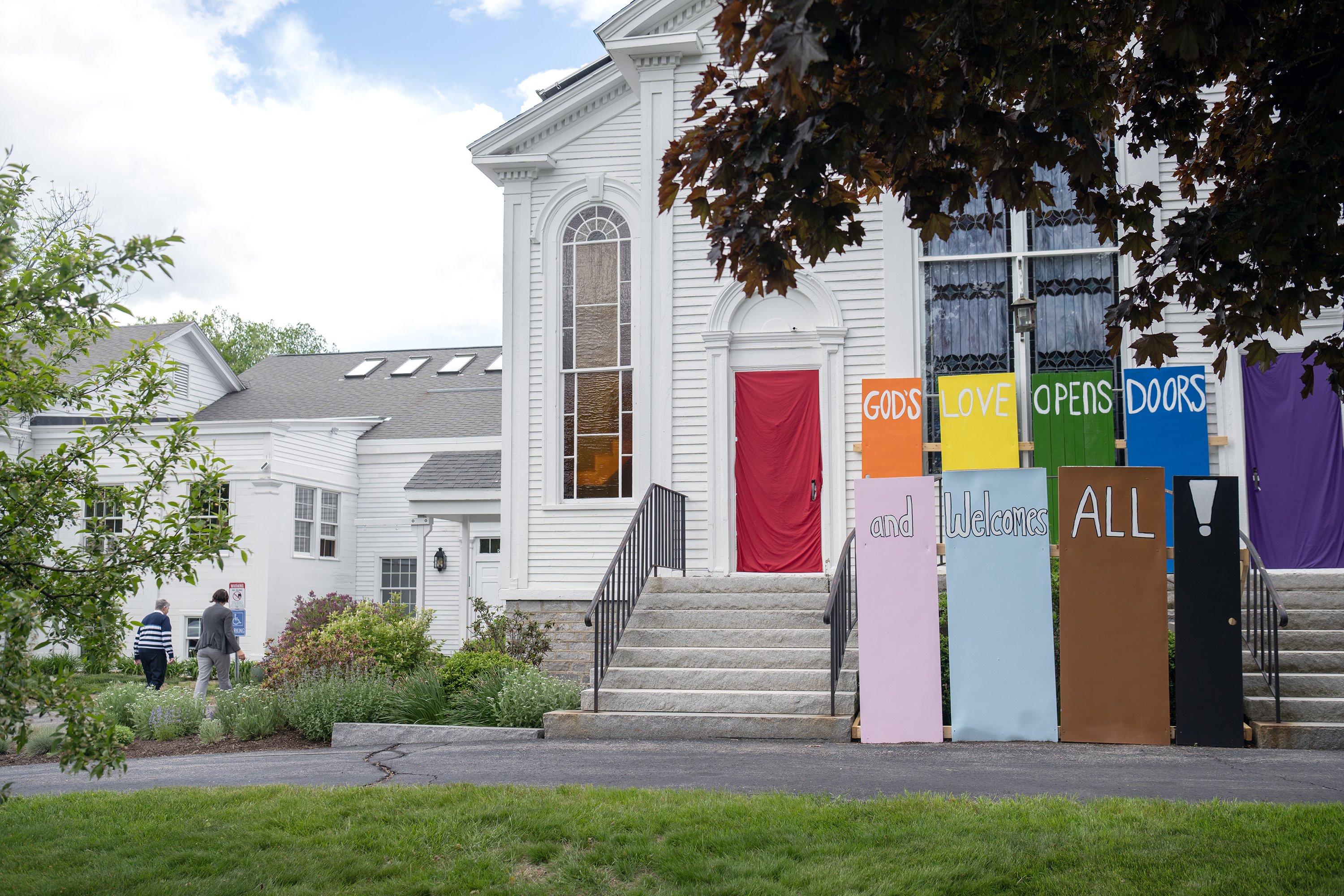
This month, for the 25-year celebration, the church also propped up eight doors, each a color of the rainbow, in front of the church, painted with the words “God’s love opens doors and welcomes all!” The display overlooks one of Cumberland’s busiest intersections that now also features a rainbow crosswalk backed by the church.
“It’s important for us to, when there’s so many negative impressions of church and faith, for us just to be bold and share God’s love,” said Smith.
As the struggle for LGBTQ+ rights and dignity take new forms with attacks on transgender people and particularly transgender youth, the accepting message of the church must remain loud, loving and clear, said Smith.
Since 2001, the “open and affirming” statement, as with the dozens like it now in churches across Maine, has drawn new parishioners through its doors.
Cumberland resident Gail Marine, 66, joined the church in 2024. One of her adult sons is transgender, and the congregation’s early and continued commitment to welcoming everyone spoke to her, she said.
“From the minute you open the door, the church is open and accepting of everything,” said Marine. “It makes the LGBTQ community just people in our community.”

Comments are not available on this story. Read more about why we allow commenting on some stories and not on others.
We believe it's important to offer commenting on certain stories as a benefit to our readers. At its best, our comments sections can be a productive platform for readers to engage with our journalism, offer thoughts on coverage and issues, and drive conversation in a respectful, solutions-based way. It's a form of open discourse that can be useful to our community, public officials, journalists and others.
We do not enable comments on everything — exceptions include most crime stories, and coverage involving personal tragedy or sensitive issues that invite personal attacks instead of thoughtful discussion.
You can read more here about our commenting policy and terms of use. More information is also found on our FAQs.
Show less