


Thornton Academy and the Saco School Department have reached a deal.
The Saco School Board unanimously approved the contract at a meeting Tuesday night, nearly a week after a conflict became public and more than 100 people attended a school board meeting amid the contentious negotiations.
Thornton is a town academy, a private school that serves public school students through a 200-year-old agreement with the city of Saco. The two parties were in the midst of negotiating their next contract, and both the school and district had said they want to maintain their longstanding relationship, despite points of disagreement.
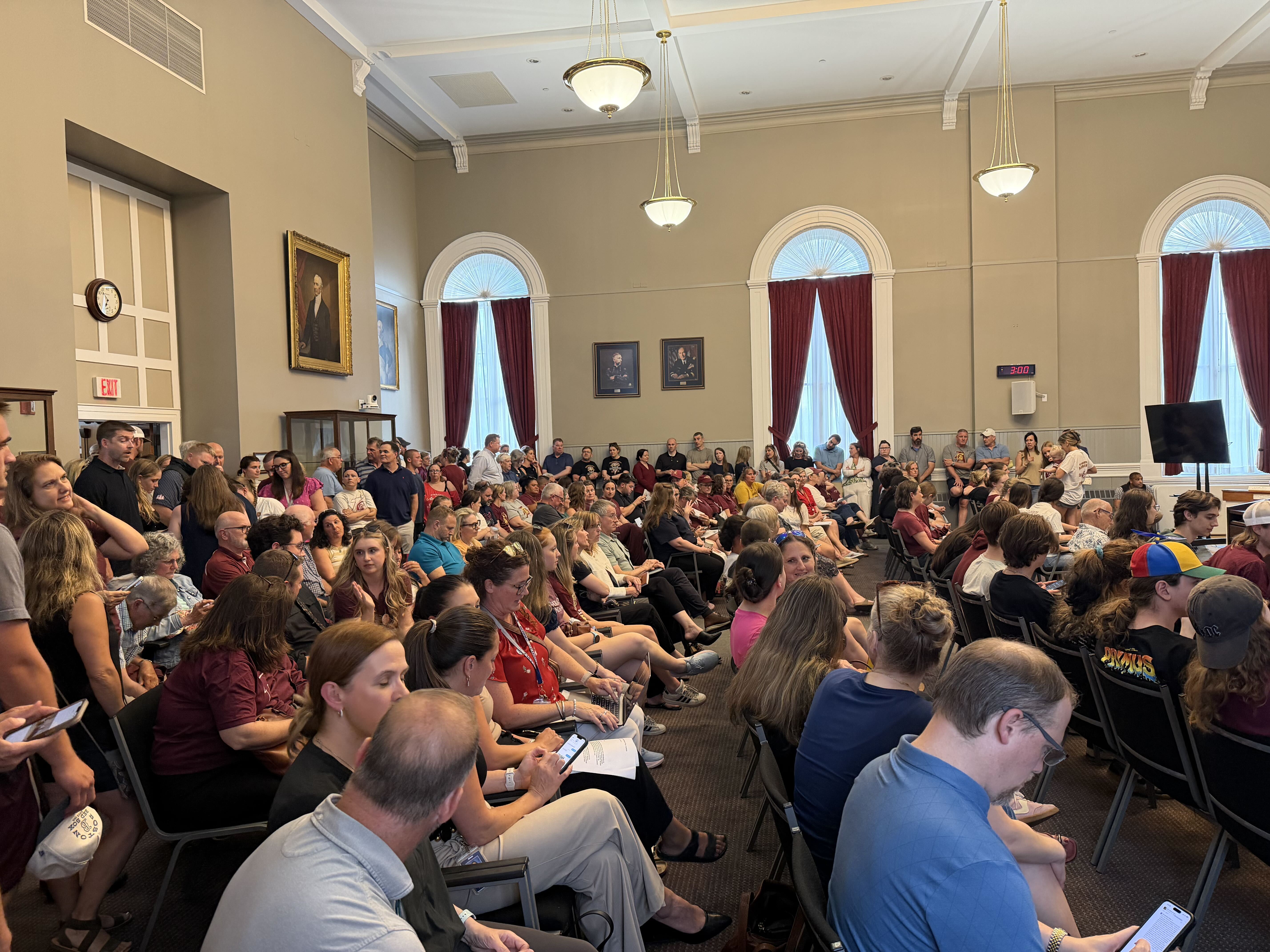
That relationship appeared to be at risk following a public statement from the school’s headmaster last week, leading up to the current contract’s end date of June 30. Headmaster Rene Menard told families the district had “drawn a line in the sand” close to the end of the window to secure a new agreement.
However, the district said the contract was not in jeopardy and that there were just two major sticking points remaining, which leaders explained in detail at the well-attended school board meeting.
The private school and district announced the agreement in a joint statement posted to both Thornton Academy and Saco Schools’ social media pages Tuesday evening.
“While there were challenges along the way, the outcome of these contract negotiations provides a foundation for continued partnership in support of Saco families today and into the future,” the joint statement said. “Negotiations are rarely easy, but we were able to accomplish a great deal for Saco students — securing stability in our continued partnership between Thornton Academy and the Saco School Department, and ensuring free lunch for all Saco students, PK-12.”
The two sides had been at odds over the length of the contract. The academy wanted a five-year deal because of its master and financial planning schedules — and a history of five- or 10-year deals — while the school district wanted a three-year deal with an option for two additional years to provide some flexibility.
They settled on a five-year deal, ending June 30, 2031.
Another sticking point had been language on superintendents’ agreements, which allow students to change school districts.
Previously, the headmaster was responsible for such agreements, even though in most districts that decision falls to the superintendent. However, even though Saco now has its own superintendent (the city was at one point part of a regional school unit), Thornton Academy still wanted to have a say.
Superintendent Jeremy Ray explained at the board meeting last week that the school and district had yet to come up with a way to deal with situations when the superintendent and headmaster disagree on whether a student should go to a different school.
School board Chair Sarah Truman said at Tuesday night’s meeting that the new language on superintendents’ agreements seems “fair.”
“These agreements never allow Saco students full choice,” she said, and the language reflects it being “a team decision.”
“If no decision is reached,” Truman added, “the students will stay.”
Free school lunches for all Saco students, which are also secured in the contract, had previously been a subject of dispute. While the district was adamant that provision be included, Thornton Academy insisted on maintaining independence from federal funding, which supports universal school meals statewide.
The academy ultimately decided to foot the bill for the lunches, and the two parties agreed on that item in early June, according to the district, prior to negotiations spilling into the public sphere.
“As we move forward together, we do so with gratitude and renewed purpose,” the joint statement said. “This agreement provides the stability needed for both the school department and the academy to focus our attention where it belongs — on our students and the excellent education that Saco families have come to expect from Saco’s public schools and Thornton Academy.”
Staff Writer Riley Board contributed reporting.

Comments are not available on this story. Read more about why we allow commenting on some stories and not on others.
We believe it's important to offer commenting on certain stories as a benefit to our readers. At its best, our comments sections can be a productive platform for readers to engage with our journalism, offer thoughts on coverage and issues, and drive conversation in a respectful, solutions-based way. It's a form of open discourse that can be useful to our community, public officials, journalists and others.
We do not enable comments on everything — exceptions include most crime stories, and coverage involving personal tragedy or sensitive issues that invite personal attacks instead of thoughtful discussion.
You can read more here about our commenting policy and terms of use. More information is also found on our FAQs.
Show less