
Phyllis Chinlund of Cumberland Foreside, whose late husband’s struggle with Alzheimer’s disease inspired her to write a book, “Looking Back from the Gate: A Story of Love, Art, and Dementia, ”will talk at the Freeport Community Library at 6:30 p.m. on Wednesday, Oct. 12.
Chinlund will draw from the perspective of her two careers – geriatric social work and documentary film director and editor. She dealt with the cognitive decline of her husband, photographer Ray Witlin, until his death in 2002. She used journal entries, photographs, letters and recorded conversations to write the book.
“Back in 1965 I moved to New York City with my first husband and a master’s in documentary film at Stanford University,” she said. “I was thrilled to be living in New York. I had been born there but my parents moved in Pittsburgh when I was 4 years old.”
For more than 20 years, Chinlund directed and edited films.
“Meanwhile,” she said, “I changed partners after a love affair with Ray Witlin, a filmmaker and photographer who became my second husband. Then I made another change, this time to a new career. Obtaining an (master’s of social work) degree in 1989, I specialized in geriatric mental health. Is that strange? Ray was 19 years older than me. I guess I’ve always liked older people.”
They came to Maine in 1998 from New York City.
Chinlund answered questions on her book and her devotion to her late husband for the Tri-Town Weekly.
Q: At what point did you decide to write “Looking Back from the Gate?”
A: “Looking Back from the Gate: A Story of Love, Art, and Dementia,” grew out of a journal I kept during the years that we figured out how to keep Alzheimer’s from ruining our lives. It wasn’t until 10 years after Ray’s death that I decided to return to the journal and build it into a book. The book was completed and published in April.
Q: Was writing the journal helpful to you?
A: Writing the journal was not only helpful. It was vital. I didn’t have any family close by for support, and friends didn’t always see what the problem was, so I did a lot of consulting with myself that way. I highly recommend journal writing to anyone going through a period of crisis and difficult decision-making. Writing the book, I revived my skills in documentary film and wove together the journal with Ray’s photographs, letters he had written during his foreign travels when he was healthy, and reports from the helpers I hired in Maine to keep him connected to photography and the arts.
Q: Tell us of the challenge in moving to Maine.
A: When I realized we could no longer afford to live in New York without Ray earning money, it was scary. The first part of the book describes some of the roller-coaster of doubts about the future, while Ray’s cognition was daily deteriorating. He was bored, had no interest in photographing urban scenes, and made frequent trips to the local wine store. If I sold our co-op apartment, we would have enough money to buy a house in a less expensive location. But where? It was like following a trail while the ground keeps changing underfoot. It dawned on me that I have always loved the Atlantic coast. I learned that Portland had everything – nature, culture, affordable real estate (this was 1998), helpers for Ray and employment for me. As soon as we arrived, Ray got out his cameras and began exploring the natural world. Now I think of the move to Maine as our salvation.
Q: How can this book help others? Would you care to advise others in your situation?
A: “Looking Back” is not a how-to-do-it book, but people doing caregiving, whether for dementia or other conditions, are finding it helpful because it shows that by trying to stay flexible we managed to live full lives. For us that meant that I would keep working, Ray would enjoy creative activity, and most important we would keep on loving each other. Mind you, there were lots of stumbling blocks, some humorous and some sad, but in the end it was a rich experience that I’m not sorry I lived through.
Q: How often do you make these presentations, and where?
A: There’s no regular schedule, but I’ve been pretty busy. There’s information about events on my website, www.phyllischinlund.com. I love offering the book to interested people and will happily go anywhere to do that. In libraries I have a PowerPoint presentation with some of Ray’s photos. For support groups and other smaller venues I have a more interactive approach which can lead to good discussions. I’m incorporating information about new approaches to treatment that I stumbled on before they were officially discovered. I’d like to add that a lot of people who have no connection to Alzheimer’s disease have praised the book. They like the writing, the photographs, and the love story.
Q: What are your fondest remembrances of Ray?
A: Well, that’s a hard one. There are so many. We really had a good marriage because we always worked things out when we got mad at each other. But OK. Leaving out the sexy parts, I fondly remember our long conversations. I’ll quote from the book: “As we went our separate ways with our work, our lives continued to converge at mealtimes: 25 years of breakfasts and dinners blend into a single scene. We are sitting at our dining table overlooking the rooftops and water towers of upper Manhattan. The sun is rising or night is falling. Long after we finish our meal, we still sit talking. About our friends, the movies we saw, how the universe began, whether there is life after death …”
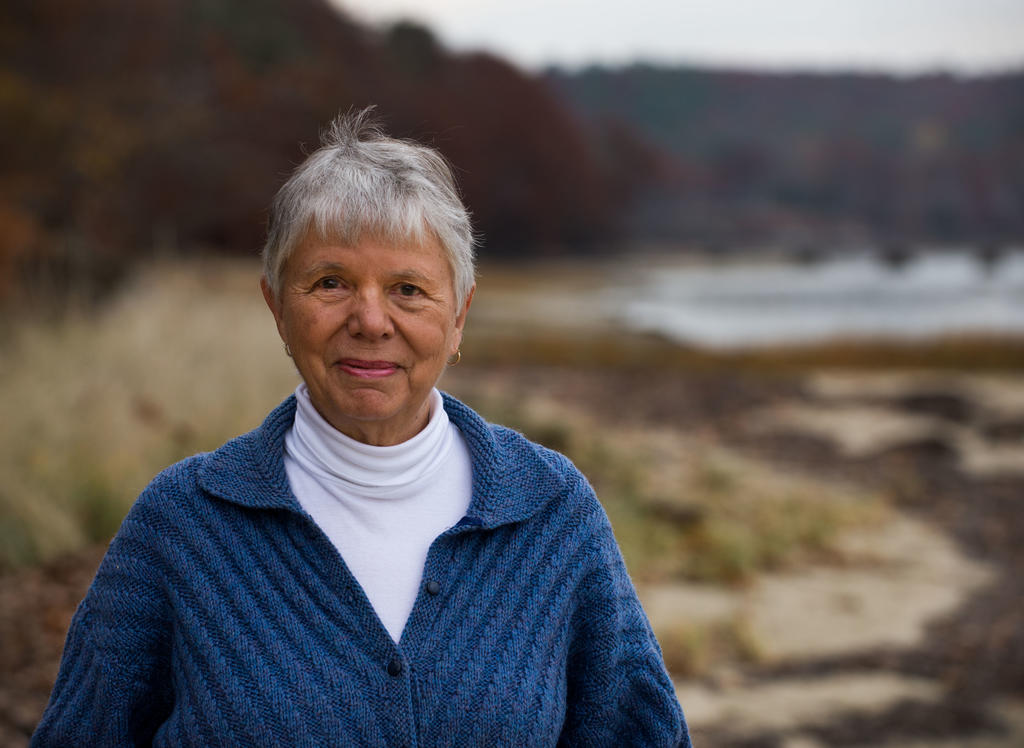
Phyllis Chinlund of Cumberland Foreside will speak about her book, “Looking Back from the Gate: A Story of Love, Art, and Dementia,” on Wednesday, Oct. 12, at the Freeport Community Library.
A closer look
Author Phyllis Chinlund speaks on her memoir, “Looking Back from the Gate: A Story of Love, Art, and Dementia,” Wednesday, Oct. 12, at 6:30 p.m., at the Freeport Community Library.
The library will also host a program, “The Basics of Alzheimer’s,” Monday, Oct. 17, at 6 p.m. Freeport Community Library. Mark Pechenik of the Maine Chapter of the Alzheimer’s Association will present the program, which is for anyone who would like to know more about Alzheimer’s disease and related dementias.
Comments are no longer available on this story