
Owling
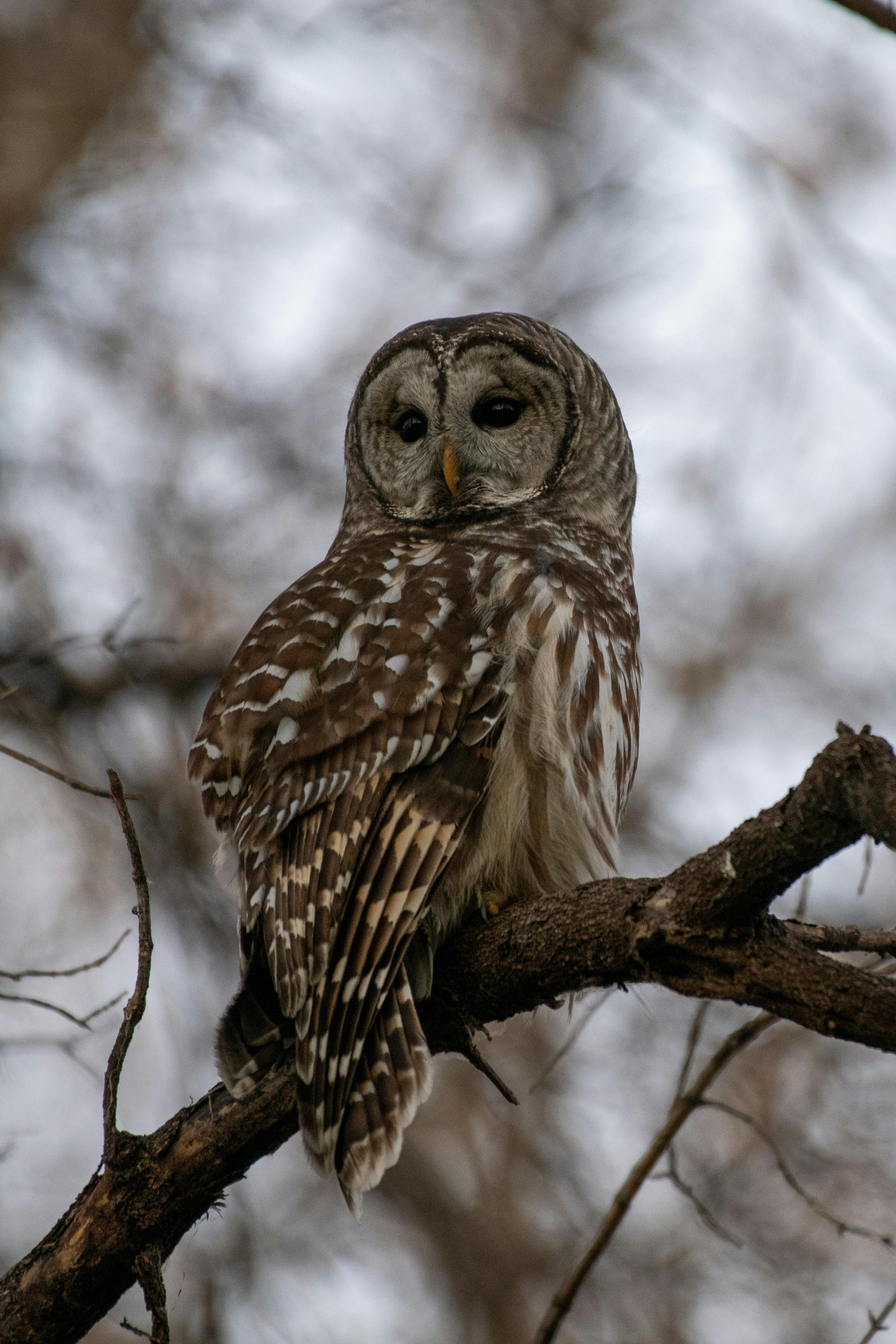
Spring nights seem to gather with an intensity unlike the year’s remainders. Everyone’s out there looking for mates, and perhaps it’s also the compression of that night, pressed in from either side by light and its various shades. If, for example, you are a night hunter, there’s no time to waste.
And so at this hour — 1 a.m., post first-sleep — the local barred owl is insistent with his owling announcement. Listening through the open window, I count the beats between tonight’s hoots, which are two and elongated, different from the usual two four-hoot sequences often represented by “Who cooks for you; who cooks for you?”
Even here, by the window but inside, the remnant fur rise on the back of my neck. If I were a night scamperer, I’d freeze, wait for the next two-hoot and try to figure … was that one closer?
The local out there
As we neared May’s end, it was also the end of the Himalayan silly season, that narrow slice of time before the monsoon makes already extreme weather impossible for climbing. And in the various base camps beneath the planet’s grandest mountains, especially Mount Everest, expeditions are arranged like little summer camps for adults. I say this because most of the climbers there are with commercial expeditions led by guides who function as counselors — they make all the decisions, set the schedules, assess the ground and sky before them. And the “campers”? They follow along, plod and haul themselves, or are guide-hauled through unimaginable weather and terrain; occasionally, often in clusters, they even lose their lives — it is after all an extreme camp. But mostly, they do as they’re told. Some come back having “climbed” to the world’s highest summit.
It is also the 30th anniversary of the guided Everest climbs and deaths chronicled in John Krakauer’s “Into Thin Air.” Recently, a friend sent me link to a YouTube interview, where the now 72-year-old Krakauer looked back, often with deep regret, on that May 1996 tragedy in that thin air. “I wish I’d never gone,” Krakauer says at one point, even as his book made him famous and is still read avidly by thousands.
The day of this writing, at noon and under the springiest of skies, I stepped from my door and set out on foot for local woods. I had in mind mostly trails softened by recent rains. These are also mostly level, known trails, so it wasn’t long before I’d fallen into a lulling cadence and my mind had drifted free. I had mountains on my mind, mostly from my habit of carrying a topo map with me for those spare moments when I’m waiting for something — an appointment, a friend, a pizza. My maps usually feature the White Mountains or local USGS quadrangles, but recently, the Himalayas have been in my pocket.
Perhaps that’s because I’ve been thinking about the long ago, when my parents realized a lifelong dream and walked 175 miles from Kathmandu to the Base Camp of Everest, took in those awesome uplands from 16,000 feet (took hundreds of photos, too) and then walked the 175 miles back to Nepal’s capital. I was in high school at the time and relieved to be allowed to stay there. And, of course, they brought back maps, which I read avidly, along with the mountain books my mother collected. For my parents, an essential part of the dream was walking the Himalayan landscape and approaching Everest under their own power. Yes, they had a Sherpa guide and small party of porters, but this was well before the trekking era set in; only sporadic expeditions of real mountaineers or oddball dreamers visited in those days.
For some reason, around that time, and despite a fascination with and affinity for the upland world, it became clear to me that I was happy confining far-flung mountainscapes to maps, that I liked my near-flung woods and hills enough for a lifetime. And that, unlike many of my younger self’s convictions, has held.
I have, over the years, found expression for the deep local travel that I had intuited as a teenager. It now seems to me that where I walk and run is all one landscape, and that, when I trace the contours on one of my maps, I can recall that foot-tracery on nearby trails.
One day last midwinter, I was looking out at the roof-dumped snow just beyond a plate glass door; up its vertical ice, a cold-stunned fly was climbing, making his way higher across the seracs and up the gullies. Surely, that fly was on his own Everest; it was nearby.
So, too, is mine. No need to hire planes and outfitters, no need to arc across the world; just unfold the local quadrangle and aim for those two bunched contours you’ve never visited … or the ones that puddle like silk dropped to the floor. They all run together underfoot.
Sandy Stott is a Brunswick resident, chairperson of the town’s Conservation Commission and its Steering Committee for the Restoration of Mere Brook, and a member of Brunswick-Topsham Land Trust’s board of directors. He writes for a variety of publications. He may be reached at [email protected].

The Times Record Sustaining Sponsor
We believe a community must be informed to thrive. bowdoin.edu
Comments are not available on this story. Read more about why we allow commenting on some stories and not on others.
We believe it's important to offer commenting on certain stories as a benefit to our readers. At its best, our comments sections can be a productive platform for readers to engage with our journalism, offer thoughts on coverage and issues, and drive conversation in a respectful, solutions-based way. It's a form of open discourse that can be useful to our community, public officials, journalists and others.
We do not enable comments on everything — exceptions include most crime stories, and coverage involving personal tragedy or sensitive issues that invite personal attacks instead of thoughtful discussion.
You can read more here about our commenting policy and terms of use. More information is also found on our FAQs.
Show less