

Summer’s in full swing, which means art is everywhere in Maine. There are so many shows and such great variety to be found at this time of year that it’s impossible to get to it all. So, this week and next we’ll abandon any grand overarching themes and, instead, offer groupings of short reviews to try and cover more territory.
INTERLOC
“Jenna Ransom: Greetings,” through July 25, 153 Main St., Thomaston. For more, go to interloc.co or email [email protected]
I’ll be honest: Generally speaking, I am averse to heart shapes in paintings. I don’t even usually give Jim Dine a pass on that one. They just feel too pop to me. But something about the way they mix with fauna and flora — and a sprinkling of other pop imagery — in Jenna Ransom’s paintings made them more palatable. That’s quite a feat in my book (sort of like succeeding at making swarming armies of rats look cute in the Disney Pixar movie “Ratatouille”).
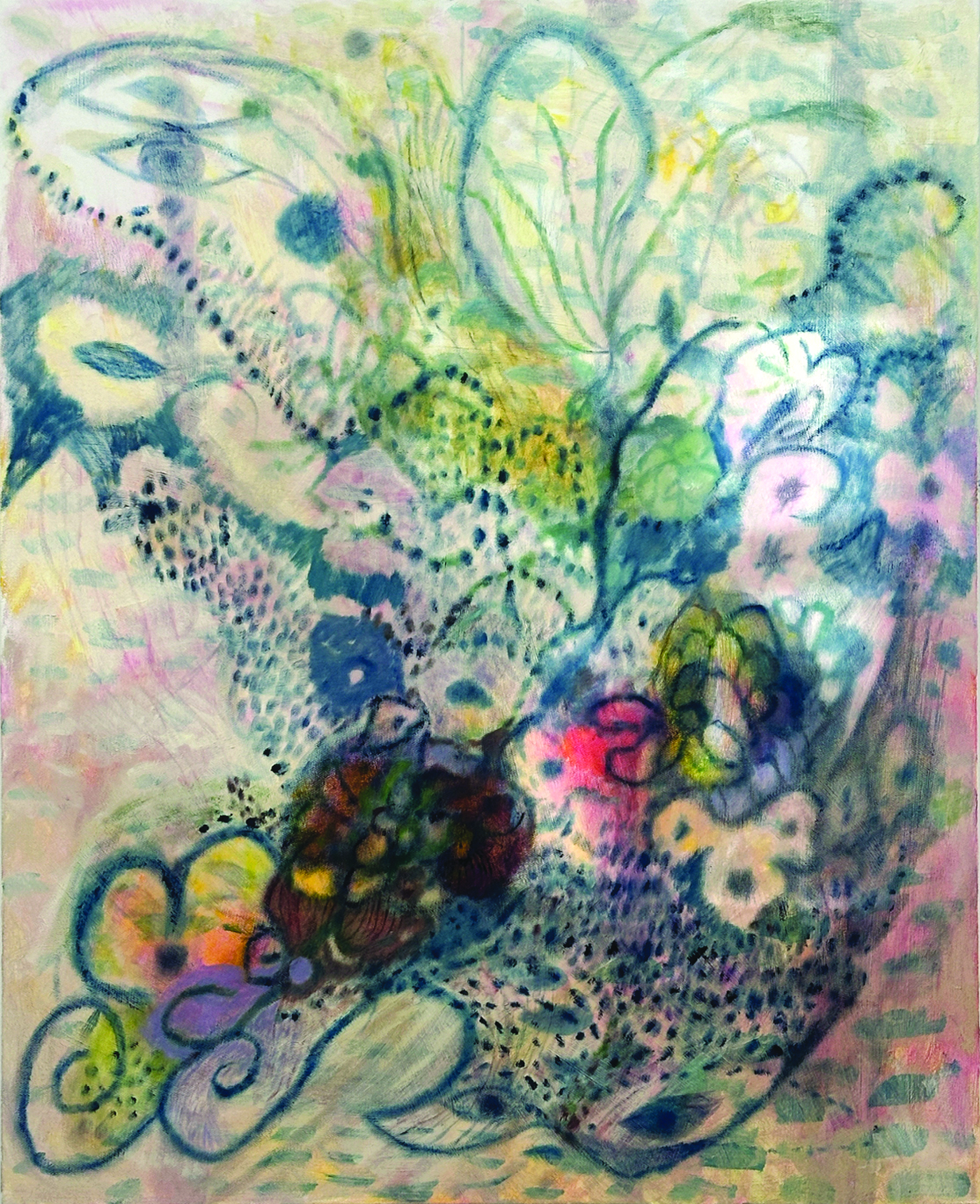
That’s because Ransom’s paintings feel bewitching and enchanted. They are created mostly in a pastel palette (also not my favorite unless it’s deployed with irony) that conveys a sense of having been conjured in some sort of trance state. The many layers of paint altering with washes (both white and black, but mostly white), make them feel hazy and blurred, which evokes a disorienting unsteadiness in us. We may feel woozy, as if the effects of some potion Ransom has administered are finally overtaking our nervous system.
They are unabashedly romantic and soft, filled with flowers, butterflies, eyes, what look like strings of pearls, leafy and spore-like forms. Even the titles can sound woo-woo: “Eternal Shell of the Mind,” “She Dreams of Night,” “Heart Beats Fast.” I attribute the fact that all this does not grate on my sensibilities to Ransom’s tremendous drafting skills, the sense of fluidity they embody and the many layers we seem to be looking through. All this creates complexity and perplexity, both of which stimulate curiosity and searching.
OCEAN HOUSE GALLERY
“Open Forms,” through July 25, 93 Ocean St., South Portland, oceanhousegallery.com. For more, call 207-956-1988
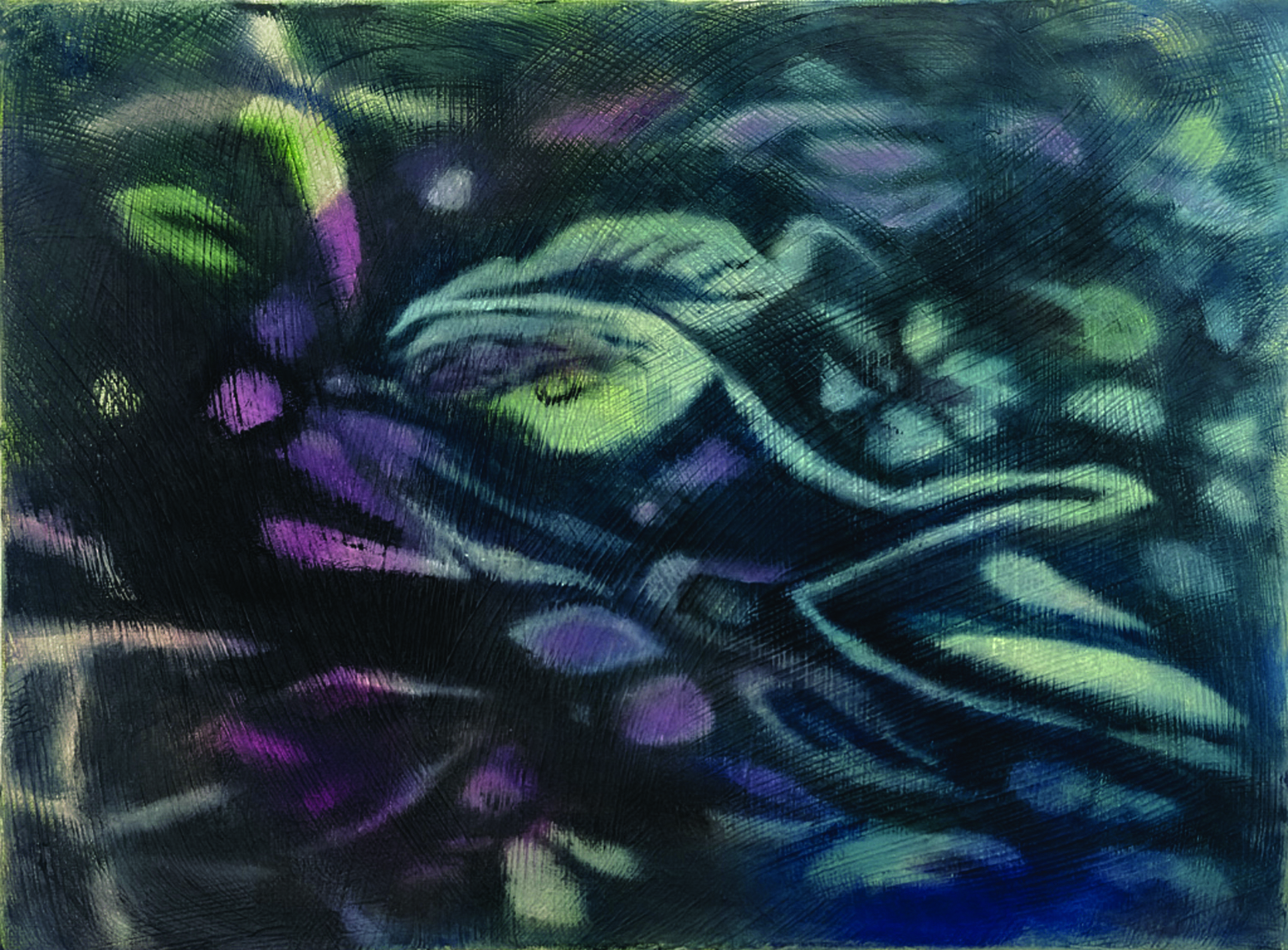
This small gallery and frame shop is ground central this month for non-objective painting. Curated by Munira Naqui, it brings together works on paper by an international roster of 16 artists with whom she has exhibited around the world at one time or another.
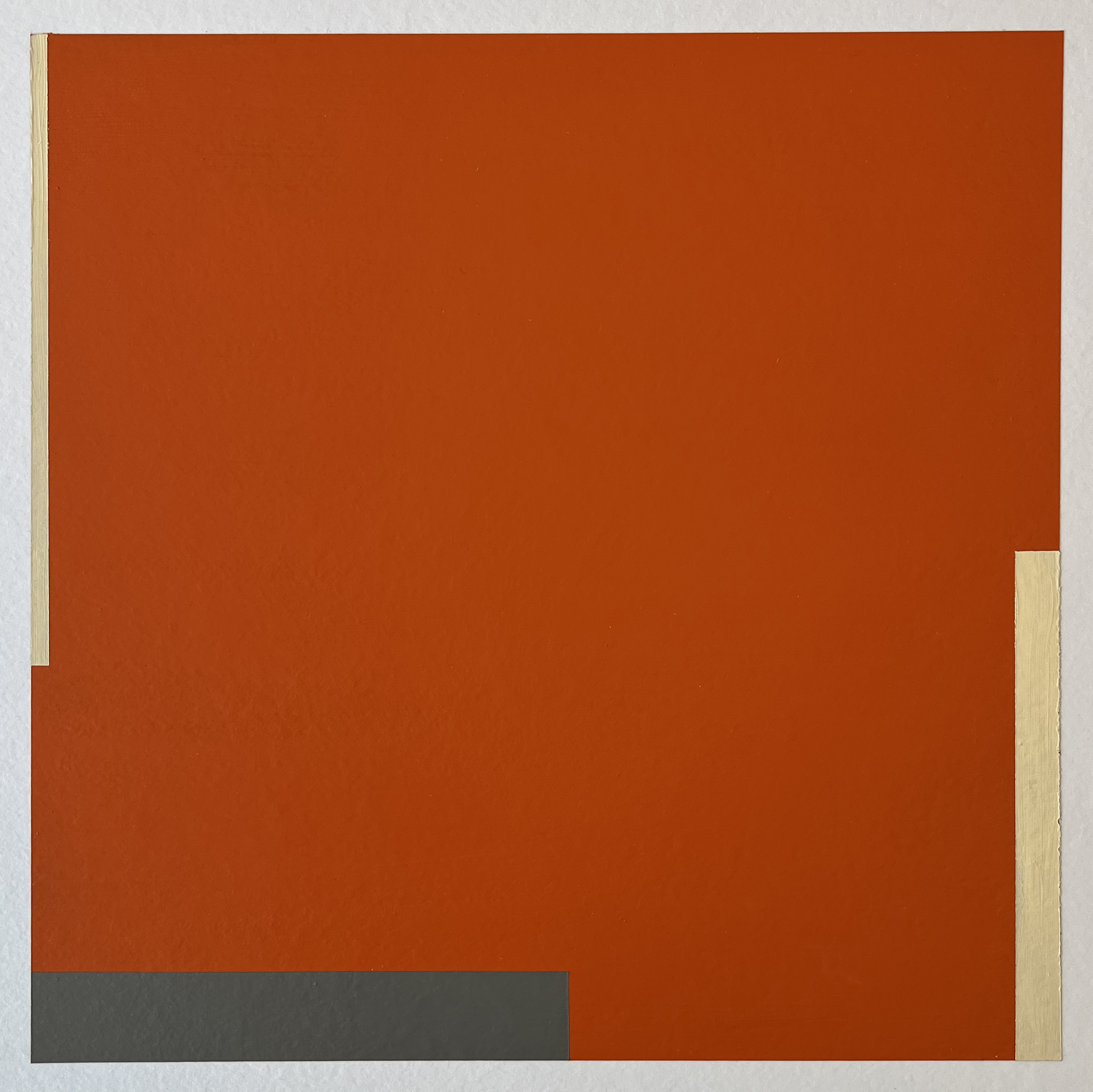
Naqui’s own work (“Untitled”) reflects what she has described as her life on the edges. Always feeling like an outsider, even in her native Bangladesh, her paintings feature bands of color around (and partially enclosing) another single ground color. It is the perimeter that has the privileged view on the entire enormity of life in a way obscured to an “insider.”
Several works by French artists play with our perception similar to how Optical Art did in the 1960s. Mehdi Sioud’s “Kalila” pairs perforated mirrored paper with another layer of black perforated paper suspended above it in a shadow box, placing obscuration and reflection in a tense, ever-morphing relationship. Milija Belic creates “Cubes,” which seems straightforward enough until we realize they manifest a confusing array of angles that, the catalog reads, “invite the viewer to question their usual points of reference.” And Delnau’s “No. 625” will have your eyes zooming in and out, left and right, up and down in a futile quest to bring perspectival order to his dizzying felt-tip drawing.
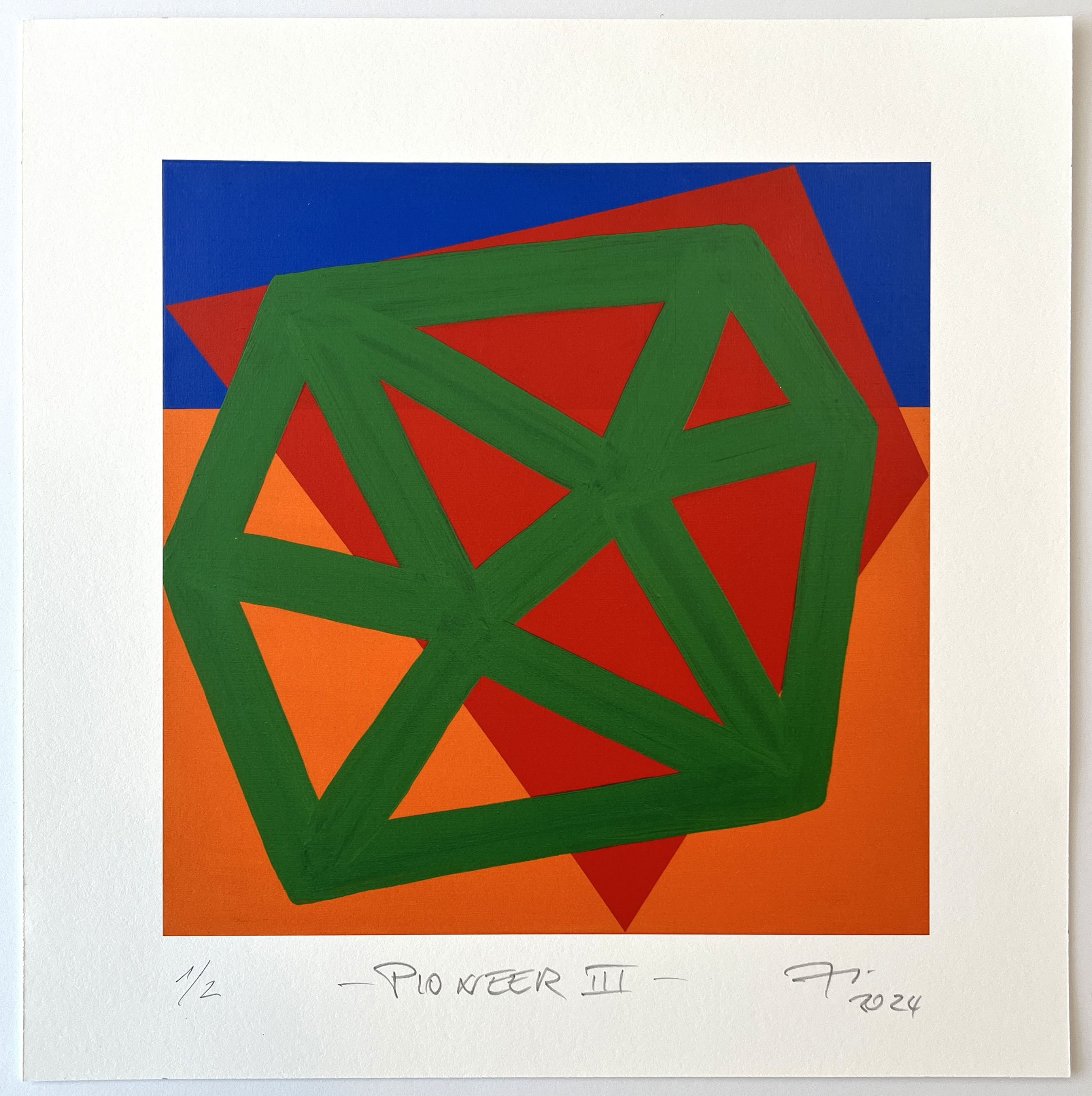
There are works that rely on graphic geometric line to explore ideas. German artist Ivo Ringe’s “Pioneer III” layers rectangles of orange and blue and a red trapezoid under a green hexagon to question how we perceive structure. Turkish painter Erdem K. Köroglu uses continuous lines to limn geometric forms that also harken to his culture’s ornamental and calligraphic art.
CALDBECK
“Jeff Epstein,” through July 31, 12 Elm St., Rockland, caldbeck.com. For more, call 207-594-5935
Jeff Epstein studied with the legendary Lois Dodd, and it has always been apparent to me that he profited much from her instruction in terms of technique. However, whereas Dodd’s work seems matter-of-factly observed, with no subliminal messages, Epstein’s paintings dwell in a kind of clash between what is natural and what is manmade. These two things aren’t always in opposition, of course, but often the relationship between them feels tentative to say the least.
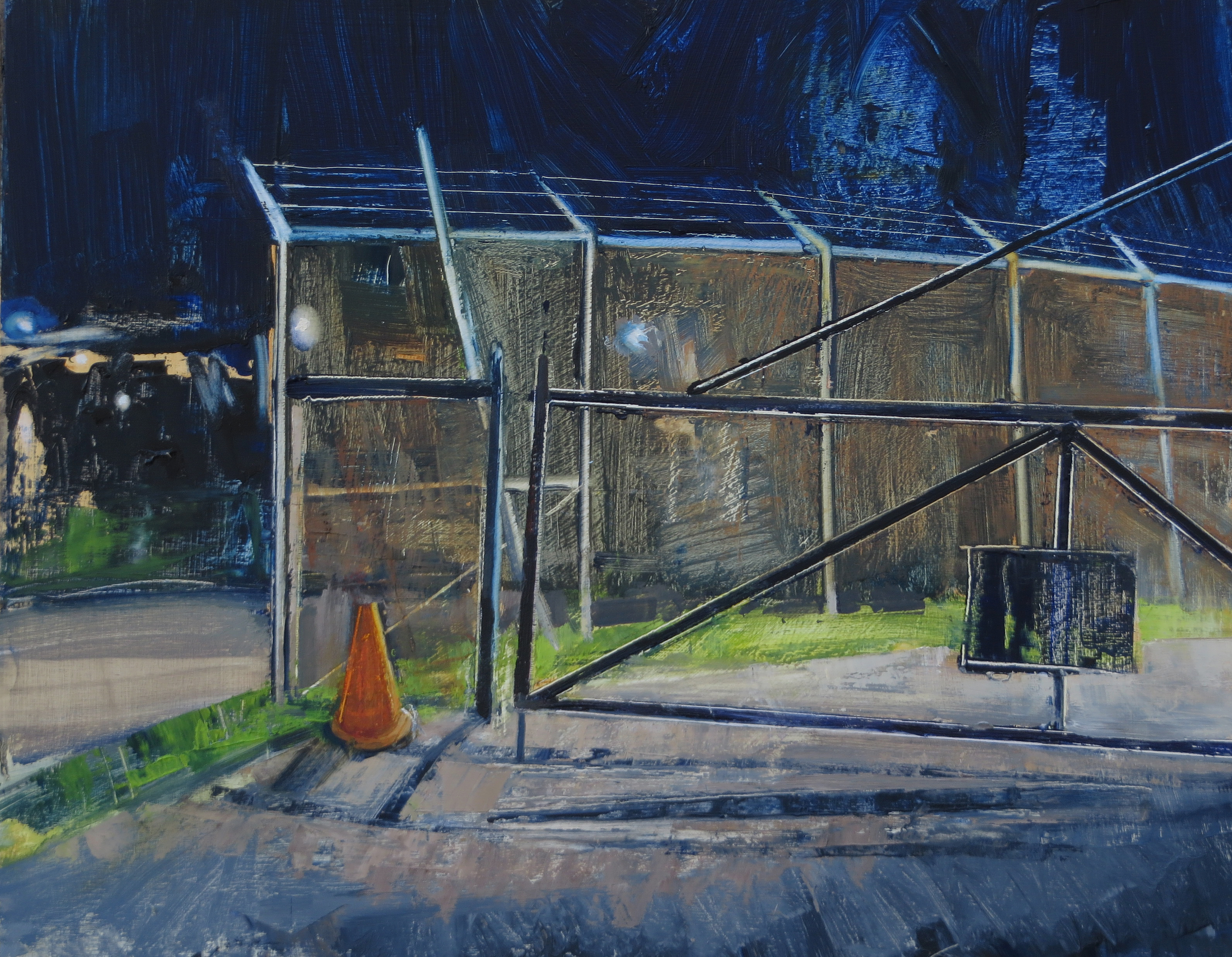
This latest suite of paintings (one of four shows currently up, this one in the adjacent barn space), leans into a more ominous sensibility, even telegraphing a sense of danger that heightens our experience of them. For instance, three paintings feature orange safety cones. These bright orange objects exhort caution, warning us of an unknown imminent peril ahead. They look even more portentous at night (“Night Cones No. 2” and “Metal Fence with Safety Cone”). But the presence of the yellow line in “Safety Cones and Broken Yellow Line” also implies speeding into oncoming traffic.
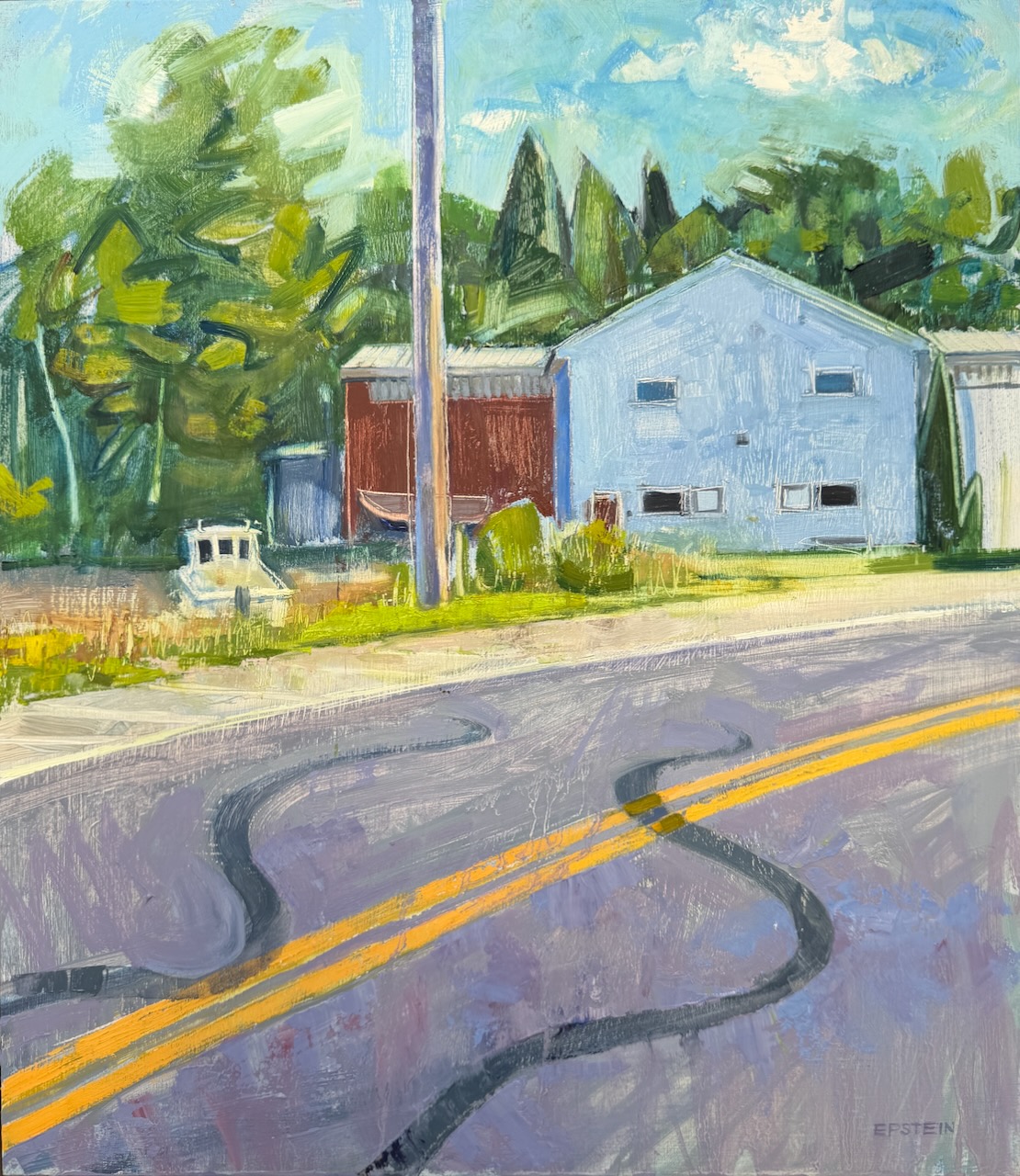
The latter is almost a companion piece to “Burnouts, Double Yellow Line-No. 2,” in which an otherwise placid bucolic road is marred by skid marks of a car that swerved out of control. “Headlights, Early Morning” may be an innocuous painting of a house at dawn, but the headlights of the title project head-onto one side of the dwelling, making us wonder if it is that same driver, about to crash into someone’s bedroom as they sleep.
There is moody lighting (“Streetlight, Foggy Night”) and a looming monster-like black machine (“Night Excavator”). All these feel a far cry from Dodd’s mostly sunny, quiet scenes of nature and domesticity — her houses in flames notwithstanding. To be sure, these paintings aren’t all gloomy and mysterious, a quality of which I am, perhaps morbidly, a fan. But these notes of uncertainty and subtly suggested approaching catastrophe add a fascinating element to the Maine plein air painting we’re used to seeing.
MAINE MUSEUM OF PHOTOGRAPHIC ARTS
“Looking at You,” through Aug. 1, 387 Commercial St., Suite E, Portland, mainemuseumofphotographicarts.org. For more, call 207-808-8919
What’s fascinating about street photography is the way it captures fleeting moments of human weirdness, humor, beauty, the odd or providential juxtaposition. It is unselfconscious (on the unsuspecting model’s part), unpremeditated and surreptitiously observed, so we feel a bit like voyeurs intruding on a private instance.
Curator/photographer Jan Pieter van Voorst van Beest has compiled the work of seven photographers at the new outpost of the MMPA on Commercial Street. It was originally planned for the former Middle Street space but has been adapted to the new digs. It is, like the MMPA itself, way overhung. Most of it is really wonderful, even if there’s too much here, with many works so far above eye level that you strain to view them.
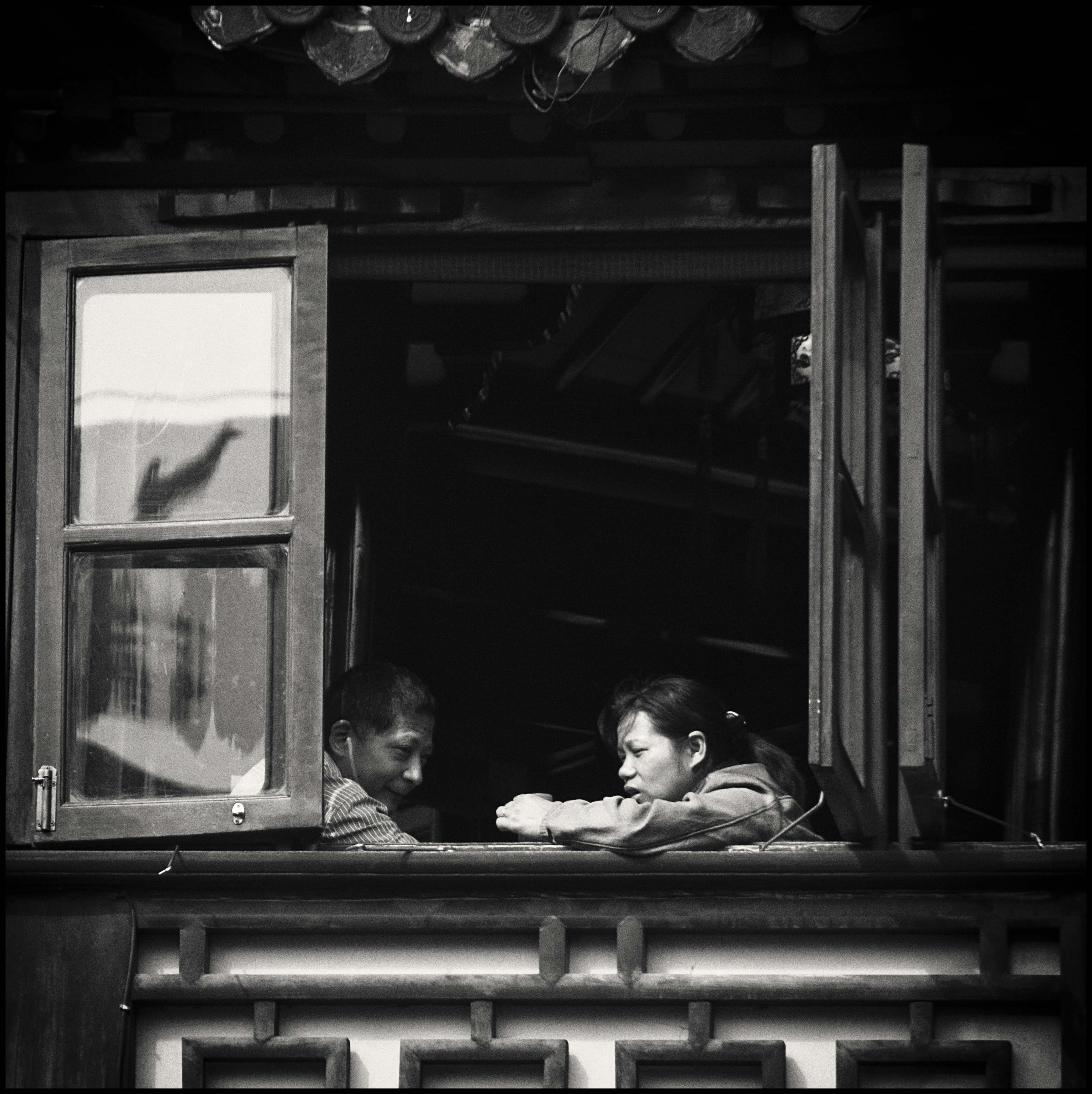
The curator’s own works set the tone. There is what looks like a heated conversation between a man and a woman in “Shanghai Teahouse” and a guitar player in the New York subway next to a large poster advertising the HBO noirish series “Boardwalk Empire,” in which the ad’s period-dressed characters seem to have traveled through time just to come listen.
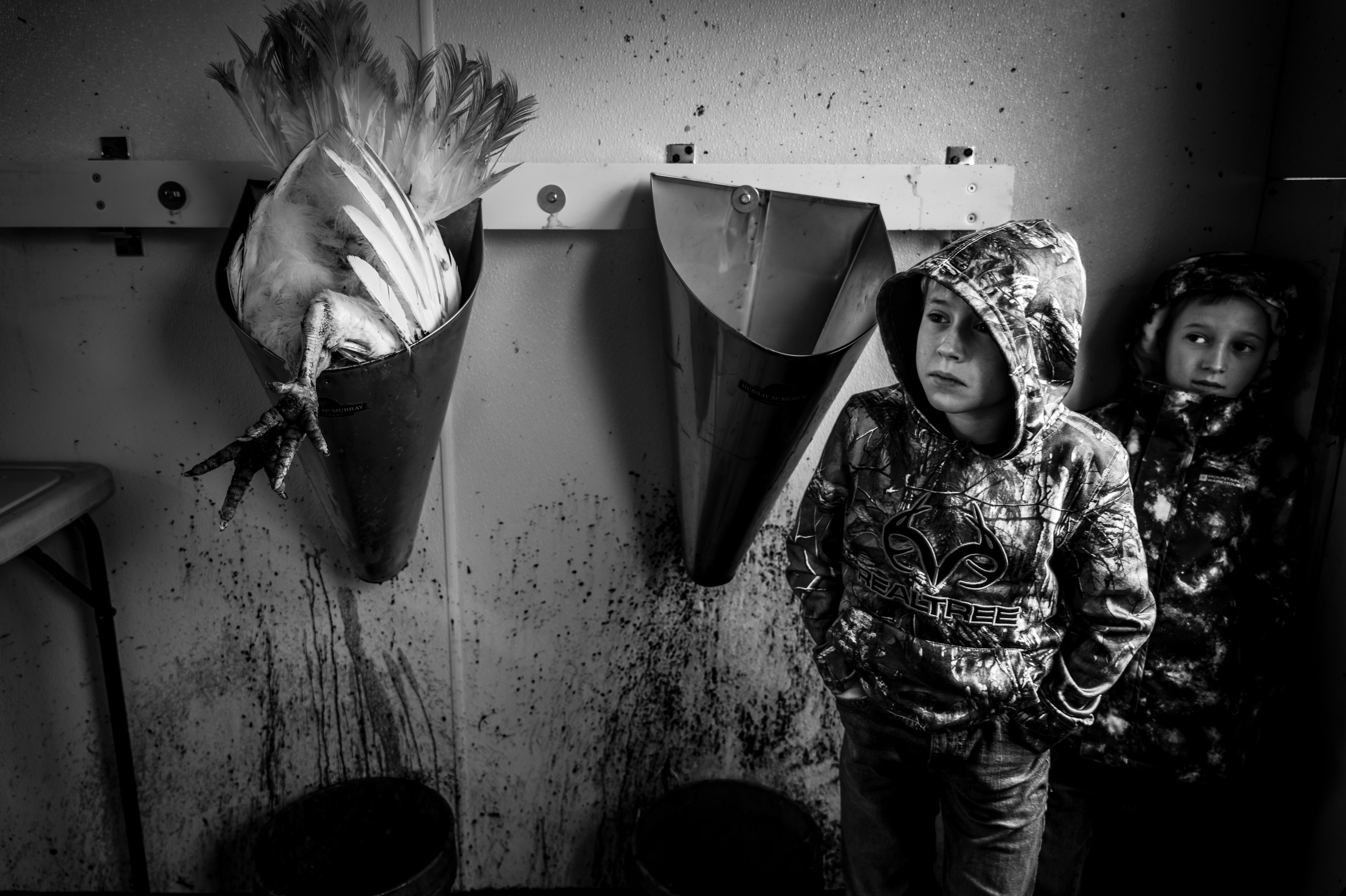
Barbara Peacock snaps curious scenes on Maine farms, such as “Butchering Day,” where two children stand next to a dead chicken shoved head-first into a cone-shaped holder on the wall, and “Cora and the Geese,” an image of a girl in a chicken-patterned dress with live geese on either side of her. These are glimpses into worlds we rarely see and can seem almost shocking.
The other photographers are Kevin Brusie, Arlene Collins, Denise Laurinaitis, Jack Montgomery, Richard Wexler and Bret Woodard. In the latter’s hysterically funny photos, Woodard plays every character in an art gallery (in one) and on a subway (in another, except for his father, who makes a cameo appearance). I love Woodard’s work. He’s like Cindy Sherman with a twisted sense of humor. But including him here is a bit of a stretch, since these scenes are carefully composed and digitally manipulated. I’d love to see a larger solo show of his work.
This is emblematic of what happens all too frequently at the MMPA, which shoehorns in everybody and their mother and hangs it salon style. I understood this to some extent in the former space because they were trying to maximize every inch of the tiny gallery to support their mission. But here, with more room, it feels not only unnecessary, but also doesn’t do the artists any favors. From the street it looks like a tourist poster gallery, which is a pity because it is filled with marvelous work. I hope that as the MMPA matures, the powers that be here will finally learn that more is not always more.
DOWLING WALSH
“Richard Estes: Woods and Waters,” through Aug. 1, 357 Main St., Rockland, dowlingwalsh.com. For more, call 207-596-0084
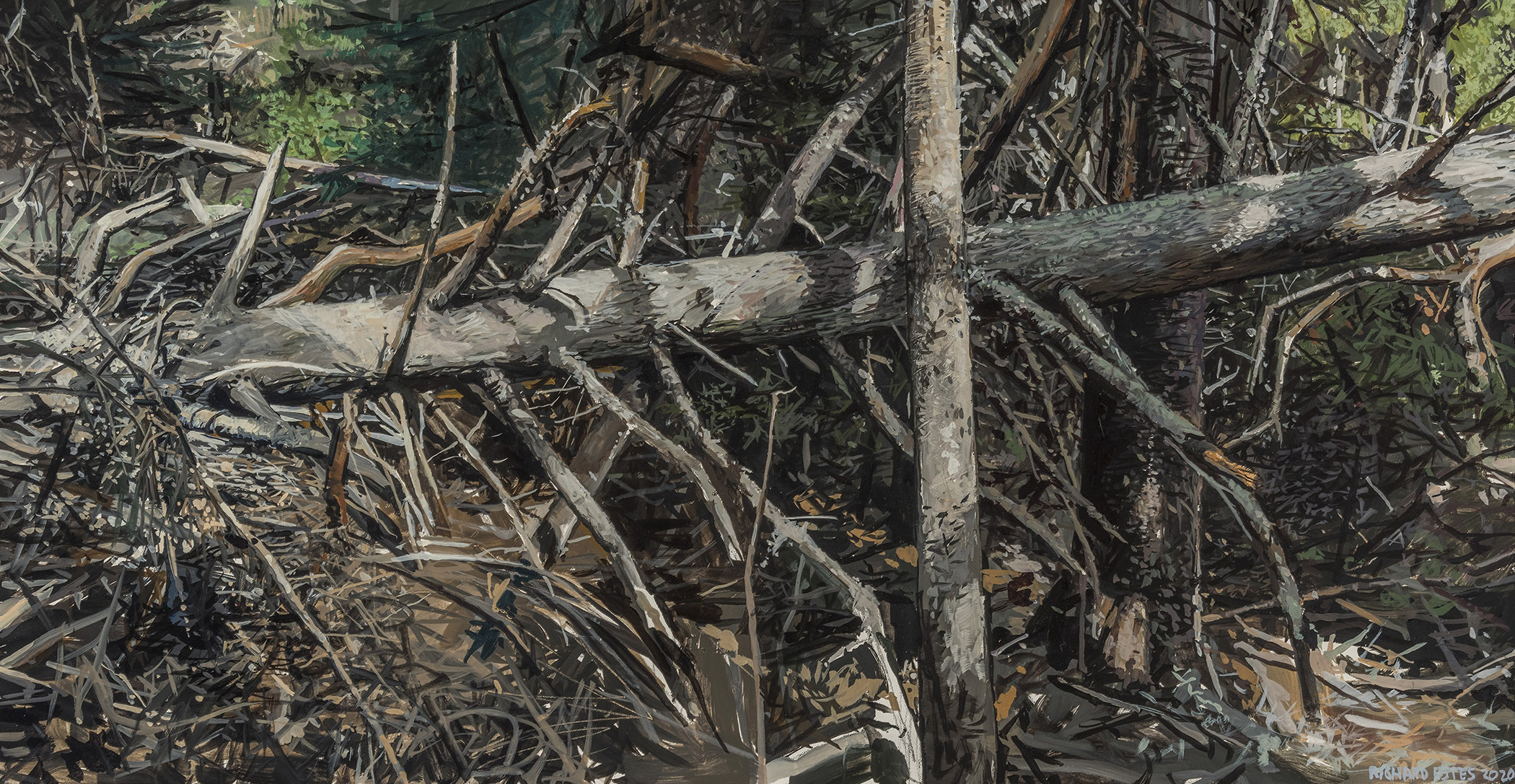
Have you ever really looked closely at a Richard Estes painting? I guarantee you that it is one of the most startling art-viewing experiences you can have. Estes is a legend: father of the Photo Realism movement, a master of observational detail, a peerless interpreter of reflective surface and, nearing 95, still going strong. Fortunately you have the rare opportunity this summer to view this great artist’s work here and also at Schoelkopf, Estes’s New York gallery, which is presenting another solo show “Richard Estes: My Camera Is My Sketchbook” through Aug. 21.
The Rockland show presents meticulously rendered views of Acadia National Park (woods) and Lake Champlain (water). All lead a double life. That is, they are one thing when viewed from a few feet away — appearing as precise as the photographs he takes of the images he will paint, often taken from multiple angles — and quite another thing when viewed up close (that is, veritably painterly). It is miraculous enough to see “Lake Champlain VIIII” [sic] of 1996 from afar; it’s sea gently rippling from the wake of an unseen boat, the sun glistening on the surface at left, clouds reflected in the mirror-like surface and the shadow cast from the boat in the foreground.
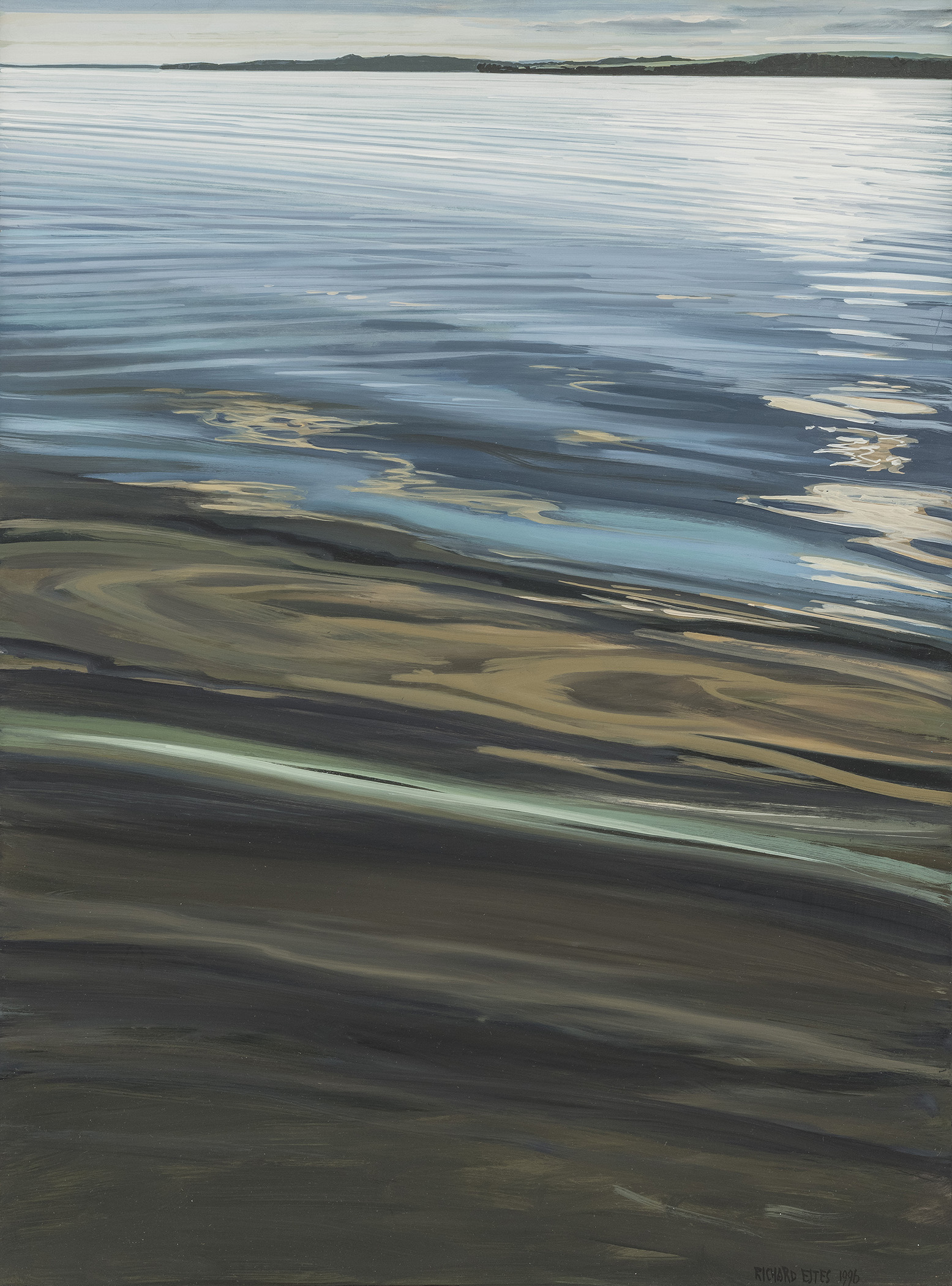
It is altogether astonishing to then move in to find what you had perceived dissipating into brushstrokes, where the opaqueness of the paint seems to deny what you have just understood and almost dissolve it into pure abstraction. What we think is real is suddenly revealed to be pure illusion.
We can even find the graphite lines of his underlying drawing in “Acadia Park I” of 2020. The moistness of moss is palpable in “Acadia Park VI” (also 2020), and the flinty and dangerously slippery surface of rocks in “The Coastline of Maine” (2006) can make you feel like stopping before walking onto it. Yet with all of these, close scrutiny confounds the image. It’s a spellbinding sensation. Estes is an undisputed master of his craft.
Jorge S. Arango has written about art, design and architecture for over 35 years. He lives in Portland and can be reached at [email protected]. This column is free to access through support by The Dorothea and Leo Rabkin Foundation.
We invite you to add your comments. We encourage a thoughtful exchange of ideas and information on this website. By joining the conversation, you are agreeing to our commenting policy and terms of use. More information is found on our FAQs. You can update your screen name on the member's center.
Comments are managed by our staff during regular business hours Monday through Friday as well as limited hours on Saturday and Sunday. Comments held for moderation outside of those hours may take longer to approve.
Join the Conversation
Please sign into your Press Herald account to participate in conversations below. If you do not have an account, you can subscribe here. Questions? Please see our FAQs.