
You can always be sure that Christmas will fall on Dec. 25. But when it comes to Easter, the date varies each year, sometimes by more than a month.
For example, Easter Sunday this year is right around the corner ¬- on April 4. But it was on April 12 last year, and will be on April 24 in 2011. In 2008, Easter fell on March 23.
That’s because Easter – the most important Christian holiday of the year ¬- is what is known as a moveable feast. When it occurs depends on the moon.
“The date of Easter is determined by when the first full moon is after the beginning of spring,” said Msgr. Michael Henchal, pastor of the Roman Catholic parishes of St. Bartholomew in Cape Elizabeth, Holy Cross and St. John the Evangelist in South Portland, and St. Maximilian Kolbe in Scarborough.
Henchal said that Easter always comes on the first Sunday following the first full moon of spring.
Spring begins with the vernal equinox on March 21. This year, the first full moon of spring was on March 30. So Easter is on April 4 because that is the first Sunday following that full moon.
Henchal said that the reason the celebration of Easter is tied to the moon dates back to the time of Christ.
“Jesus himself was, of course, Jewish … and the Jewish calendar is a lunar calendar,” Henchal said.
Easter celebrates the resurrection of Christ and he died around the time of Jewish holiday of Passover, Henchal said.
Passover, which this year began on Monday, March 29, at sundown, appears to move around as much as Easter does. However, Passover, called Pesach in Hebrew, always occurs on the 15th day of the month of Nisan in the Hebrew calendar, which is based on a lunar cycle. In the Gregorian calendar, used in the Western world, Nisan corresponds to the months of March and April.
Greek and Russian Orthodox Christians, who use the Julian calendar, calculate the date of their celebrations based on when Passover falls.
The Rev. Basil Arabatzis, presbyter of St. Demetrios Greek Orthodox Church in Saco, said the word “Easter” is a term that was never adopted by the Eastern Christian church. Instead, he said, the holiday is called Pascha, which is derived Pesach. He said Pascha falls on the first Sunday after the first full moon of spring, but also after Passover. “Those three things are there,” Arabatzis said.
This year, Pascha – known in secular terms as Orthodox Easter ¬¬- also comes Sunday, April 4.
Arabatzis said there are six congregations of Orthodox Christians in Maine. Four are Greek Orthodox, one is Russian and one is Serbian, he said.
Henchal said that Easter is the most important Christian holiday.
“Although in American society, Christmas is thought of as huge, Easter is really more important than Christmas,” he said.
The birth of Christ is important, Henchal said, but his resurrection after death is key from a spiritual point of view.
“What we see as the victory of Christ is really Easter because it is the victory over death,” he said.
Because Christ’s resurrection took place before dawn, Henchal said, “we celebrate the first Mass of Easter in the dark. It’s in the midst of the darkness of that night that new life comes.”
An Easter Vigil Mass will take place on Saturday, April 3, at St. Bartholomew’s in Cape Elizabeth, at Holy Cross in South Portland and at St. Maximilian Kolbe in Scarborough. Services begin at 7:30 p.m. in all three parishes.
At St. Demetrios Greek Orthodox Church in Saco, a Resurrection Service and Divine Liturgy begins at midnight on Saturday, April 3, and continues until 1:45 a.m. on Easter Sunday morning.
The church’s Web site describes the event: “On the evening of Holy and Great Saturday, the people gather in the church. At midnight in the darkened church, one will witness the most moving moment in the Orthodox calendar. The priest exits from the sanctuary holding a lighted candle, representing Christ the Light of the world, saying: ‘Come ye and receive light from the unwaning Light; and glorify Christ, who has risen from the dead.'”
For other Christian churches, major services occur on Easter Sunday ¬- some at sunrise.
For example, a group of churches in Cape Elizabeth, Scarborough and South Portland have a long tradition of a holding a sunrise service Easter morning on public land at the end of Two Lights Road in Cape Elizabeth overlooking the ocean.
The Rev. Ruth Morrison, pastor of the Cape Elizabeth United Methodist Church, said the event, which begins at 5:45 a.m., is a decades-long tradition.
“It’s a gathering of many churches in the area,” she said.
Her own church is involved, she said, as is the Cape Elizabeth Church of the Nazarene, the Thornton Heights United Methodist Church in South Portland, and the West Scarborough United Methodist Church.
Morrison said that others not affiliated with those churches also come to witness the moving service in the beautiful setting.
Afterward, a breakfast will be held at the Cape Elizabeth Church of the Nazarene, for which a small donation is requested to cover the cost of the meal.
Morrison said all are welcome.
“We’re just inviting people to come and dress warm,” she said.
If the weather is clear at the service, it’s possible to see the sun rising and the moon setting at the same time, she said. If it’s cloudy, she said, the views might not be quite as spectacular.
But Morrison said that whatever the weather, she’s sure of one thing.
“It’s going to be a wonderful day,” she said. “It’s going to be Easter.”
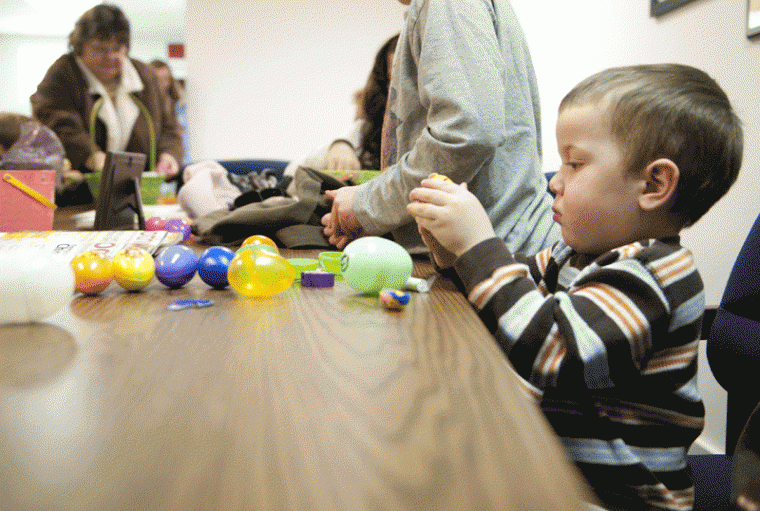 Ewan Thompson, 3, of Cape Elizabeth sits at a table and checks out his collection of eggs he gathered during the Easter egg hunt at Coastal Wellness Chiropractic in Cape on Saturday. (Staff photo by Brandon McKenney)
 Cindy McBrady of Cape Elizabeth hands Gabe Harmon, 4, an egg that he couldn’t reach during the second annual Easter egg hunt at Coastal Wellness Chiropractic in Cape on Saturday. Nearly 20 kids participated in this year’s hunt, double the number from last year. (Staff photo by Brandon McKenney)
Comments are no longer available on this story