
A national campaign to oust a bee-toxic class of insecticides from home gardens has provoked anger among Cumberland County independent garden retailers, many of whom are facing down a barrage of inquiries from concerned customers.
The campaign, which has assumed a local dimension in recent weeks, targets the use of neonicotinoids, a class of systemic insecticides that are used on more than 140 types of crops across the world, and are sold at many garden retail centers.
Neonicotinoids, like many insecticides, can prove fatal to pollinators, such as butterflies and honeybees. Honeybee populations, which have declined across the planet in recent years, are crucial to the production of nearly two-thirds of the global food supply.
On June 25, the Organic Consumers Association held a press conference at the Honey Exchange in Portland promoting a new study from the Friends of the Earth and the Pesticide Research Institute. The study, entitled “Gardeners Beware,” concludes that pre-treated plants sold as “bee-friendly” at large garden centers in Portland may contain harmful levels of neonicotinoid residue.
The study tested 71 nursery plant samples from “major nursery outlets and garden centers,” such as Home Depot, Lowe’s, and Walmart stores in 18 locations across the United States and Canada, one of which was Portland. According to the study, 36 of the plant samples, or 51 percent, tested positive for neonicotinoid residues. Based on these results, the study concluded that “the chance of purchasing a plant contaminated with neonicotinoids is high.”
“Many home gardens have likely become a source of exposure for bees,” the study found.
Neonicotinoids, on the market since 1994, are taken up through the roots and into the leaves of the treated plants, including the pollen and nectar, which is what bees need to live.
The “Gardeners Beware” study said that neonicotinoids could not only poison bees directly, but that low-level exposure could also impair a bee’s ability to forage, as well as its immune system.
Erin Forbes, a Portland-based master beekeeper who spoke at the June 25 press conference, said that neonicotinoids are “the biggest controllable threat” to her hives.
“Individual gardeners are purposefully creating what they think are pollinator-friendly habitats on their own property, and by that I mean removing lawns, seeding flowers into lawns, and creating pollinator corridors, planting milkweeds for butterflies,” Forbes said. “Doing all of these things and, unknowingly, the plant material that they are buying is laced with systemic pesticides, so it’s poisonous to bees and other pollinators.”
According to Jack Hildreth, the vice president of the Maine State Beekeepers Association and a former president of the Cumberland County Beekeepers Association, Cumberland County’s bee population has declined by 30 percent a year for the past three years. In Hildreth’s view, the campaign against neonicotinoids is a welcome development.
“I think most of the public does not understand what is happening with the big box stores and what they’re doing to make their products look beautiful,” Hildreth said. “They’re not realizing the effects of what it’s doing to the pollinators in the area.”
To many independent garden retailers in the area, however, the campaign comes as a rude and misguided surprise. Although these retailers agree that some neonicotinoids, if used excessively, pose a grave threat to bees, they say the focus on neonicotinoids obscures the complex factors behind the collapse of pollinator populations. In particular, they argue that the Varroa mite, a parasite that attacks honeybees, poses a far greater threat to bees than neonicotinoids. According to Maine State Apiarist Tony Jadczak, “the primary cause for bee loss world-wide is the Varroa mite and viral complex associated with the mite’s feeding behavior.”
In the “Gardeners Beware” study, the authors note that “managed honeybee losses have been linked to multiple factors including Varroa mite infestations, pathogens, malnutrition and habitat degradation.”
Jeff O’Donal, the owner of O’Donal’s Nursery in Gorham, said that many small independent garden retailers feel that the recent media coverage of the “Gardener’s Beware” study has paired them with the large chain stores in the public mind.
“We all believe that when they said box stores and the press said garden centers, we were all lumped in together,” O’Donal said. “It touched a nerve, there’s no question about it.”
O’Donal said that numerous customers have contacted him about the study.
“They were questioning it, because they came to the same conclusion, that when they said garden centers, it meant all of us,” he said.
O’Donal said that his store will no longer sell off-the-shelf neonicotinoid insecticides.
Phil Roberts, the owner of Broadway Gardens Greenhouses in South Portland and Westbrook, said that local growers have been focused on the threats to local bee populations for years.
“The Maine growers have been talking about this for 10 years and all of a sudden the beekeepers are getting all excited,” Roberts said. “We all kind of feel like we got thrown under the bus about it.”
“We’ve been banging the drum for a number of years and saying we need to watch out for the bees and use pesticides that don’t take out the bees,” Roberts added.
Roberts said that he has received customer inquiries since the press conference. He said that his stores label off-the-shelf insecticide as bee-toxic.
Christine Viscone and her husband, Joe, owners of the Highland Avenue Greenhouse & Farm Market in the Pleasant Hill Road area of Scarborough, are among local growers who do not use pesticides on their plants. They were chosen to take part in the press conference held by the Organic Consumers Association.
Joe Viscone is the third generation of his family to own and operate the Highland Avenue Greenhouse & Farm Market. He and his wife, who have a 3-year-old and a child on the way, have been in charge since 2007.
Both Christine and Joe Viscone grew up in the Pleasant Hill neighborhood and still live right next to the farm, according to Christine.
She said the couple does not have any specialized training and while the Highland Avenue Greenhouse is not a certified organic operation, the Viscones are still completely committed to not using any pesticides.
“We are working on finding or developing an organic fertilizer that works for our commercial setting,” Christine Viscone said. “Bees are one of many important pollinators in our environment. Without pollinators, plants would have to rely on wind or other unreliable sources to move pollen from plant to plant in order to produce fruit. In simple terms, the more flowers that are pollinated the more fruit that is produced.”
Genevieve Coombs, nursery manager at Roosevelt Trail Landscape and Garden Center in Windham, said she has spoken with the center’s growers about neonicotinoids. The Roosevelt center’s plants are not treated with the insecticides, she said.
“The Friends of the Earth and other similar organizations want to have a smoking gun,” Coombs said of the complex issue surrounding the so-called colony collapse disorder. “They want to say, ‘This is the problem everybody needs to stop doing this and our problem will be solved.’ But that’s not how it works.”
Mark Faunce of Limington, beekeeper and former president of the Maine Landscape and Nursery Association, disparaged the “Growers Beware” study.
“The ‘report’ that was issued by Friends of the Earth stated that 36 out of 71 plants sampled from across the country contained neonicotinoids, but what the group is suggesting, and what the newspaper headlines read, is that more than half of the plants bought at garden centers contain levels of neonicotinoids that will harm or kill honeybees,” Saunce said. “That’s what I find to be disingenuous about the FOE press conference.”
“Scaring the public isn’t going to help honeybees to rebound; neither are labels on plants, or local ordinances prohibiting the use of pesticides,” Saunce added. “The focus needs to be on the Varroa mite. If we could get that under control, honeybee populations would start to recover almost immediately. The problem is, in order to kill the Varroa mite, we need to use a pesticide. We’re trying to kill a bug on a bug, and that’s a tough thing to do!”
To Saunce, labeling plants pre-treated with neonicotinoids is “unrealistic” due to the length and complexity of the supply chains involved. But to Forbes, the Portland beekeeper, labels would be a sensible step forward.
“As a beekeeper I would love to see plants labeled,” she said. “I would like to see plants that are neonicotinoid-free labeled as such. If I could find a greenhouse that showed me everything on this side has no neonicotinoids that’s where I’m going to go spend a lot of money, I mean truly. If I felt there was anybody I could trust I would absolutely buy there, and I would tell my friends to buy there.”
Tiffany Finck-Haynes, a campaigner for Friends of the Earth, said that the organization has partially focused its campaign on neonicotinoids for strategic reasons.
“This is one piece of the equation that we can do something about right now,” Finck-Haynes said. “It’s something that they can fix right now in their own back yards, a way that they can be part of the solution to protect bees and other pollinators. Bees have enough trouble. Our back yards don’t need to be part of the problem.”
Also, Finck-Haynes said, neonicotinoids can actually exacerbate the effects of the Varroa mite viral complex.
“Varroa mite is a problem that is one of many problems that impact bee populations,” she said. “We’re concerned about neonicotinoids because it weakens the bee’s immune system to fight off Varroa mite and other diseases and pests and pathogens.”
While neonicotinoid pesticides are legal, the European Commission has suspended the use of three types of the pesticides on flowering plants that attract bees in an attempt to better protect the bee population.
And, in the United States, a bill in Congress, entitled the “Saving America’s Pollinators Act,” has 68 sponsors. In addition, the city of Eugene, Ore., was the first community in the nation to ban the use of neonicotinoid pesticides on municipal property.
The Minnesota Legislature also recently passed a bill that bans retailers from labeling plants pre-treated with pesticides as being bee-friendly.
Other states, including Maine, Vermont, New York, New Jersey, Maryland, California and Alaska, are also looking at measures that would protect bees from neonicotinoid pesticides. And some retailers are now committing to phasing out the use of these pesticides.
As far as Finck-Haynes can tell, the Friends of the Earth campaign is already showing results, as garden retailers respond to customer inquiries about neonicotinoid usage.
“From the retailers I’ve talked with, they’re responding to growing consumer demand in the marketplace,” she said. “They’re getting constant calls from their customers.”
– Kate Irish Collins contributed to this report.
A CLOSER LOOK
See www.foe.org/beeaction to download the complete “Gardeners Beware” report, a first-of-its-kind study by the Friends of the Earth and the Pesticide Research Institute that claims that pre-treated plants at large garden centers often contain pesticides that are harmful or deadly to bees.
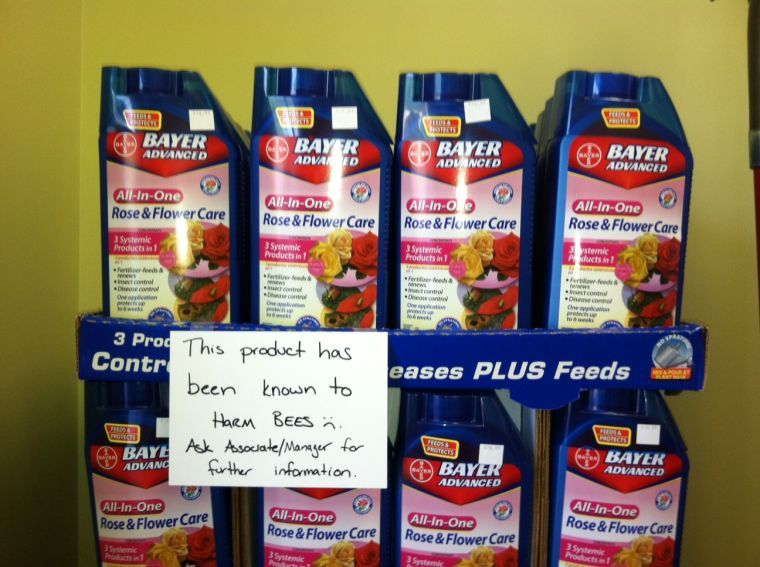 Broadway Gardens, an independent garden retailer with stores in South Portland and Westbrook, warns its customers about the dangers its off-the-shelf neonicotinoid insecticide products pose to bees.
Comments are no longer available on this story