
Eight years ago, Meg Wolff took a chance that might have saved her life.
Wolff gave up on conventional treatment for breast cancer and decided against a bone marrow transplant.
“I just felt in my gut that it would kill me,” said Wolff, who grew up in Westbrook. Instead, she began a strict, healing macrobiotic diet that she credits with curing her cancer and helping to improve the quality of her life.
Nearly a decade after turning to macrobiotics, Wolff is cancer free and feeling healthier than ever – both mentally and physically.
Recently, after three years of work, Wolff published a memoir of her illness and recovery, “Becoming Whole,” with the help of writer Tom Monte. Over two years Monte would visit Wolff at her home in Cape Elizabeth for a few days as she told him her story, piece by piece. Eventually, as she recalled her life and struggle against cancer for Monte, the book emerged.
“There were days when I’d think I’d much rather be at the beach reading a book,” said Wolff. “What really kept me going and pursuing this was that not many people have the chance to make a difference in someone’s life like I think I can with this book.”
The cover of the book, a portrait of Wolff that reveals both her prosthetic leg – the result of bone cancer – and parts of her upper body, was another decision that took guts, said Wolff.
“I really wanted to show what breast cancer does,” said Wolff.
After seeing the work of Joyce Tenneson, Wolff knew she wanted the well-known photographer to take her portrait. Tenneson, who has displayed her portraits in over 150 exhibitions worldwide and published 10 books of portraits, teaches in Maine during the summer. Tenneson and Wolff were able to meet and create the perfect image for the book, said Wolff.
Another book on macrobiotics, a diet that is centered on whole grains, vegetables and sea vegetables, was what planted the seed for Wolff. After reading a book by a man who wrote that his pancreatic cancer was cured by macrobiotics, Wolff believed what she read but still wasn’t ready to make the change.
“I still believed health was something you either have or you don’t,” said Wolff. “People think that bad health is like a lightening bolt,” she added. “But illness takes a number of years to develop.”
After losing a leg to bone cancer in 1991 and then being diagnosed with breast cancer eight years later, Wolff was told her chances for survival were small.
“Doctor after doctor kept talking to me with these long, sad faces,” said Wolff. Eventually she was told that a bone marrow transplant was her only decision – something Wolff believed would only make things worse. She asked her doctor to recommend someone who practiced alternative medicine.
When her new, naturopathic doctor happened to mention that some breast cancer patients benefited from a macrobiotic diet, Wolff remembered the book she’d read in the 1980s.
“That was my ‘ah-ha’ moment,” said Wolff.
After reading a flier promoting macrobiotic cooking classes in Portland in the Whole Grocer store, Wolff signed up with the Five Seasons Cooking School and began a complete lifestyle change.
“It’s a way of life,” said Wolff. “It’s a diet and a lifestyle. The food helped me heal, but it also cleared my mind and when that happens all the stuff you need to deal with is right in front of you.”
Not only did she drastically change how she ate and viewed food, but alsoshe started to look at parts of her life that needed a change. For example, said Wolff, instead of taking pain killers for a headache and covering the symptoms, she would look for the cause. If it was because she was pushing herself too hard or trying to do too many things at once she would slow down, rest and the headaches would stop.
In American society, said Wolff, people concentrate so hard on making sure their children have good schools, clothes and friends.
“But I think that the biggest piece that’s missing is the food piece,” said Wolff, citing national health problems such as childhood obesity and diabetes.
Cutting out animal proteins, processed foods, sugars and junk foods by using the macrobiotic diet is a solution to those problems, said Wolff. At first, eight years ago, she started giving her husband, Tom, and two children, her son Francis and daughter Cammie, little side dishes of the foods she was preparing for herself. Eventually, her family joined her on the macrobiotic diet. Her whole family, including her son, who is now 20, and her daughter, now 16, continue to eat and enjoy a macrobiotic diet.
Five years ago, she decided to teach others. Now Wolff is a macrobiotics instructor at the Cancer Community Center in South Portland, a nonprofit center that offers everything from health classes to support for those with cancer and their families.
“Meg has been donating her time teaching macrobiotics for as long as I can remember and probably before that,” said Michele Johns, the center’s executive director. “She’s a wonderful teacher and a great inspiration.
It’s volunteers like Wolff, said Johns, that keep it all running. The center opened in 1998 to offer support groups, wellness programs, classes like macrobiotics and the Maine Buddy Program that matches up people with similar cancer experiences for extra support.
At the center on Dec. 9, along with the help of her husband, Wolff prepared a macrobiotic dinner and signed her book for about 25 people. Sharing the macrobiotic way of life with others has become important to her, said Wolff. The second part of her book is a guide to macrobiotics, complete with recipes and descriptions of the foods.
“If I can do it, anyone can,” said Wolff as she stirred up asparagus, Atlantic salmon, capers and tikiada rice pasta. As a side dish, there were steamed vegetables – something that Wolff eats twice a day to take the place of dairy products as a source of calcium.
“I eat so many vegetables now,” said Wolff. “Some I never even knew existed. Once I would have said a rutabaga was an antique car.”
Unlike a vegetarian diet, the macrobiotic diet completely cuts out dairy. One important reason, especially for breast cancer patients, said Wolff, is that dairy can create mucus in the lymph system. Though some think it’s like being vegan, said Wolff, it again differs in an important way – vegans, while foregoing any animal products, will still eat sugars, junk food and other processed food not allowed in the macrobiotic diet. Eight years ago when Wolff was using the diet to stop her cancer, she didn’t eat any animals – including fish. Now, she is slowly working a very limited amount of fish back in.
Green leafy vegetables, like kale and collards, said Wolff, will replace milk. The macrobiotic diet, in its attempt to be as organic and pure as possible, also includes seaweeds like arame and hiziki that are harvested in Maine. All kinds of beans are also an important part of the diet, said Wolff.
Another piece that helps the macrobiotic diet stand out, said Wolff, is the emphasis on eating foods that grow naturally in your climate. Fruits grown in warm temperature, like oranges and bananas, said Wolff, are actually meant to cool your body down. In a place like Maine, she added, that’s not always a good idea. An apple or pear is often a much better choice.
Sharing her knowledge and hope with others is a major part of Wolff’s life. With both the class and her book she is able to reach others who may share her situation.
“This is something people can do for themselves,” said Wolff. It took her a long time to find a doctor who would work with her and help support her macrobiotic choice rather than continually recommending treatment she felt wasn’t right for her.
“There needs to be a partnership,” said Wolff of patients and their doctors. “People need to be supported in what they do.” An ability to feel that support and the ability retain control over your own health, said Wolff, is lacking in the health care system.
“I feel I couldn’t have lived through this experience and not share it,” said Wolff. “I couldn’t with a good conscience not share it. I know it’s not for everyone, but there are a lot of people without hope out there who will try anything.”
The biggest thing Wolff learned from her experiences, she said, was to trust herself and listen to her instincts.
“The most important thing is to just go with your gut,” said Wolff. “Go with your gut, go with your gut, go with your gut.”
 On Saturday, Dec. 9, Meg Wolff demonstrated her macrobiotic cooking skills at the Cancer Community Center in South Portland.
 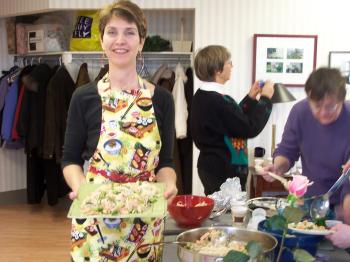 Teaching macrobiotics, said Wolff, is something she enjoys and felt she had to do.
 The cover of Wolff’s new book “Becoming Whole” was very important to her. Showing the results of both breast cancer and the bone cancer that claimed her left leg, said Wolff, was something she felt very strongly about.
Comments are no longer available on this story