
Members of a preservation group working to restore historic Scribner’s Mill in Harrison say they will find a way to power the mill despite a recent decision to deny the construction of a dam.
Marilyn Hatch, a spokeswoman for Scribner’s Mill Preservation Inc., said members would contest the Department of Environmental Protection’s initial rejection of their application to rebuild a dam on the Crooked River.
Hatch said members of the group plan to submit comments to the DEP to try to prove that the fish passage system would allow 100 percent of fish to cross the dam, habitat would not be significantly altered and water quality would not be destroyed.
“The DEP recognizes the historic significance of restoring a water-powered sawmill at the Scribner’s Mill site,” wrote Dana Murch, hydro supervisor with the DEP, in a letter accompanying the decision.
However, Murch wrote, there is evidence that the project would have a negative impact on passage, spawning, habitat and fishing for landlocked salmon, an ecologically and economically significant fishery. Murch found that the economic benefits and advantages of the project did not outweigh the costs and adverse impacts to the environment.
Officials from the Department of Inland Fisheries and Wildlife and other environmental and angler groups have opposed the proposed dam, saying that it would have a negative impact on the landlocked salmon population in Sebago Lake, 21 miles downstream. The Crooked River is the primary spawning habitat for the salmon.
Members of the nonprofit Scribner’s Mill Preservation Inc. have been working to restore the historic mill on the Crooked River in Harrison since 1975, three years after the original dam was breached to improve fish passage. They initially submitted an application to rebuild the dam to power the mill in 2002.
In a state that once had a strong lumbering industry and numerous small mills, Scribner’s Mill, where wood cutting began in 1847, is one of the last that remains intact.
Hatch said the mill will operate even if the dam is denied. The backup plan is to pump water from the river into a holding tank to power the water wheel. The downside of this plan would be the 90,000 pounds of carbon dioxide released into the air each year from the gasoline-powered pump, Hatch said.
Murch will receive comments on the draft decision until Nov. 26 and will make a final decision around Dec. 24.
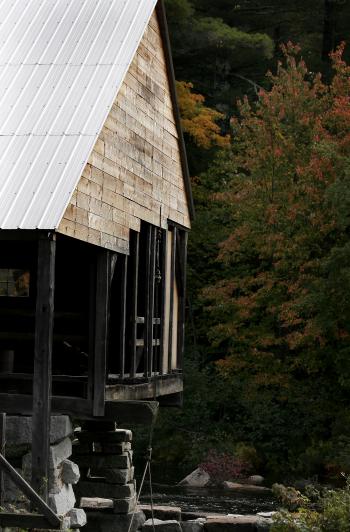 After the Department of Environmental Protection made an initial rejection to an application to rebuild a dam to power Scribner’s Mill on Crooked River in Harrison, members of the preservation group vowed to contest the decision. Comments on the decison can be filed until Nov. 26.
Comments are no longer available on this story