
SOUTH PORTLAND – On its fourth iteration, the proposed new Thornton Heights commercial zone in South Portland is significantly reduced to honor long-standing uses in that area of the city.
The zone also no longer includes the municipally owned lot on the corner of Westbrook and Main streets, which caused significant controversy this past spring, particularly with the adjacent Congregation Bet Ha’am synagogue.
In addition, the proposed new zone – the subject of a Planning Board public hearing on Tuesday, after the Current’s deadline –respects the existing boundary between commercial and residential areas on the west end of South Portland in order to exclude properties that have not historically been commercial in nature according to Steve Puleo, the city’s community planner.
Although the coverage area of the Thornton Heights commercial zone has been severely contracted, Puleo said, it’s still worthwhile for the new zoning rules to be implemented, particularly because the new zone specifically lists permitted and special uses and applies design standards to new construction.
Assuming the board gives the proposal a positive recommendation, it would come back to the City Council for discussion and final approval in late summer or early fall. A new approval process is required because so many substantive changes have been made since the Planning Board and council last took up the zoning change.
The purpose of the Thornton Heights commercial zone, according to the ordinance, is to “provide a higher density residential and commercial services zone that allows a broad range of retail, commercial, service, entertainment and hospitality uses in an auto-oriented environment.”
Under the new zone, construction of mid-rise buildings that conform to design and dimensional standards would allow the district to better accommodate job and housing growth on the west end of South Portland.
The majority of the new zone is located on the east side of Main Street, between Main and the rail yard. Some parts of the new zone would also apply to properties with frontage on Main and Westbrook streets, as well as the Maine Turnpike spur.
Permitted uses within the zone would include assisted living facilities and nursing homes, combined live and work spaces, bed-and-breakfasts, medical and other professional offices, retail stores, drive-through facilities, restaurants, churches, day care centers, museums and art galleries and commercial greenhouses, among others.
The minimum lot size would be 5,000 square feet. The maximum building height would be 70 feet and the maximum number of stories allowed would be six. In terms of density, 36 units per acre would be allowed in terms of residential uses.
The original Thornton Heights commercial zone was controversial because members of the synagogue feared that applying the zone to the city-owned lot on the corner of Main and Westbrook streets would leave the door open for a new, 24-hour Dunkin’ Donuts to go in next door.
In late 2013, Massachusetts-based developer Cafua Management purchased the former St. John the Evangelist Church, on the corner of Thirlmere Avenue and Main Street, and announced plans to tear down the historic structure and replace it with a Dunkin’ Donuts.
However, after much neighborhood opposition, the development company backed down and began talking with the city about building its new store on the corner of Westbrook and Main streets instead.
Now, a new Main Street Community commercial zone, approved unanimously by the City Council this past spring, means Cafua cannot use the St. John’s site to build its new Dunkin’ Donuts, since that zone specifically bans both drive-through restaurants and 24-hour business operations.
Following several meetings and many hours of public comment, the City Council failed to pass the original Thornton Heights commercial zone in mid-May, but in mid-June the council allowed the proposed new zoning to move forward under the compromise that it would not include the city-owned lot.
The council is still debating the best use of the corner lot, with at least councilors Tom Blake and Patti Smith advocating to keep the 2.3 acres as open space, which it has been since the city first purchased the property in 1919.
Mayor Gerard Jalbert has been an advocate of rezoning the Thornton Heights neighborhood for more than a year, mostly because he’s concerned about the rapid rate of urban decay on the west side of Main Street.
“We need to make a change (there) and the new zone is a part of moving forward,” Jalbert said at a prior City Council meeting.
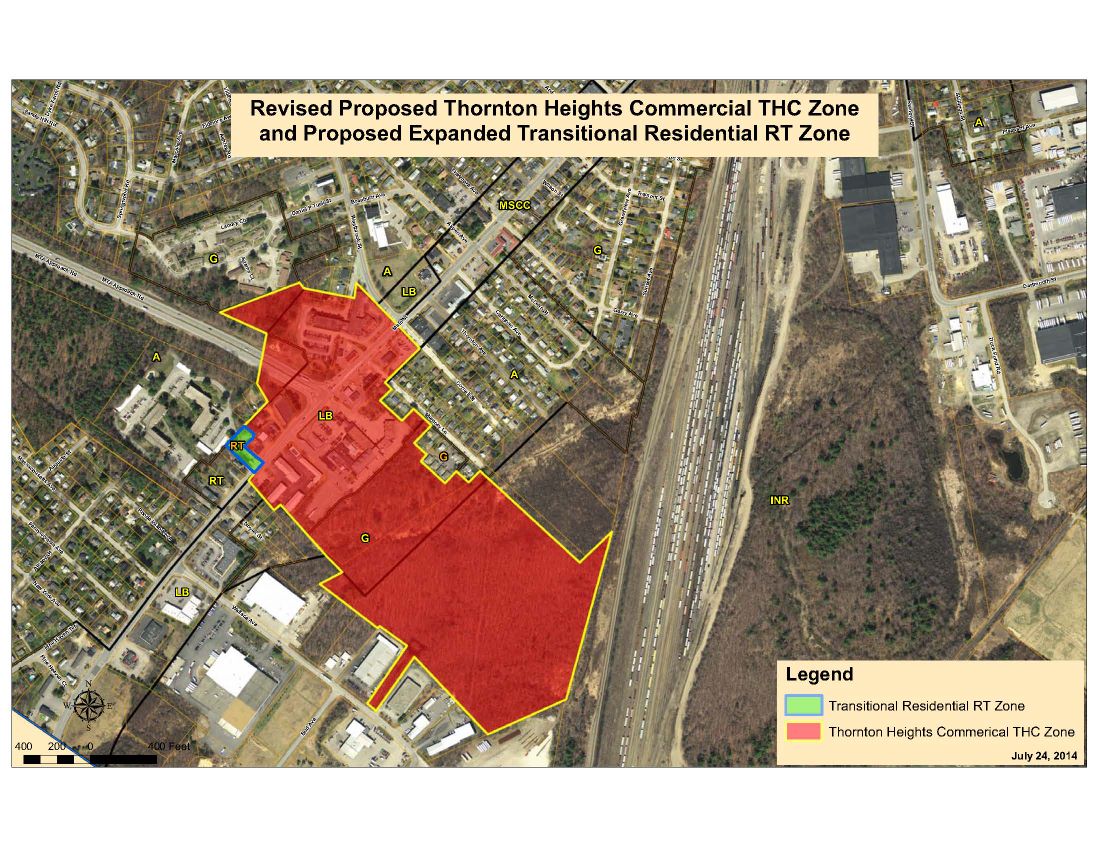 The South Portland Planning Board was scheduled to hold a public hearing on a severely contracted new Thornton Heights commercial zone this week.
Comments are no longer available on this story