
The name may conjure images of a beast from prehistoric times, but the woolly adelgid is as small and unassuming as an insect can be, nearly undetectable.
Yet, its effect can be like that of a massive mammoth running through a forest, knocking down humongous trees as it goes.
And that is bad news for hemlock trees and their owners, particularly those in coastal spots like Scarborough, Cape Elizabeth and South Portland. The destructive insect has already been found in Saco.
Scientists recently announced the further spread into Maine of the hemlock woolly adelgid, an insect that is spread by birds and the wind and targets hemlock trees, killing them slowly.
First transported to the United States from Japan on an ornamental hemlock bound for someone’s backyard in Richmond, Va., in the 1950s, the woolly adelgid, (pronounced like the woman’s name Adele with a soft “g”) has slowly spread south to Florida and north to Maine.
Here in Maine, the woolly adelgid was first discovered in 2003 on Gerrish Island, off the coast of Kittery. Three years ago, the insect made the hop to the mainland, and was discovered by Janet Mangione, a ranger at Ferry Beach State Park in Saco.
This spring, the adelgid made another leap and was found by homeowners checking for the invasive insect on their hemlock trees in Harpswell and Phippsburg. The adelgid is expected to make further inroads into Maine, meaning it will eventually take over southern Maine, and the hemlocks that reside here.
And that is bad news for anyone who has hemlock trees. Known for their strength and beauty, eastern hemlocks cover about 160,000 acres in York and Cumberland counties, and they are defenseless against the woolly adelgid. As of this month, the adelgid has spread to 10,000 acres in the towns of Saco, Kennebunkport, Wells, York, Kittery, Elliot, South Berwick and Ogunquit, in addition to the recent finds in Harpswell and Phippsburg.
Beetle release
Scientists say the only hope to limit the spread and eventual ruination of hemlocks are two types of beetles that are the only known predators of the hemlock woolly adelgid.
The beetles are similar to ladybugs, but black in color. Without common names, they’re known as sasajiscymnus tsugae, which is native to Japan, and laricobius nigrinus, which is native to the Pacific Northwest.
State officials at Ferry Beach State Park released about 9,000 of the predator beetles in May. The batch was the second such recent release. Another 2,700 were released last fall, according to Bob Crocker, manager of the 160-acre Ferry Beach State Park in Saco.
“We really can’t tell yet whether (the beetles) are helping, it’ll take some time. The weather is as big a factor as anything. Real cold winters would help us out a lot,” Crocker said.
Crocker said he is “really worried, absolutely” about the threat the adelgid poses to the park.
“It’s unpredictable what can happen. At this stage they haven’t infested the whole tree, but we do have quite a bit of it. If we do lose the hemlock, it could change the entire ecosystem, and we don’t want to see that,” Crocker said.
Loss of the trees could affect the visual landscape at the day-use park, as well as being “real bad for wildlife,” Crocker said. “They use hemlock for shelter. Hemlock branches are very strong and dense and they keep things cooler in the summer and warmer in the winter.”
Robin Kerr, conservation coordinator at the 7,000-acre Mt. Agamenticus Conservation Region in York, which has two known areas of adelgid infestation, also worries about the invasive threat.
“Hemlocks matter to us. They’re an important part of the ecosystem,” Kerr said. “They provide shelter and warmth for wintering deer, and they shade streams in the summertime, providing cool nookeries for fish.”
Among possible eradication methods, which include felling affected trees and using chemical pesticides, the beetles do the least collateral damage.
“The bio-control beetles are thought to be the best control. They work in Japan and the Pacific Northwest, where populations of the adelgid are held in check, but it is a long-term solution,” said forest entomologist Allison Kanoti with the Maine Forest Service. “It’s not that these beetles will eliminate the woolly adelgid from the landscape; we think that they’ll keep the woolly adelgid’s population tolerable and hopefully prevent the trees from being overcome.”
In other words, now that the woolly adelgid is here in Maine, it’s here for good. The beetles will kill some of the adelgid, but the reproduction rate (one adelgid can lay 22,500 eggs per year) is such that Kanoti says the beetles will never be able to eradicate the adelgid population. Therefore, she is also hoping for harsh winters that will also help to keep the adelgid’s population at bay, literally.
“Along the coast, we think the warm winter allowed them to spread from York County up to Harpswell and Phippsburg. If that trend continues, and we see further warm winters, what you’ll probably see within a couple more years is their spread inland, possibly 10 to 20 miles inland along the coast. That and up river valleys,” Kanoti said.
Prevention
There are several precautions Kanoti says homeowners can take to limit the adelgid’s spread. The first is to check hemlock trees on a regular basis. Adelgid are microscopic insects, hard to see with the naked eye, but their eggs are easily seen, Kanoti said. Check for white fluffy balls, like small cotton balls, on the underside of hemlock limbs. With their straw-like mouthparts, the woolly adelgid survives on the juices of the hemlock twigs and therefore reside on the fibrous fleshy twigs, rather than needles.
“They only target hemlocks, they’re really specialized hosts,” Kanoti said.
Secondly, homeowners should notify Kanoti immediately when they see evidence of the woolly adelgid. The Department of Conservation and Maine Forest Service will make a site visit and determine the best course of action, whether that be tree removal or introducing the predator beetles, an action Kanoti said is regulated by the state.
“Sometimes cutting down a tree can be counterproductive because when the tree falls, the resulting turbulence can blow the eggs and crawlers to other trees,” Kanoti said.
Thirdly, Kanoti recommends removing birdfeeders in the summertime. Along with fierce windstorms that aid transport of the fluffy, easily windblown adelgid, Kanoti said birds flying from limb to limb along their migration routes have aided the spread of the woolly adelgid over the years.
“The adelgid egg masses can stick to the feathers, so we think that’s another way they spread,” Kanoti said.
That is unfortunate news to birding enthusiasts who enjoy feeding their birds at home. Freeport Wild Bird Supply owner and biologist Derek Lovitch says the state is oversimplifying the problem.
“Yes, birds do spread woolly adelgid, but I question if birds are the major cause of the spread, because only a small fraction of birds come to feeders,” Lovitch said.
There are many more causes of the adelgid’s spread, Lovitch said, including high wind events, squirrels, firewood coming in from affected areas, vehicles, people walking through the woods, ticks and the jet stream.
No matter the cause, the effect of the hemlock demise could be significant, Kanoti said.
“We’re really relying on help from the public to help us find areas of infestation,” Kanoti said. “The key is early identification. And folks can help us with that.”
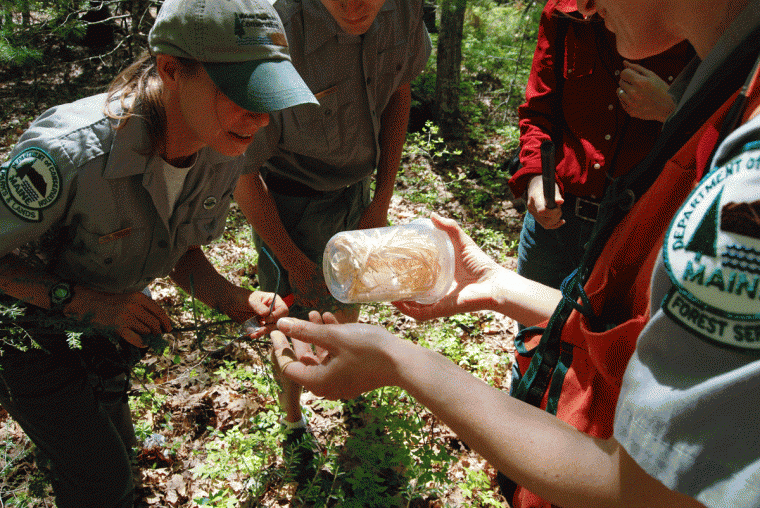 Ferry Beach State Park Rangers Janet Mangione and Nate Pierce check out the beetles the Maine Forest Service introduced to Ferry Beach State Park early in May. Forest entomologist Allison Kanoti holds the container of beetles. (Photo courtesy of Maine Department of Conservation)
Comments are no longer available on this story