
SOUTH PORTLAND – At the first of three “community building” events at South Portland’s Kaler School of Inquiry and Exploration on Sept. 24, it was hard to find a single parent willing to say the elementary school deserved the failing grade it got from the state last May.
The state grade, based on results of the New England Common Assessment Program – a test given each fall to measure the retention of information from the previous school year – factored raw scores in reading and math with growth from the previous year. The growth measure was then weighted to account for student test scores schools-wide and those of the bottom 25 percent of performers.
On a possible 400-point scale, Kaler received 169.3 points, the seventh-worst cumulative score of all 422 schools measured that house grades 3-8 in Maine.
But it was not news to staff and administrators of the school on South Kelsey Street. Kaler has the highest number of low-income students in the city, 58 percent of its 258-child enrollment. In addition, 36 percent of Kaler kids are in special education.
In 2011, the school began a “renewal” effort that included a name change – from James Otis Kaler Elementary School to The Kaler School of Inquiry and Exploration, as well as a transition into “project-based learning,” a model that includes hands-on efforts that rely on trial and error rather than rote memorization.
The school also launched the first pre-kindergarten program in South Portland and last year began to offer a free breakfast, designed to give youngsters a chance to start their day interacting with staff and community volunteers, before launching into their “work day.”
“In this informal setting, our community gathers to share the adventures of the previous night, good books they are reading, or news of the day,” said principal Diane Lang. “By ensuring that each child has an opportunity to have some time checking in with an adult, they develop relationships and prepare to have a wonderful day of learning.”
This year, Kaler has rolled out another new routine for start-of-the-day activities. Called “morning meeting,” it is a part of the “responsive classroom” model that all Kaler teachers spent 40 hours learning this past summer.
In morning meeting, students take time to actually meet each other, whether it’s simply shaking hands or adding an academic component such as making some students become “capitols” and others become “states,” and then having the students find their correct partner.
The idea, says Lang, is to create a more constructive school community by making sure all students interact with each other.
“You will learn best when all of your basic needs are met – when you’re fed, when you feel safe, when you feel like you belong,” said Lang. “We’re trying to meet all of those basic needs and then, from there, our students can really feel free to explore.”
Other aspects of the “responsive classroom” include: “rules and logical consequences,” in which students role-play to model proper classroom behavior; “guided discovery,” a technique that moves students through a deliberate and careful introduction to new experiences with no assumption that they already know how to do something before they begin; “classroom organization,” which provides “active interest areas” for students and space for student-created displays of work along with a mix of group and individual instruction; “academic choice,” in which students are invited to take control of their own learning; and “assessment and reporting” to parents on results.
Each Kaler teacher is required to employ all six aspects of the responsive classroom model.
So far, says Lang, it’s too soon for any of these new structures to show up in annual test results. However, there already has been a marked improvement in an area she considers to be perhaps even more important: Attendance.
In the 2009-2010 school year, 41 percent of Kaler students missed eight or more days of school. Last year, that number dropped to 29 percent, and Lang feels project-based learning, breakfasting with an adult, and the morning meetings are a direct cause of that uptick in attendance.
“So far this year it’s been even better and we’re going to keep on trying to get that [absenteeism] lower,” said Lang. “I think they are here regularly because we have an engaging curriculum, and we’re building relationships. From there the scores are going to go up.”
Parents who sat through a demonstration of the morning-meeting concept at Kaler’s Sept. 24 community night say they are impressed with the result, as well.
“I love it. I think it’s great, it’s a great sense of community,” said Karen Grenier. “I love how this school gets the kids really, really involved and excited about doing the right thing and being kind to one another.
“It’s a way of really approaching learning in a positive way and empowering the kids to do the right thing with great structure and having them being accountable for their own actions,” Grenier said. “It’s getting a great response from my son with his first year in kindergarten.”
“It’s nice to know what they do to start their school day. It’s fun for them to talk about how they feel and express communication to each other,” added Kristine Bastarache, parent to a first-grader. “It’s definitely a good step. It’s sad to see your child’s school get a failing grade. When you get that letter in the mail you are concerned about it and you ask questions, but I think they are taking all of necessary steps they can to build a better school, and I think half of a great school is the environment.”
Kate McGrath said she was given the opportunity to send her children to another South Portland school in 2011. That was the year Kaler landed on a federal list as a Continuing Improvement Priority School for failing to meet “adequate yearly progress” toward federal education goals. As such, Kaler parents had to be given the option to withdraw their students for enrollment in other city schools. About 40 did so, while another 20 children simply disappeared from the district, dropping pre-K through Grade 5 enrollment to 176, from which the school has since rebounded.
“I gave it a shot here, and I haven’t been disappointed, “she McGrath. “I think the teachers are top-notch amazing.”
Kaler finished its Sept. 24 event with a short rally held in conjunction with the International Day of Peace. On Sept. 25, the entire school hiked up Bradbury Mountain in Pownal. The final event will include a K-5 tour of the Southern Maine Community College campus.
 Students, staffers and parents at South Portland’s Kaler School of Inquiry and Exploration form a peace symbol and sing a song of brotherhood during the school’s annual Community Night, Sept. 24, held to coincide with the International Day of Peace.
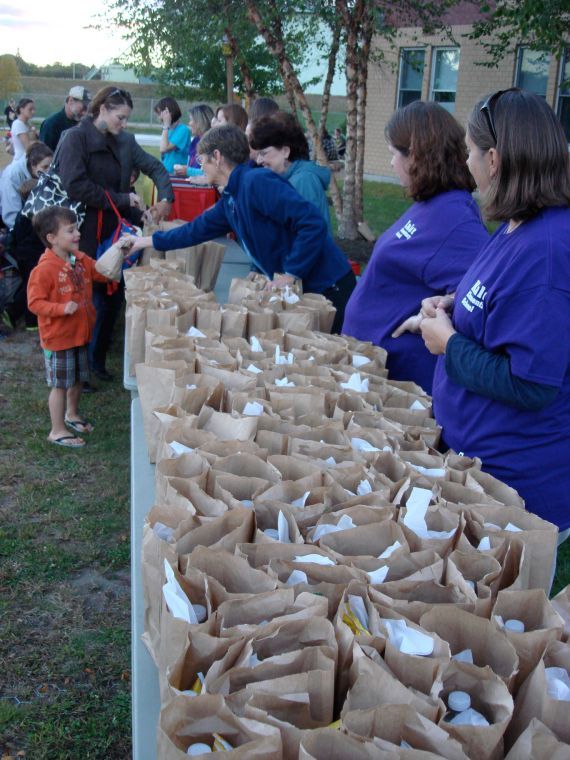 Staffers at South Portland’s Kaler School of Inquiry and Exploration hand out bag lunches to students and parents during the school’s annual Community Night.
 Karen Grenier and her daughter, 2-year-old Meya Grenier-DiDonato, enjoy a picnic on the front lawn of Kaler School of Inquiry and Exploration along with Grenier’s son, right, kindergartner Reeve Grenier-DiDonato, during the school’s annual Community Night on Sept. 24.
Comments are no longer available on this story