
Many children in the former Soviet nation of Belarus have no future. Those who live in derelict shacks are subject to malnutrition and physical abuse. Others are abandoned and left to the streets, or put in poorly supervised orphanages.
Belarus is a landlocked Eastern European country located between Poland and Russia. It received the majority of the nuclear fallout from the Chernobyl disaster in 1986, and poverty is rampant.
Moved by the plight of these children, members of a Gorham church are doing their best to make a difference. Mariya Barankevich, 22, of Windham, is a member of the First Russian Baptist Church on Mosher Road. She and other members of the church have been making the 4,100-mile trek to Belarus since 2002 to spend time helping some of the country’s abandoned children, as well as those in Siberia.
“We go there for a month and we live there with the kids,” said Barankevich, who first went in 2004. “It’s an amazing experience. It makes you value your life from a different perspective.”
The church’s ministry group, called Hand in Hand, is raising money to buy Christmas gifts for the orphanage children. They will depart on Dec. 28 and present to each child a small toy and a piece of fruit in a box.
“The whole goal of our mission isn’t just to give them physical support,” said Barankevich. “We want to give them love and dignity, too.”
A cycle of poverty
Belarus has a population of about 10.3 million, and 35,000 are in orphanages.
“These children have never really known love,” said Dr. Karen Lemke, an elementary education professor at St. Joseph’s College in Standish. She said the Chernobyl nuclear disaster has created a host of problems that fill the orphanages.
Lemke said after the nuclear fallout killed an untold number of parents and grandparents, the economy became unstable and many people turned to alcohol. Most of the children in the orphanages still have parents who are alive – so technically, they are not orphans – but have been abandoned or the parents were deemed unfit to care for them.
“It’s a cycle of poverty and alcoholism,” said Lemke.
She said Barankevich was a student in her human development class a few years ago and did a presentation on Belarus orphans that shocked most of the class.
“They didn’t know how dire the conditions were,” said Lemke.
Her students were moved by the images of children who have never been shown love or compassion. Since then she and her students have been helping to raise money for Hand in Hand. This week they have been collecting donations.
A few years ago it cost about $2.50 to give each child a gift package. The same present now costs $4 because of inflation.
In addition to raising money, St. Joseph’s College students have been making Christmas cards in Russian for the orphans, and they get grateful letters back.
“They’re so happy about it,” said elementary education major Danielle Johnson, 20. “I was teary-eyed.”
“What we’re doing is a drop in the bucket, and a leaking one at that,” said Lemke. She said the Belarusian President Alexander Lukashenko has ignored the problem and in 2004 made it illegal for the orphans to be adopted outside of the country.
The United Nations won’t help either, said Lemke, because the orphans are not refugees or displaced, and are still getting an education.
Ready to go
Dwayne St. Ours, 43, of Gorham is one of about 60 volunteers from Hand in Hand who will depart at the end of the month and return in mid-January. Group members stay in churches. It will be his 10th time visiting Belarus.
St. Ours works at the U.S. Postal Service in Portland. He and his wife of 15 years, Irina, have adopted two children from Belarus. He said Natalia, 15, and Andrey, 13, are just two of the eight adopted kids in his extended family.
“We love kids. God has blessed us, and we want to give back a little,” said St. Ours. He and Irina also have two biological children, Anastasia, 9, and Roman, 5.
“When you go over there and you see all these wonderful kids, you want to help them. I wanted to adopt all of them,” he said.
St. Ours met his wife in 1991, when she was a part-time Christmas worker at the post office. She was a Christian refugee who immigrated from Kazakhstan, a country in central Asia bordered by Russia and China, in 1989.
Since then he’s learned the Russian language, but he said his kids correct his grammatical errors on a regular basis.
“It’s a hard language, I promise,” he said.
St. Ours said he is looking at adopting another boy and girl, this time from Siberia.
“We know the kids in Belarus. We probably would adopt from there if we could,” he said, as it is now illegal for foreigners to adopt Belarusian children.
A different world
Barankevich was last in Belarus in June to spend time at several orphanages. She said the culture is very different from ours.
“You only smile to people you know, and the general mood is very repressed and sad,” said Barankevich.
Barankevich and the other mission members perform day-to-day activities with the children, from chores to afternoon soccer matches. They teach them arts and crafts and sing songs with them in Russian.
“When we teach them to pray, a lot of the time they pray for their parents,” said Barankevich.
She remembers seeing two girls arrive at an orphanage who had to get their heads shaved because they had been living with their mother in a lice-infested mud hut.
“We asked, ‘What is your mother’s name?’ and they said, ‘The Drunk,'” Barankevich recalled.
A lot of the children were dropped off somewhere by a parent who never returned, or left to die in a trash bin or on the railroad tracks.
She remembered seeing one shy boy pick up a stick and start hitting everyone in sight with it. When he was asked to stop, he said, “Why? It is what my father always did.”
Barankevich said that in America a 5-year-old is considered a baby, but in Belarus you can see children of that age living on the streets, taking care of themselves. They keep warm by crawling under houses and sleeping next to the hot water pipes.
While life in the orphanages is better than on the streets, they are still a rough place for a child. Adult supervision is limited and many kids abuse alcohol. Barankevich said it’s not uncommon to see 5-year-olds smoke cigarettes or pregnant 16-year-olds.
And the children those girls have usually end up in orphanages.
Barankevich said only about one-tenth of the orphans will end up with a somewhat normal life. About half of them will end up in jail and another one-tenth will commit suicide.
The boys who want a legitimate job can find work as a builder, plumber or carpenter. Barankevich said the girls can get a job sewing or cooking. Aside from those vocations, they have few options.
Mariya Barankevich’s sister, Sasha Barankevich, 24, who has also participated in Hand in Hand, said many of the girls turn to prostitution.
“I was amazed at the list of the girls who I had met that were out on the street,” she said. “I just sat down and cried.”
Mariya Barankevich, whose family immigrated to America from Kyrgyzstan when she was 6, said she feels blessed to have all the opportunities that are possible in America. Her family moved here after her father had a near-fatal motorcycle accident.
“We could have been orphans, too,” she said.
HELPING HAND
Donations to Hand in Hand can be sent to the First Russian Baptist Church, P.O. Box 695, 211 Mosher Road, Gorham, ME 04038. Checks should be made out to the church.
For more information, log on to www.handforyou.org.
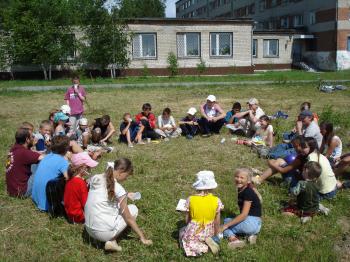 Belarus1: Maine volunteers from Hand in Hand sing songs with orphans in Siberia. Hand in Hand is a ministry program from the First Russian Baptist Church in Gorham that has helped brighten the lives of orphans in the former Soviet Union since 2002.
 Belarus3: This Belarusian orphan Eugene, 12, smokes a cigarette after plastering himself with arts and crafts supplies. Eugene’s mother abandoned him shortly after birth. Smoking and drinking is common among the 35,000 orphans in Belarus.
 Belarus 4: Children play at an orphanage in Grozava, Belarus. Hand in Hand volunteers, a ministry program from the First Russian Baptist Church in Gorham, have been visiting orphans in the former Soviet Union since 2002 to help brighten their lives.
 Belarus 7: Sasha Barankevich, 24, translates the thank-you notes of Belarusian orphans to elementary education major Kayla Soucy, 19, at Saint Joseph’s College in Standish. Students of Dr. Karen Lemke have been drawing Christmas cards and raising money for the orphans since 2004.
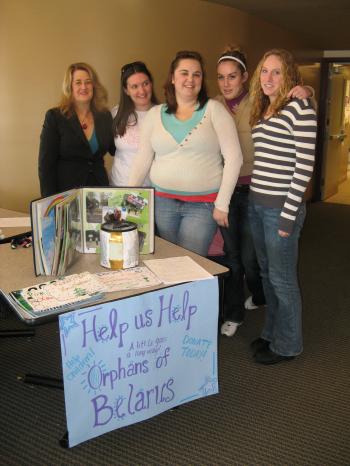 Belarus 6: Dr. Karen Lemke and some of her elementary education collected donations for the orphans of Belarus and wrote them Christmas cards in Russian. From left: Lemke and students Crystal Malloy, Danielle Johnson, Carolyn Freeman and Kayla Soucy.
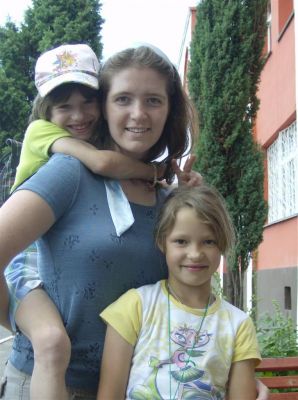 Belarus 10-11: Mariya Barankevich, 22, of Windham is shown here with orphans from Belarus as part of a missionary trip from the First Russian Baptist Church in Gorham that has helped brighten the lives of orphans in the former Soviet Union since 2002.
 Belarus 10-11: Mariya Barankevich, 22, of Windham is shown here with orphans from Belarus as part of a missionary trip from the First Russian Baptist Church in Gorham that has helped brighten the lives of orphans in the former Soviet Union since 2002.
 Belarus2: Maine volunteers from Hand in Hand sing songs with orphans in Siberia. Hand in Hand is a ministry program from the First Russian Baptist Church in Gorham that has helped brighten the lives of orphans in the former Soviet Union since 2002.
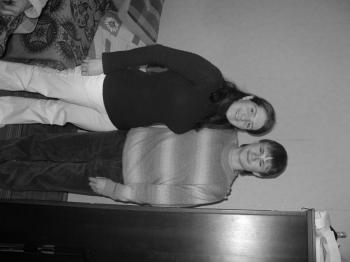 Belarus 5: Mariya Barankevich, 22, of Windham is shown here with Misha, one of the orphans from Belarus she met as part of a missionary trip from the First Russian Baptist Church in Gorham that has helped brighten the lives of orphans in the former Soviet Union since 2002.
Comments are no longer available on this story