
It’s difficult for many adults to identify their dreams and passions, let alone a 13-year-old kid. For Cape Elizabeth High School alumnus Henry Kramer, that’s when he knew what he wanted to do for the rest of his life.
Kramer, now 18, said that’s when it happened for him.
Kramer, who is now studying piano in his freshman year at Juilliard, has been playing since he was 11. He will perform a noonday concert today at the First Parish Unitarian Universalist Church at 425 Congress St. in Portland.
At the age of 13, Kramer had an epiphany: He was going to play the piano for a living.
“I decided that’s what I wanted to do forever,” he said.
His piano teacher at the time, Portland resident Elizabeth Manduca, introduced him to the national student music scene. It was as a spectator, at this introductory national competition in Minneapolis, Minn., that the realization materialized, said Kramer.
Manduca said Kramer had an innate natural talent and at the time was better than any other players in the area. She wanted to broaden his perspective, and help him realize the amount of work involved in becoming great.
“He needed to see the big picture,” she said. “He needed to get out and see what really terrific players were like.”
Kramer had been unaware until then that students his age studied classical music seriously. “I was totally amazed,” he said. It was then he decided to pursue piano as a career.
But Manduca said there were struggles along the way. Though Manduca knew Kramer was a capable, passionate and inspired student, she said he had his own reservations about making a career out of music. Kramer was unaware of the discipline and commitment required for the profession.
“He was a bit overwhelmed by the work it took,” she said.
His reservations were typical to anybody considering a music career, she said. “Making a career in music, is very difficult and there are a lot of unanswered questions all the way through,” she said. But she said, “he certainly stepped up to the plate.”
Kramer’s mother, Patricia Callahan, a dialysis nurse, said Kramer worked diligently convincing Manduca he was serious about his lifelong pursuit. “She wasn’t sure if piano was a passing fling,” said Callahan.
It was Kramer’s mother who initially pushed him into piano lessons at all. Kramer did not want to study piano. As his mother called to arrange lessons, Kramer knelt on the floor begging her not to do it. “I thought piano was for losers,” he said.
His mother decided to sign him up for lessons after witnessing his repeated attempts to play a song by ear. “He’d listen to the CD, and then try to make it happen on the piano,” said Callahan.
That’s when she decided piano lessons might be a good idea. “I just figured he’d be less frustrated,” she said. Inspired by a friend who was learning piano as well, Kramer began teaching himself the song his friend played for him. He learned his first song, the theme to “Titanic,” by ear. Now, he said, that admission is “kind of embarrassing.”
It was during that first competition he also discovered contemporary French composer Maurice Ravel, now one of his favorites. For Kramer, classical music isn’t intellectual; it’s emotional. He thinks young people are intimidated by classical music because it’s perceived as an intellectual pursuit.
For him, it’s simple. Its mission is emotion. He argues the music is “whatever you feel. Trust that,” he said. “It’s not too complex.”
Prior to realizing his passion for piano, Kramer thought he might pursue psychology or study law. Though still interested in taking psychology classes, he smiles coyly when admitting he ever considered studying law.
Kramer has also experimented with the saxophone and percussion, xylophone and bass drums.
Since then, everything else, aside from his social life, has taken a backseat to piano – to the detriment of his schooling at times. Though he was never a poor student, Kramer concedes he could’ve derived more from his formal public education than he did.
“Some assignments weren’t handed in, in a prompt manner,” said Callahan.
That, however, didn’t prevent him from getting into one of the most prestigious music schools in the country. Kramer attends Juilliard in New York City where about 7 percent of applicants are admitted to the music program, said Kramer.
While preparing for his college auditions, Kramer would rise at 4 a.m., play until school started, and then return home to play until midnight. During this time, he practiced, on average, six to eight hours a day.
“He slept through some classes,” said his mother.
Kramer will return to Juilliard for the spring semester, but not before playing a few concerts locally. In addition to today’s noonday concert at First Parish Unitarian Universalist Church in Portland, he will also perform for a local assisted living facility and also play in Boston.
Kramer has appeared on National Public Radio’s student musician show “From the Top” twice as a soloist, studied at the Bowdoin International Music Festival, and graduated from the pre-College division of the Juilliard School last year.
 Pianist Henry Kramer will perform a noonday concert today at First Parish Unitarian Universalist Church at 425 Congress St. in Portland.
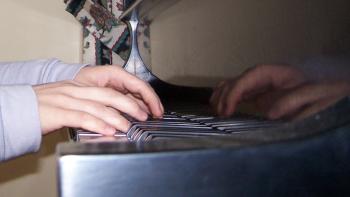 Cape Elizabeth alumnus, 18 year old Henry Kramer began studying piano when he was 11.
 The first song Henry Kramer played on the piano was the theme song to Titanic.
 A passion for piano
Comments are no longer available on this story