
WINDHAM – While politicians and pundits wrangle over the impact the national debt has on America’s overall economy, local business leaders are more focused on a recently released study of the North Windham retail sector that reveals the commercial hub of the Lakes Region is having trouble clawing its way out of the recession.
According to the numbers, which were compiled by Tom Bartell, Windham’s economic development director, using state sales tax figures from the State Planning Office, North Windham’s retail economy shrank 18 percent from 2006 to 2010. In comparison, the overall Maine economy decreased 4.2 percent in the same period.
While the overall trend shows a long-term downward trend starting in 2007, the retail economy of North Windham started rebounding in 2009, with 2010 numbers only slightly lower than 2009.
In dollar terms, all retail businesses in North Windham, such as restaurants, supermarkets and auto dealers, earned $274 million in 2006, its historic peak. That number shrank to $263 million in 2007. As the national economy started to sour, North Windham’s retail activity dropped to $250 million in 2008 and $227 million in 2009. In 2010, North Windham retailers did $224 million worth of sales, a small decline, but at a less precipitous rate than the previous two years.
In comparison, statewide numbers aren’t so grim. In 2006, retailers in the state did a total of $17.18 billion in sales. In 2007, when North Windham was starting to lose ground, state retailers increased revenue to $17.41 billion. In 2008, Maine retailers dipped to $17.15 billion, followed by a 2009 that saw $16.01 billion in retail spending. In 2010, state retailers did $16.46 billion in sales, showing an uptick in activity compared to Windham’s continuing downward trend.
Causes
Among the major drivers of the recession, Bartell noted, is the stagnant construction industry. The Lakes Region is home to many beautiful homes and seasonal dwellings. In the mid-2000s, the towns surrounding Sebago Lake were also a hotbed of subdivision activity. But when bank lending dried up and mortgages were harder to come by, new housing starts flagged and construction dropped off. With fewer contractors finding less work, stores like Lowe’s and Home Depot were negatively impacted.
According to sales tax figures, by 2010 building materials sales were off 40 percent from their highs in 2006. In comparison, Maine’s building materials sales were off 22 percent.
According to the State Planning Office’s figures, supermarkets in North Windham also took a hit, with sales off 5.5 percent from 2006. In comparison, statewide supermarket sales increased 10.1 percent from 2006 to 2010.
Other major downward drivers include lodging, which was down 49.6 percent in the five-year study period compared to the statewide increase of 9 percent. In addition, the automobile sales and repair sector has decreased 19.4 percent since 2006, double the statewide decrease of 9.3 percent.
A small bright spot in North Windham’s numbers is restaurant sales, which increased .5 percent between 2006 and 2010. Still, statewide, restaurant sales jumped 8 percent in the same period.
In addition to the impact the housing market has had on North Windham’s economy, Bartell said, food store sales are an important economic driver since many shoppers come from around the region to shop at supermarkets such as Shaw’s, Hannaford and Walmart. But with stores opening in other areas, such as the new Hannaford on Route 26 in Gray that opened in 2009, fewer grocery shoppers are driving from outlying areas, Bartell said.
“Supermarket traffic really drives sales in other areas. So if they don’t need to come to North Windham to do their grocery shopping, that’s one less opportunity for other retailers in town to capture their business,” he said.
Since most supermarket food isn’t taxable, Bartell said, the State Planning Office used a formula incorporating taxable items at supermarkets, such as pet food and paper products, to determine overall sales.
Feedback
While local business leaders aren’t surprised by the shrinking North Windham economy, some were surprised at the lack of a turnaround locally to mirror the rebound that seems to taking place in the statewide figures. Barbara Clark, executive director of the Sebago Lakes Region Chamber of Commerce, which is headquartered in North Windham, says local retail “continues to be challenging.” She said businesses are seeing swings not just seasonally but week to week as world news seems to dictate Americans’ spending behavior.
“It’s a very mixed bag, and these (business) owners are telling me they’re seeing week-to-week changes depending on international and national headlines such as the debt situation,” Clark said. “Locally, they’re saying it’s affecting them almost on an hour-to-hour based depending on what the news media is saying. But overall, tourists and locals are just cautious.”
Clark sees some bright spots, especially with Naples’ ongoing transformation of its downtown thanks to the new bridge project. She expects the Naples renovation to be a regional economic driver in years ahead as more people flock to the area.
“There’s a lot of excitement in Naples, a lot of excitement from everybody,” she said. “And that’s good for the whole region.”
Clark said the chamber is also employing new tactics to bolster the North Windham retail community by establishing a new Retail Committee last year. Chaired by Dan Hancock of Gorham Savings Bank, the retail committee launched a Shop Local campaign this summer that aims to remind year-round residents to spend their money in Windham.
Laurie Noel, of Cross Insurance, helped start the Retail Committee when she was the chamber’s president last year.
“We just realized that we didn’t have a lot of retail members and that was mostly because the chamber wasn’t doing anything for them,” Noel said. “So I created a retail committee to address those needs.”
Involved in business banking at Gorham Savings Bank, Hancock has taken the Retail Committee as his personal passion. Familiar with the area’s economic issues, Hancock wasn’t too surprised with the North Windham retail survey results.
“Basically, what you see in Windham is pretty much reflective of what’s happening across the country,” he said. “Windham’s decrease is a bit steeper, which is attributable to the building sector, which is always a major factor.”
Hancock said the new Retail Committee is a way for local business owners to band together. The committee has held two meetings so far seeking input from local business owners. Hancock said the committee is one prong in a three-prong approach that includes Bartell and the Windham Economic Development Corporation. All three, he said, are helping to draw businesses to Windham and market the region in local and regional media, including newspapers and TV.
“There’s a lot of cooperation starting to happen because it’s serious enough that it needs all three groups working on it,” Hancock said.
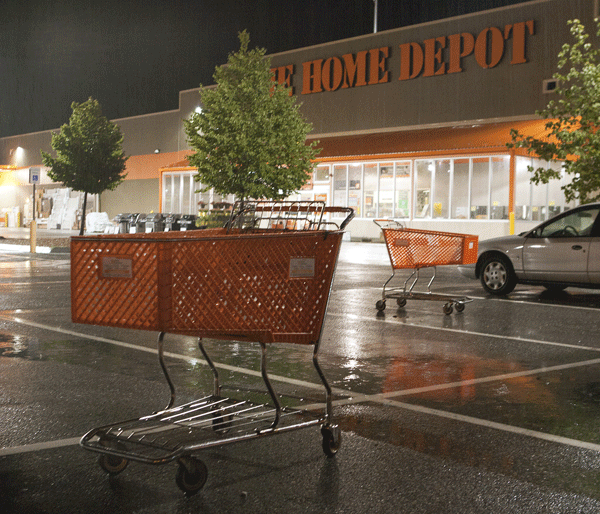 According to a recent study, North Windham’s retail sales were
Comments are no longer available on this story