
A Maine railroad startup that hopes to move freight on a state-owned portion of the Mountain Division line starting as early as this summer is awaiting the outcome of lease negotiations with the Maine Department of Transportation.
“It’s up to the state and how they perceive our presentation,” said David Schwanke of Norridgewock, the president of Golden Eagle Rail Corp. “It could be a go. It could be no.”
According to Schwanke, a former logistics manager for the Hollywood film industry, the three members of the rail startup hope to secure the rights to a continuous rail line running from Portland to St. Johnsbury, Vt., that would ultimately host freight trains, as well as ski – or “excursion” – trains running from Portland to the White Mountains. The company is in discussions with the states of Maine, New Hampshire and Vermont, as well as businesses in all three states, Schwanke said.
Nate Moulton, director of the transportation department’s rail program, most recently met with Schwanke on Jan. 15 to discuss a potential lease of 45 miles of state-owned rail that would last for a minimum of a decade. Moulton said he asked Schwanke to “update” his business plan for the line, but declined to discuss the original deficiencies in the plan.
“Our goal is to put these lines back in service,” Moulton said. “We need to be able to see data and information that backs up the vision. It’s one thing to say, ‘I’d like to run this service,’ it’s another thing to bring forward and meet all the needed criteria. If we’re going to lease this property and tie it up for a period of time with a railroad, we need to make sure they’re going to make good use of it.”
Construction of what is now known as the Mountain Division line, which runs from Portland to North Conway to St. Johnsbury, and winds through Windham, Gorham, and Standish, began in 1869. The line closed in 1983, and in 1998, the state Department of Transportation acquired 40 miles of the line, stretching from Windham to Fryeburg. The department acquired another five miles, stretching from Windham to Westbrook, in 2008. Pan Am Railways owns six miles of the rail, from Westbrook to Portland.
While much of the Mountain Division line already has 85-pound-per-yard track, which can support freight trains at 25 mph and passenger trains at 30 mph, much of it is lying on an eroded rail bed. Before freight or passenger rail can be reintroduced, the entire works need to be replaced, especially at road crossings where the rail has in many places been paved over. The department estimates that it would cost at least $20 million to rehabilitate the Maine section of the Mountain Division. The department’s Office of Freight Transportation estimated in 2007 that total costs of restoring the track and reviving rail service would cost more than $31 million for the Maine section of the Mountain Division line.
On Jan. 6, Schwanke appeared in Standish before the Route 113 Corridor Committee, a regional economic development group established in the mid-2000s that has sought to create jobs by revitalizing the Mountain Division line. During the meeting, Schwanke updated the committee on his plans, and faced hard questions, particularly relating to rail financing.
Golden Eagle hopes to run Class 1 freight trains, which are allowed to travel a maximum of 10 miles per hour, on the Mountain Division as early as this summer, Schwanke said. Schwanke said he has spoken with 15 businesses that have expressed interest in shipping goods on the Mountain Division, once the freight trains are up and running. Ultimately, the company would like to run a Class 3 passenger service – which can travel up to 60 miles per hour – on the line by the fall of 2016. According to the department’s 2007 report, Class 3 service, which costs more than double Class 1 or 2 rail, requires 115-pound-per-yard rail and other track material to anchor the rail.
Schwanke said the company expects to invest $11 million in parts of the line in Maine and New Hampshire by the winter of 2016, and another $10 million to $20 million by the summer of 2017.
Tony Donovan, the managing director of Maine Rail Transit Coalition and an advocate for commuter rail on the Mountain Division line, questioned whether $11 million would be enough to run Class 1 freight on parts of the line.
“Your numbers are extremely off of anything that anybody has ever done on a study about rail that I’m aware of,” Donovan said.
“That’s yours and everybody else’s opinion,” Schwanke responded. “It’s not ours. Sitting down and going through, what we figured out we can do is get this up to a Class 1. It’s all we’re looking at doing at this time. If we get told no over here, we go over into New Hampshire. We continue on from there. All we can do is get a start. This is just a start.”
Donovan asked Moulton if $11 million would be a large enough investment to revive freight on the Mountain Division.
“That’s not what our report says,” Moulton said. “That’s not what our stuff indicates.”
Following Schwanke’s presentation at the corridor meeting in Standish, Caroline Paras, economic development planner for the Greater Portland Council of Governments, asked Moulton whether the department is likely to approve Golden Eagle’s lease request.
“What is DOT’s position on allowing the line to be rebuilt and operate at a Class 1 standard?” Paras asked.
Instead of directly answering the question, Moulton told an anecdote about the Maine Northern Railway, which operates on a state-owned line in Aroostook County.
“The railroad has yet to make a dime,” Moulton said. “They’ve operated 31?2 years, probably lost $6 million. Luckily, we have a very good partner with deep pockets, that has agreed to stick this out for a while. But without that, very likely, that project would be a failure at this point.”
Moulton also warned of the possibility that truckers would simply drop their prices if a freight rail cut into their business.
In summer 2011, a crew of laborers from South Portland-based Maine Track Maintenance laid rail along the 5.25-mile section of the Mountain Division line from Bridge Street in Westbrook almost to the Mallison Falls Road rail overpass in South Windham. The $4 million project, which turned the section of the Mountain Division into a “rail-with-trail,” was approved by Maine voters as part of a $47.8 million transportation bond package in June 2010.
With the backing of state Sen. Bill Diamond, a Windham Democrat, an additional $21 million was to be placed in a bond package to be put before voters in 2011, funds that would have finished the remaining 45 miles of the line. However, Gov. Paul LePage and Republicans in the Legislature, who campaigned on promises to curb government spending and borrowing, nixed any talk of bonds that year, setting aside a reported 29 bills seeking bonds for a variety of infrastructure projects.
Diamond, who attended the Route 113 Corridor Committee meeting, said he wasn’t sure what would happen with Schwanke’s Mountain Division proposal, which has revived the idea that the entire Maine section of the Mountain Division line could be restored.
“I’ve only heard him speak twice,” Diamond said. “I don’t know how real it is or isn’t.”
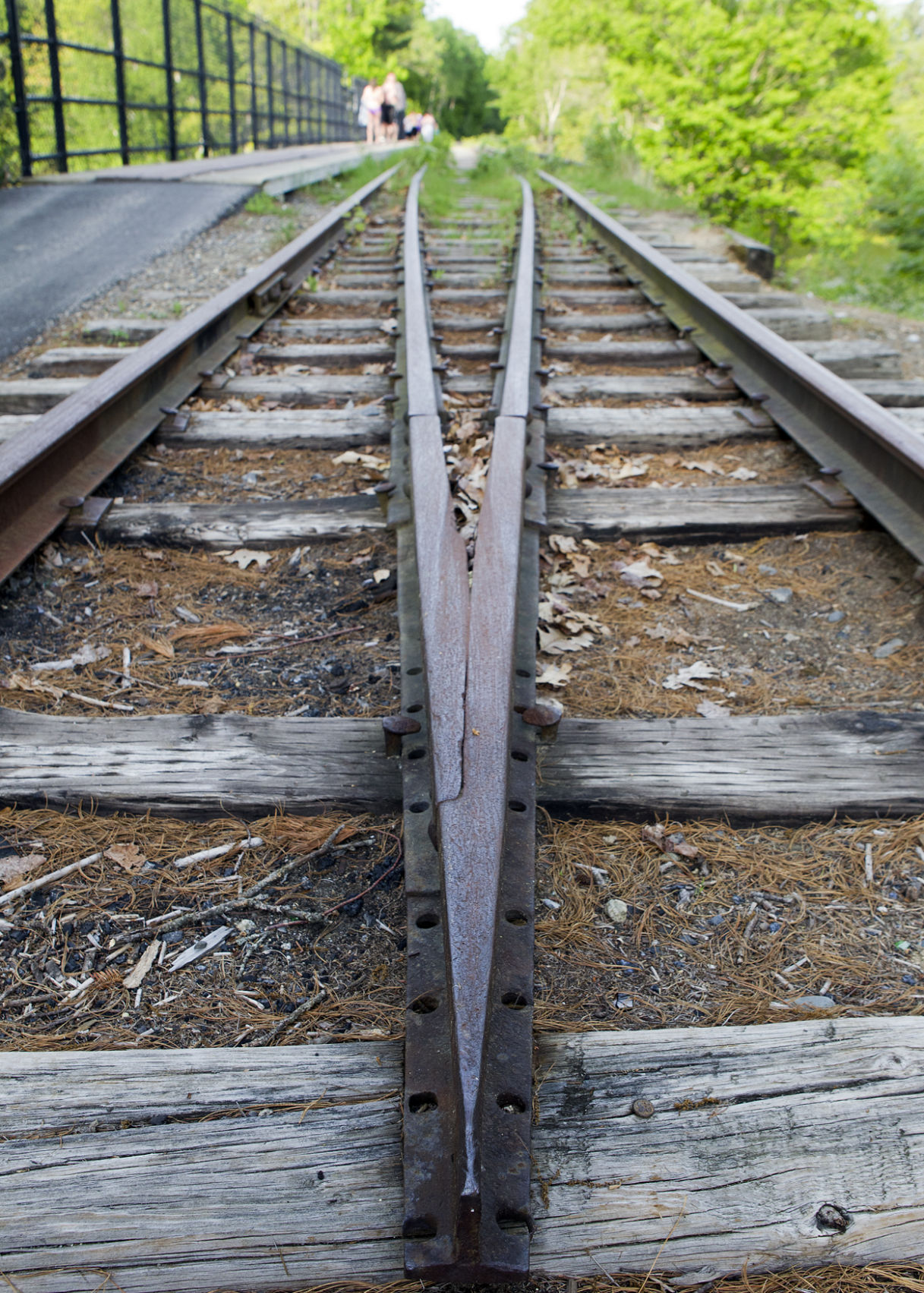 The Windham-to-Standish section of the Mountain Division rail line, along with much of the line from Portland to St. Johnsbury, Vt., would need to be upgraded to support passenger or freight trains. A Norridgewock man is considering leasing the rail line from the state and pay for improvements for freight and, eventually, passenger service. File photo
Comments are no longer available on this story