
Majestic. Stunning. Noble.
Those are some of the adjectives people use to describe many of Maine’s more than 60 lighthouses. But they tend to use another word when talking about Portland Breakwater Light in South Portland – affectionately known as Bug Light.
“It’s so cute,” said Sara Gorstein of Portland, after touring the little lighthouse with her son, William, 4, on Saturday, Sept. 12, Maine Open Lighthouse Day. “I love the size of it.”
Bug Light, one of the smallest and most distinctive lighthouses in Maine, was among the many state beacons open for tours during the event on Saturday, the first of its kind in the nation.
Maine Open Lighthouse Day was sponsored by the state, the U.S. Coast Guard, and the American Lighthouse Foundation to increase awareness of Maine’s maritime heritage.
More than half of the state’s 52 operational lighthouses, located all up and down the coast, were slated to be open free of charge, and visitors flocked to see them, despite rain showers in some locations.
Some of the lighthouses that drew big crowds included Portland Head Light in Cape Elizabeth, one of Maine’s most famous and photographed lighthouses, and South Portland’s two lighthouses: Spring Point Ledge Light and Bug Light.
Each lighthouse has a unique story and each has its own special appeal to visitors.
For example, one reason visitors enjoy the 112-year-old Spring Point Ledge Lighthouse is the picturesque hike to get there. The beacon of that “spark plug” or caisson-style lighthouse, was first lighted in 1897, and the structure originally was only accessible by boat. But a 900-foot granite breakwater, built in 1951, now stretches out to it, affording visitors scenic views of Casco Bay as they clamber over the rocks.
Spring Point Ledge Light, owned by the Spring Point Ledge Light Trust, is open 10 to 12 Saturdays a year, weather permitting. Its final scheduled opening this year is Oct. 10 from 11 a.m.-3 p.m. A $5 donation usually is requested for the lighthouse tour, with the money going toward maintenance of the lighthouse.
Ross Ketchum, chairman of the trust’s board of directors, said Maine Open Lighthouse Day was a boon for helping to increase awareness of Spring Point Ledge Lighthouse.
“I think of lot of people, even South Portland people, don’t know that we’re open and that the light is still working,” he said. “This helps us a great deal from a public standpoint.”
Bug Light, located in Portland Harbor about a half a mile from Spring Point Ledge Light, is seldom open, so Saturday’s event afforded visitors a rare opportunity to go inside.
The 134-year-old lighthouse, owned by the city of South Portland, was last open in 2002, when its beacon was relighted 60 years after it was extinguished in 1942.
On Saturday, about 500 visitors stood in line for an hour or more to tour Bug Light. Even when it began to rain in the afternoon, most held their ground, just opening umbrellas.
The Rotary Club of South Portland-Cape Elizabeth maintains Bug Light. With the interest in the light shown on Saturday, the club may consider the possibility of opening the lighthouse on a regular basis, charging a small fee that would go toward upkeep, said Bug Light’s unofficial keeper, Jack Roberts. Roberts is a past president and current member of the Rotary Club.
He was pleased but not surprised by the number of people drawn to Bug Light on Saturday.
“That light has some real character,” he said. “There’s none other like it.”
Bug Light, whose tower was first lighted in 1875, stands out because of its appearance. For one thing, it’s small. The height of its tower is 26 feet, compared to the 54-foot tower of Spring Point Ledge Light and Portland Head Light’s 80-foot tower.
Also, said Jeremy D’Entremont, first vice president of the American Lighthouse Association and its historian, Bug Light’s design is unique.
“It’s probably the only lighthouse in America based on an ancient Greek monument,” said D’Entremont, the author of a new book, “The Lighthouses of Maine,” published in June.
Bug Light was modeled after the Greek Choragic Monument of Lysicrates, constructed in the fourth century B.C., according to a history on D’Entremont’s Web site, titled “New England Lighthouses: A Virtual Guide.”
Six fluted Greek-style columns surround its cast-iron tower. Thomas Ustick Walter, who designed the cast-iron dome on the nation’s Capitol, may have been involved with the design of the little lighthouse, according to D’Entremont.
The breakwater leading to Bug Light used to be about 2,000 feet long, more than one-third of a mile. But the cove near the lighthouse was filled in during World War II to build the South Portland shipyards, and the breakwater is now so short that people can just stroll up to the lighthouse.
“I love the fact that Bug Light is right on the land,” said Kathy DiPhilippo. She’s the historian for the South Portland Historical Society, which this year moved into a new home at Bug Light Park. The lighthouse sits at the tip of that city-owned park, which was built on land where the shipyard used to be.
Bug Light, at which people sometimes hold weddings with the city’s permission, is visible from the historical society’s windows and front porch.
“You can walk right up to it. It’s very accessible,” DiPhilippo continued. “It’s a cute little lighthouse.”
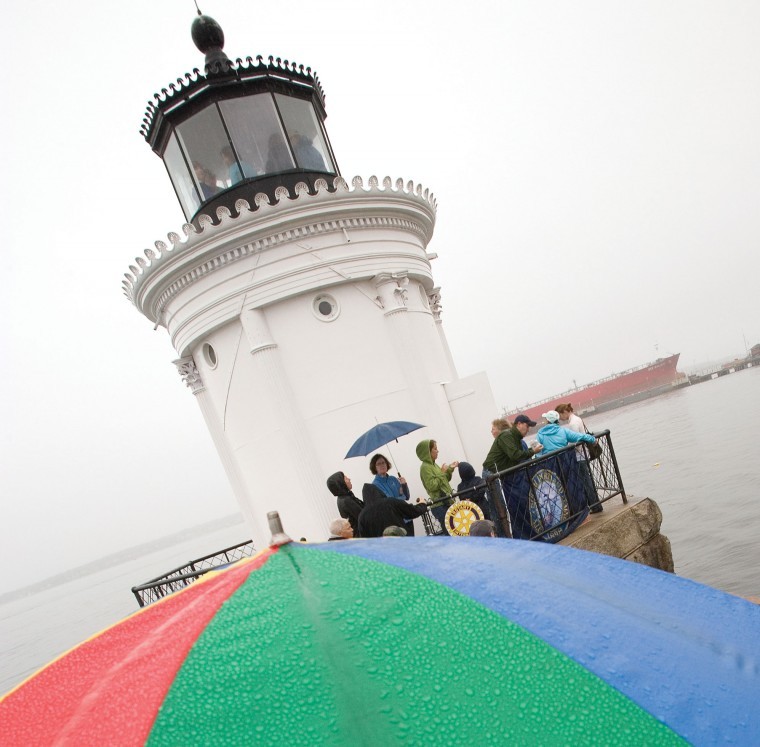 A bit of rain made the wait seem longer, but didn’t turn away many lighthouse fans who waited in line Saturday for a chance to tour historic Bug Light on the South Portland waterfront. The beacon was open to the public for tours as part of Maine Open Lighthouse Day. (Photo by Rich Obrey)
Comments are no longer available on this story