
Ben Jensen, who grew up on his family’s beef cattle and hay farm in western Montana, is right in his element as the livestock manager at Wolfe’s Neck Farm in Freeport.
Jensen, 32, lives in Freeport with his wife Carolyn and twin daughters, Caitlin Mabel and Charlie Anne. He earned a degree in animal science livestock management at Montana State University, where he met his future wife. He interned as a breeder of Hereford cattle.
The Jensens moved to her home state of Massachusetts, then he took the job at Wolfe’s Neck Farm a little more than a year ago.
“When we had our girls we wanted to move back to New England,” Jensen said. “We lived in Massachusetts for about a year then found a place in the north Freeport area a little over a year ago.”
Jensen answered questions regarding his job at Wolfe’s Neck Farm, and the challenges of this snowy winter, for the Tri-Town Weekly.
Q: Do animals have special needs in late winter? When do they give birth?
A: Over the winter, I centralize all of our livestock in our pole barn at the Little River campus. The ewes came inside in early December when there was no more grazing, and I locked the hens inside their coop about a month ago, when the snow got so deep it was covering their door. During mild winters the hens can go outside almost every day. The cows and young stock have outdoor access all the time and a bedded indoor loafing area, and during major snow events I can bring their ring feeders under cover as well. The main needs of livestock during winter in New England are dry shelter, good quality stored feed, ventilation and clean water. All our animals have heated water sources so they are never without fresh water. Our ewes will begin lambing the end of March to avoid having lambs during snowstorms and below-zero temperatures. We are looking for our new herd of dairy cows, and we are shooting for them to start calving at the end of May.
Q: At what point are they able to spend more time outside their barns?
A: I will wean the lambs in the barn for about a week in May then turn them onto pasture. The ewes will go out a few days later. The cows start grazing as soon as weather permits. I will have the first run of pastured broilers outside in May, as well. We want to have our livestock outside grazing as much as possible, but we also do not want to cause damage to our pastures by putting heavy animals on very wet ground.
Q: How many animals do you care for, and what types?
A: Last season I custom grazed and calved about 40 Angus beef cows plus another dozen or so heifers, and looked after our small flock of about 20 ewes. I also grew about 150 broiler chickens on pasture in “chicken tractors” and 300 Thanksgiving turkeys. Currently, I maintain a flock of about 60 laying hens. This season, we are transitioning to an organic dairy operation where we will be milking about 60 cows and growing another 40-50 head of young stock (calves and replacement heifers). I also plan to switch from wool sheep to Katahdin hair sheep, purchasing some really high-quality stock from our friends at Crystal Springs Farm in Brunswick. Ultimately, I will expand the sheep operation to 35-40 ewes, raising 60-70 lambs. I will raise about 400 broiler chickens and another 300 Thanksgiving turkeys this year, along with another 150 hens and 15 ducks.
Q: Could you describe your daily routine?
A: I usually get up about 5:30 or 6 with my beautiful 2-year-old twin girls, change diapers, fix breakfast, stoke the fire, and of, course shovel snow. My amazing wife and I try to trade off who gets to sleep an extra half hour and who is on double diaper duty. Once everything is in order at our home place, I drive about 15 minutes to the farm and start the morning chore routine, which consists of feeding all the different animals and ensuring they have open clean water. Monday mornings I usually bring feed to the barn and every couple weeks I head to Ames Farm Center in North Yarmouth to pick up feed and necessities from the best little feed store in southern Maine. Over the winter I like to tackle farm carpentry projects and barn maintenance. I do chores again in the evening and head home to my girls.
Q: What are your standards for livestock feed?
A: Our Thanksgiving turkeys get only organic feed and all our livestock graze our organically certified pastures. The oats I feed to the ewes during breeding and lambing and our chicken feed are Blue Seal Feeds purchased at Ames Farm Center. Our dairy animals will eat only organic feed at all times. All the grain our livestock consume is clean, fresh, wholesome and is properly stored. All the forage consumed by our animals comes right off the farm’s hayfields. I do not feed any medicated feed as I do not subscribe to the idea of mass-medicating food animals.
Q: How much meat does Wolfe’s Neck Farm raise, and what types? Where does it go?
A: I will raise about 400 broiler chickens and 20 lambs this year, and in the coming seasons we will have lots of beef available again. In two years I expect to raise and sell at least 50 market lambs. And of course the 300 Thanksgiving turkeys, which are grown on pasture. Currently, Weston’s Meat Cutting and Poultry in West Gardiner does all our processing. It is a small, family-owned abattoir and they are absolutely top notch in every sense.
Q: What are your hobbies?
A: I love music, and I play a few different instruments well enough to be only mildly irritating. I also enjoy working with horses, tinkering with my truck, fishing, and tagging along on sailing adventures.
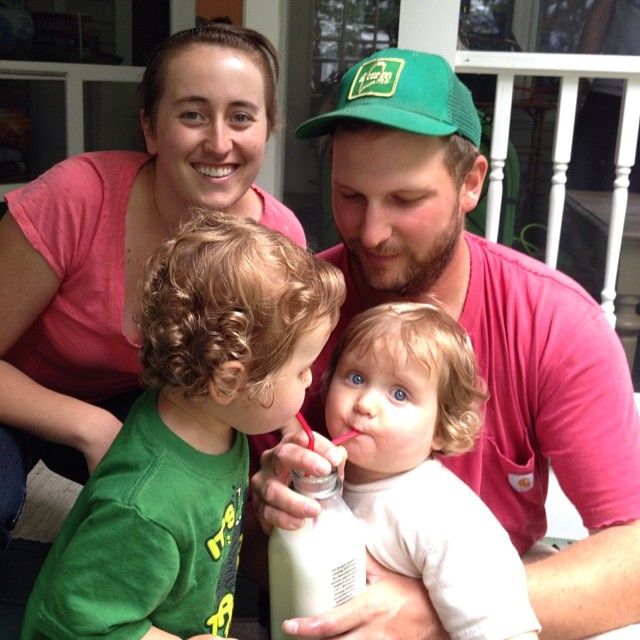 Carolyn and Ben Jensen enjoy family time in their north Freeport home. At left is Caitlin Mabel and at right is her twin sister, Charlie Anne. Courtesy photo
Comments are no longer available on this story