

Spring is here (at least officially), bringing with it a crop of new shows that warms us up for the summer cacophony of exhibitions and events. Many are idiosyncratic and definitely not mainstream — either eccentrically conceived or hyper-focused — but that is part of their charm. They fit perfectly into this a kind of shoulder season for art, and they would likely get lost among the plethora of offerings that divide our attention during the summer.
QUESTIONING THE REAL
In the former category we have “The Hidden Real” at SPACE (through April 18), curated by Andy Graham. The premise is based on Philip K. Dick’s reality-warping novel “Ubik,” whose plot is too convoluted to describe here. Suffice it to say that the narrative’s suspense turns on events that keep you constantly questioning whether your personal reality exists in the present or past, and whether you are alive, dead or only half alive. The title refers to an aerosol spray that one can deploy to change events in the past and achieve a different present.
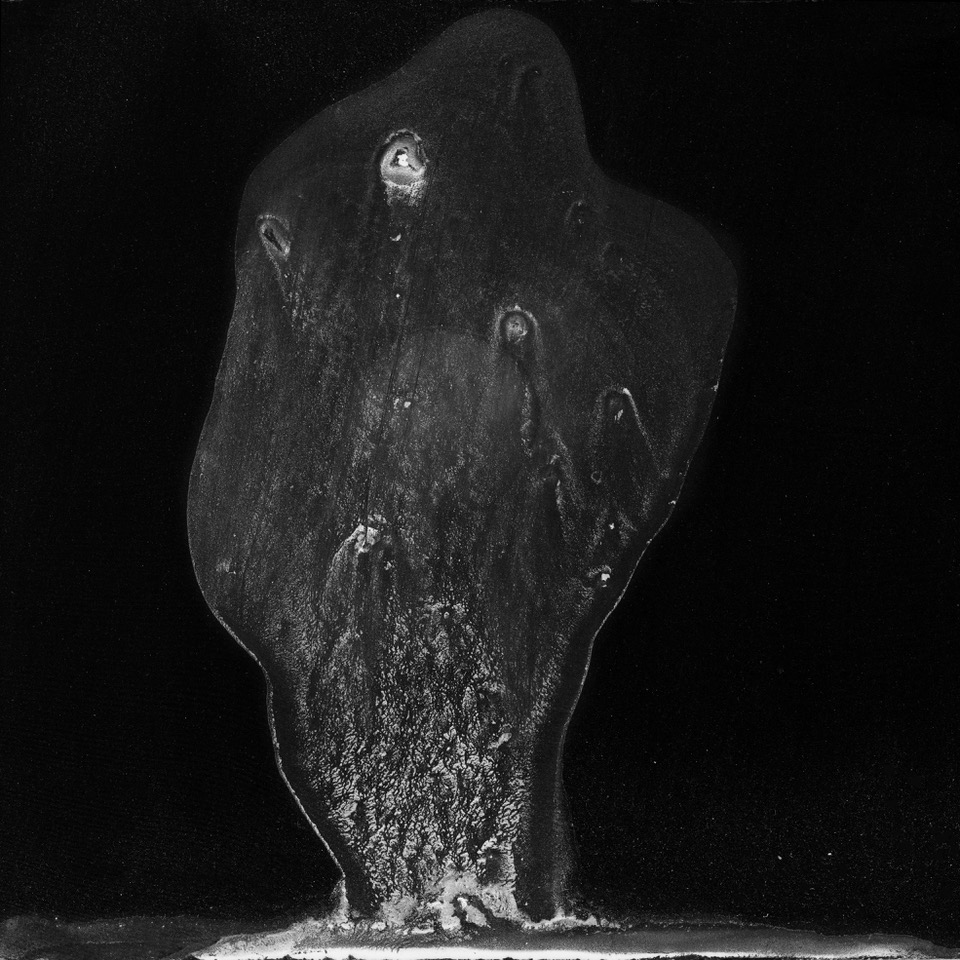
Likewise, “The Hidden Real” confuses one’s logic in interesting — and occasionally, unsettling — ways. It begins with four large photographic works by Shoshannah White. Two were originally photograms made using sand from the Rio Grande activated by magnesium, then printed on panel with gold leaf, silver leaf, graphite and cold wax. So, they are records of a specific ancient material, but evolved through time and processes into the current works.
The other two are the same essentially, except that they’re derived through a 19th-century process called cliché verre, whereby White covered a glass plate with a slurry of Pennsylvania coal and melted glacier water from Prince William Sound in Alaska, then created an image on it (usually by scratching through the slurry or using pigment atop it as here) and, finally, printed it onto light-sensitive paper. Again, ancient earth materials incorporated into contemporary objects. In a way, we could view the photogram and cliché verre processes as a version of Ubik’s capabilities to revise reality, creating a new present by altering something from the past.
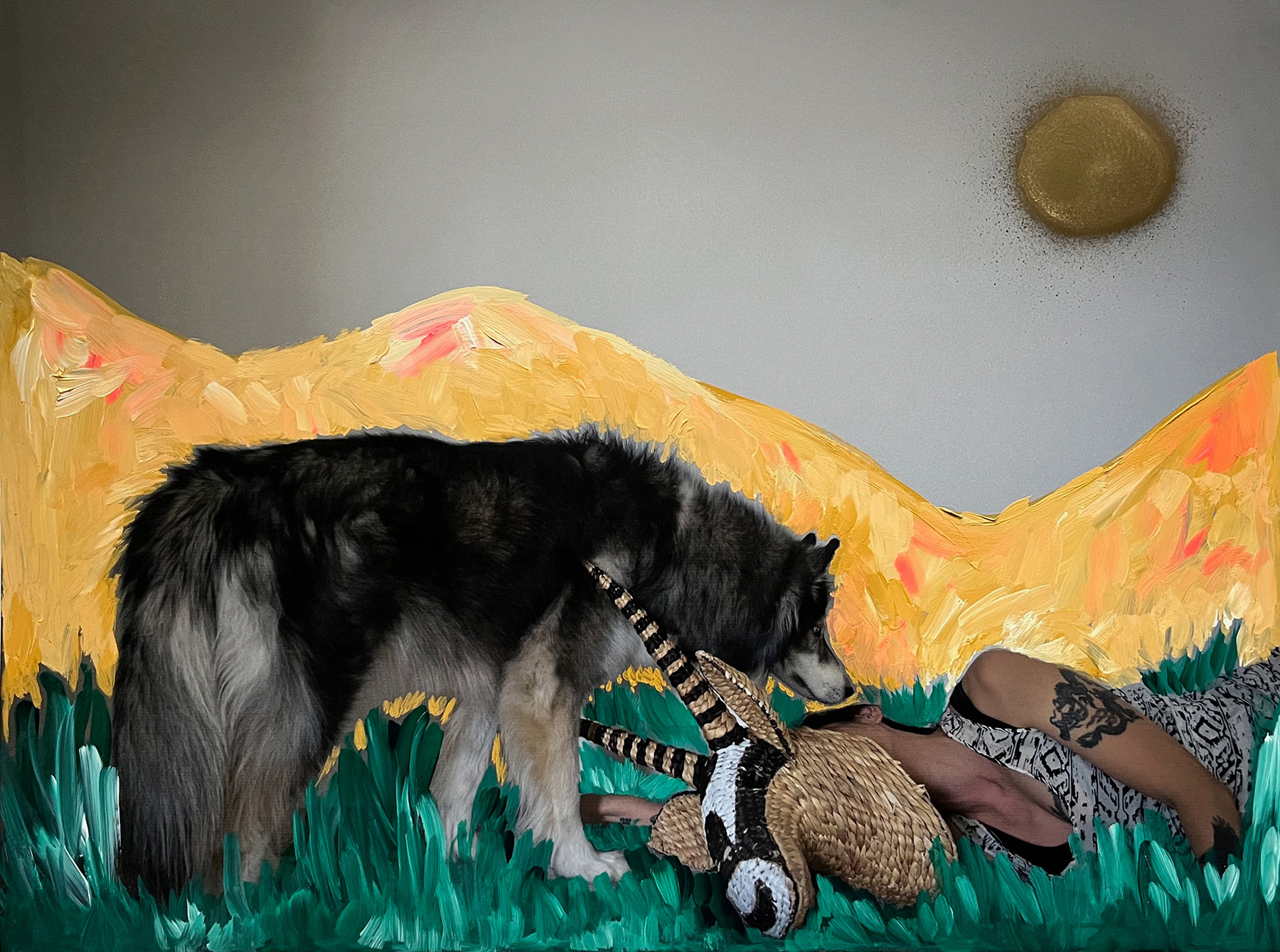
June Kim’s stand-in for Ubik is the painting she does on her large photo prints. These range humorous to poignant to apocalyptic. There is “Alien Dog,” a picture of one of her huskies with its head protruding out of a half-opened car window, over which she has painted a flying saucer around the canine, so it now appears to be peeking out of its spaceship window as it rockets through the galaxies.
“Eve’s Demise” is a picture of her father and mother lying fully clothed on their bed. To her father’s left, Kim painted the serpent and the forbidden apple of the biblical tale, and around the couple, animals, raindrops and foliage. Kim also outlines the two bodies in a way that evokes chalk outlines of fallen victims at crime scenes, as though presaging her parents’ eventual passings. But what makes it doubly poignant is that her mother was diagnosed with dementia in 2018. The outlines would then imply someone who is, as in Dick’s novel, half alive and half gone.
I don’t mean to suggest the artists in this exhibition were literally creating their works with “Ubik” in mind. But metaphors about the surreality of the present and the way that, in some dimension of our existence, we can inhabit various realities simultaneously definitely thread through the show.
A suite of paintings by Alan Bray, for instance, make us wonder what exactly is going on by depicting side-by-side realities in one scene. “Ghost” presents a stand of trees that appears to have grown over a rectangular depression in the land delineated by a stone wall. Is it a tomb? A foundation of an old structure? Either way, the forest has taken it over and practically buried it, the only evidence of its past a “ghost” in the form of the stone-walled rectangle.
Bray’s paintings have always gotten curiouser and curiouser the more we look at them. They are ostensibly representations of nature and landscape, but they are often too perfect, too ordered and too static to be “real.” Intricately painted with casein (a milk-based tempera), they are labor-intensive re-creations of what surrounds him, yet the obsessiveness yields places that seem to live their full reality only in a kind of suspended state between memory and imagination.
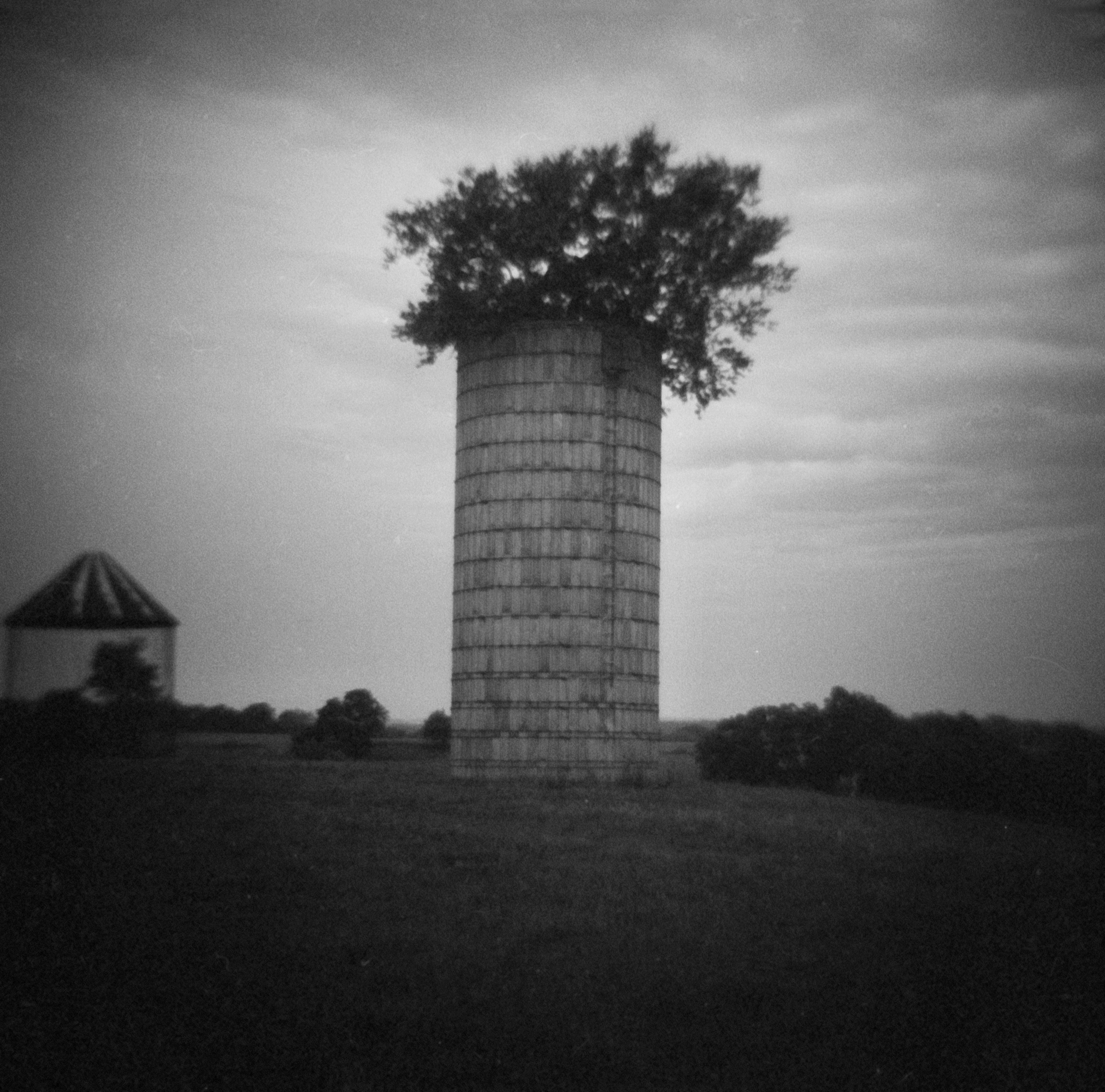
A grouping of archival pigment prints by Roswell, New Mexico-based Tonee Harbert feel like relics of the past, not only because they feature remnants of dilapidated billboards or abandoned silos with trees growing out of them, but because Harbert reproduces them on photo paper he has crumpled and flattened out again. They appear as if emerging from memory, but the crumpling makes the memory feel less stable. Two of them are also sprinkled with what looks like glitter, giving them a sort of magical presence, as though they are being conjured from pixie dust (or in the exhibition’s rubric, a spray of that Ubik). The very mention of Roswell, of course, suggests a reality hidden from view and an unresolved past (especially for conspiracy theorists).
There are other works (a video of Anne Riesenberg’s shadow on a beach, Greg Jamie’s enigmatic watercolors, even an excerpt from Cocteau’s “La Belle et la Bête” in which a glove and a mirror possess transmogrifying, teleportative powers).
MARK BY MARK
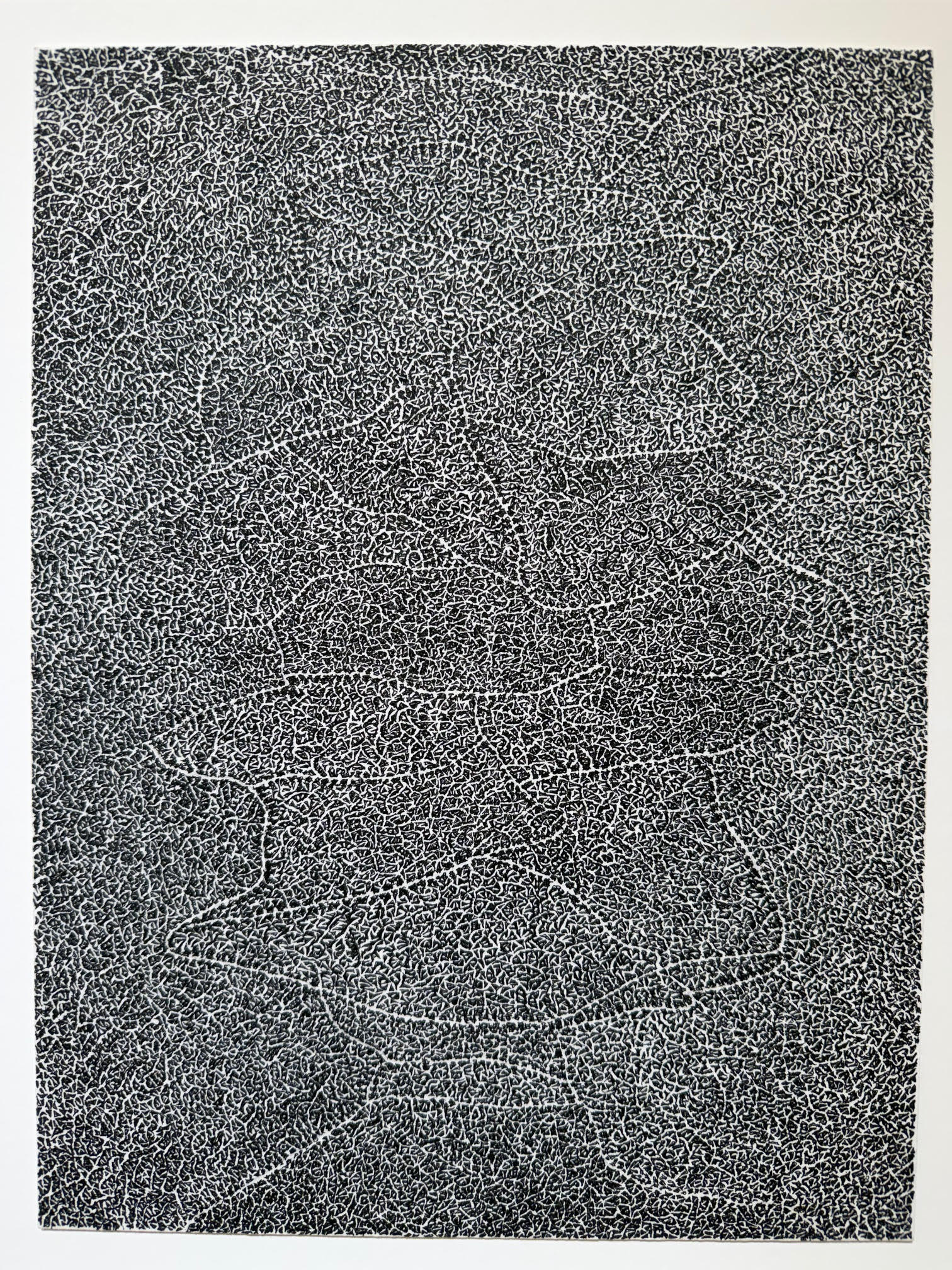
“Ellen Golden: Strata” at the Maine Jewish Museum (through Apr. 30) is a new and exciting development for an artist whose repetition of marks has always resulted in the creation of rigorously geometric, nonobjective works. Which is not to say these fastidiously produced ink drawings are objective. They are remarkable for their painstaking techniques, but they also feel as though Golden is expressing something freer and more organic than what came before.
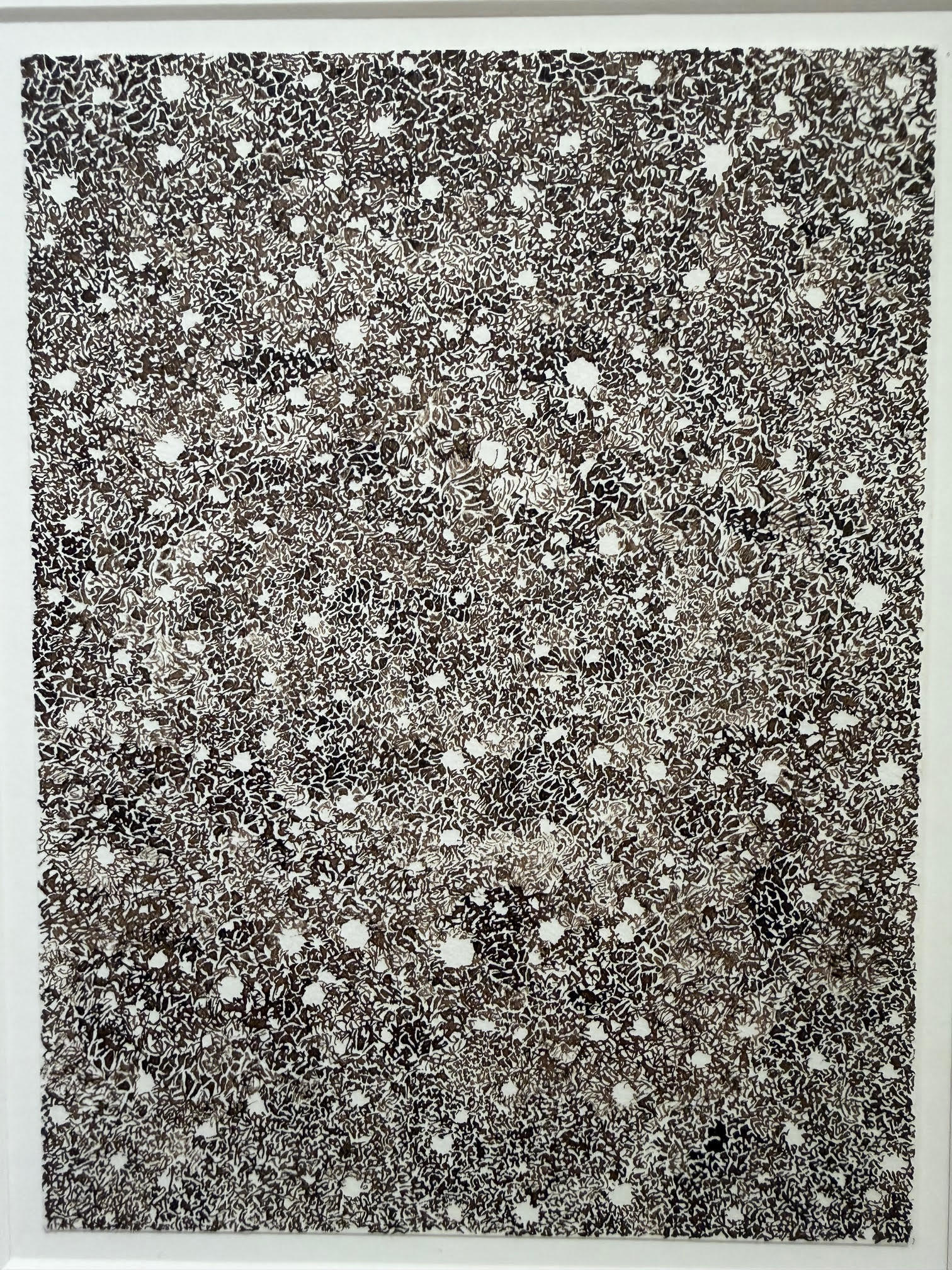
For one thing, the only real geometry here is the rectangle of the paper on which she is applying the ink. Otherwise, they are noticeably freeform and fluid. Sometimes she will trace graphite lines at the start of a work and fill in the spaces between them with her ink marks before erasing the graphite. These lines are decidedly meandering and unstructured, moving this way and that, looping back and up and down.
Though they are not recognizable as one specific thing (and so still nonobjective), they nevertheless suggest a myriad of objective possibilities. We can see how some might intimate the “strata” of the title, appearing almost like a rockface with fissures traced into it by condensation and its perpetual expansion and contraction. But they can just as easily appear like aerial views of fields with the white un-inked spots reminding us of meadow flowers or fireflies.
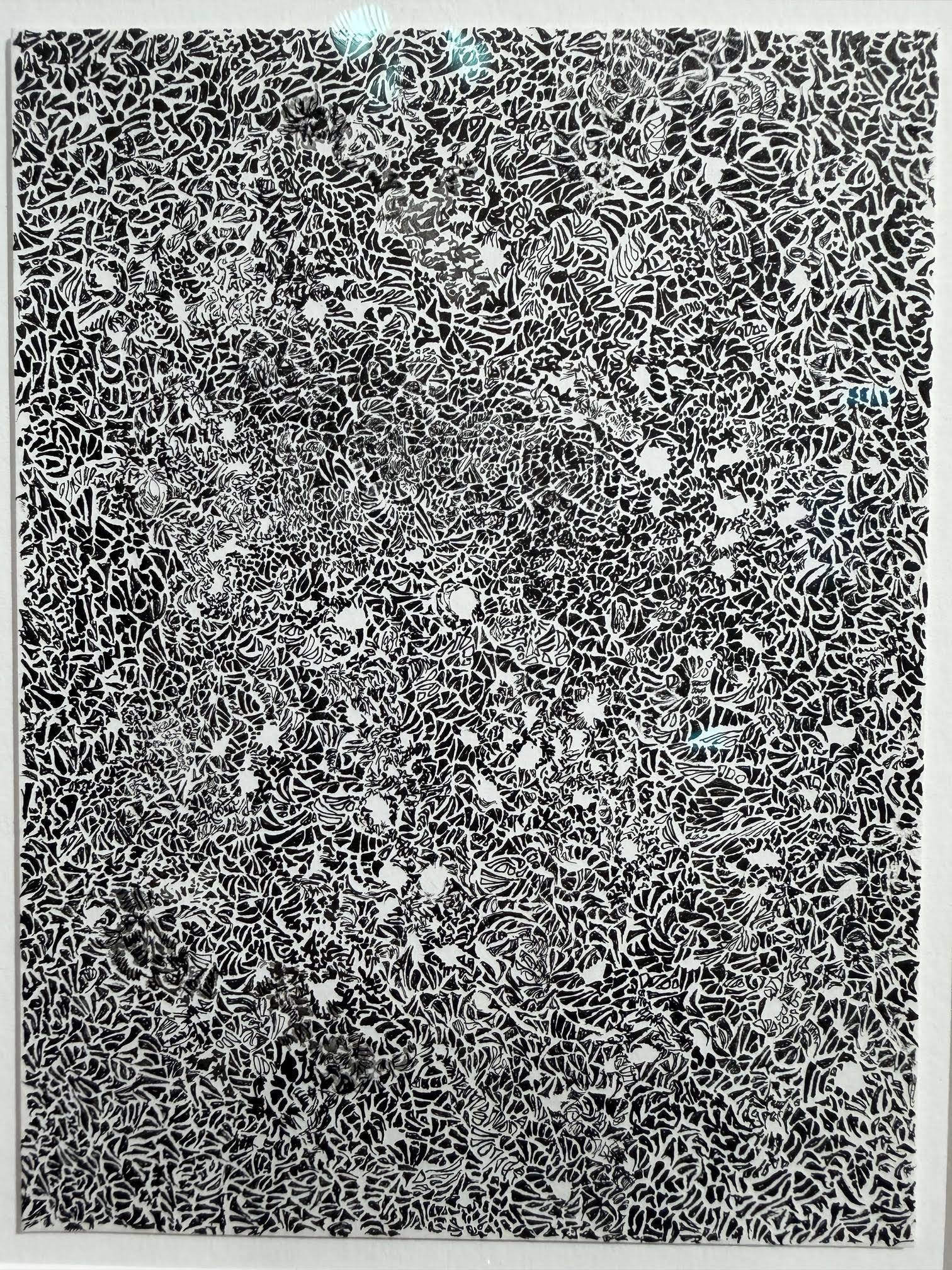
Or they can simulate bird’s-eye views of a mountainside, the meandering lines a network of paths through the “trees” of each mark. Those in which the lines are arranged centrifugally can remind us of subterranean mycorrhizal networks, or even the capillary-patterned membranes of organs. It is striking that so much association can be summoned by simple repetitions of marks. It is even more remarkable that everything suggested are living organisms. While Golden’s works might have occasionally alluded to planets and universes in the past, most often they felt more like human-built structures — thoroughly handmade and preoccupied with how modular forms can be used in the service of geometry.
The fact that we sense something that is living is likely due to the marks themselves, which are also a departure for the artist. There are thousands of them in each work, yet none appears to be repeated conventional forms like squares, rectangles, triangles and circles. They are iterative in the sense that each mark is predicated on the one that came before. Every single one is irregularly shaped, insinuating a stream-of-consciousness spontaneity that comes off as perpetually generative in nature, thus enhancing the sense of something organic and living rather than static and rigidly regimented.
Jorge S. Arango has written about art, design and architecture for over 35 years. He lives in Portland and can be reached at [email protected]. This column is free to access through support by The Dorothea and Leo Rabkin Foundation.
IF YOU GO
“The Hidden Real,” Space, 538-534 Congress St., Portland. Through April 18. Noon-6 p.m. Thursday-Friday, noon-4 p.m. Saturday. Free. 207-828-5600, space538.org
“Ellen Golden: Strata,” Maine Jewish Museum, 267 Congress St., Portland. Through April 30. Free. 207-773-2339, mainejewishmuseum.org
We invite you to add your comments. We encourage a thoughtful exchange of ideas and information on this website. By joining the conversation, you are agreeing to our commenting policy and terms of use. More information is found on our FAQs. You can update your screen name on the member's center.
Comments are managed by our staff during regular business hours Monday through Friday as well as limited hours on Saturday and Sunday. Comments held for moderation outside of those hours may take longer to approve.
Join the Conversation
Please sign into your Press Herald account to participate in conversations below. If you do not have an account, you can subscribe here. Questions? Please see our FAQs.