


PORTLAND — As I sat watching the blur of passing storefronts on the return leg of my maiden journey, I started dreaming up places I might take the bus in the future — to see a show downtown, maybe, or to go shopping in Freeport. Very quickly, I was ready to declare myself a Greater Portland Metro convert.
As we approached the stop on Forest Avenue where I planned to get off, however, the bus kept going.
I half-stood, hoping the driver might see that I wanted to exit. As we sailed past another stop, I started wondering if I was going to end up in Westbrook. Fortunately, a fellow passenger was waiting to board in front of Magic Scissors hair salon. As soon as the door opened, I grabbed my grocery bags and started backtracking on foot, grateful I’d chosen to forgo a gallon of milk.
This wasn’t my only moment of uncertainty while riding the bus last week, when I decided, with Earth Day on my mind, to see how easy or difficult it would be for me to get around Portland without a car.
Not exactly a moon mission, I know; people took nearly 1.9 million trips on the Metro last year (a number that’s been creeping back toward the pre-pandemic high of 2.1 million in 2019).
KNOW BEFORE YOU GO
My first mistake as a novice Metro rider, whose bus experience is limited to elementary school and interstate travel, was not reading the section of its website with the heading “How To Ride The Bus,” where I later learned that I’d done multiple things wrong.
I sat in the front, which is designated for riders who are older or have disabilities. My overflowing grocery bags and I exited from the front instead of the side door, getting in the way of people boarding. And— as you already may know — I was supposed to pull on a cord that runs along the windows to alert the driver I wanted to get off at the next stop.
I hoped the learning experiences were behind me for the next bus journey I had planned: commuting to work in South Portland, an hour-and-16 minute trip that, in addition to taking five times as long as my normal drive, would require changing buses (this is free to do within a 90-minute time frame) and traversing a busy stretch of road with my packed lunch and laptop in tow.
At first, I tried to figure out the routes I was going to take by comparing various bus schedules online. I was relieved to discover the Umo app, where you can plug in your starting location, destination and the day and time you want to leave or arrive, and it does it all for you.
It’s also where you can load money to prepay for your trips and then, when you board, scan a QR code (on, to my delight, a non-finicky reader!) to deduct the fare. You can do the same with a smart card or pay cash. Standard rates are $2 per ride, though Greater Portland Metro is considering an increase of 25 cents starting Aug. 1.
ROLL THE DICE
The app gave me an option for nearly door-to-door service that would have dropped me right at my office on Gannett Drive, but I chose to shave off a half hour and take the route that required walking from a stop on Cummings Road (a harrowing experience along a narrow shoulder that I ended up regretting).
The first bus arrived at my Brighton Avenue stop a couple minutes late. No big deal. The driver couldn’t have been friendlier, greeting me as I got on and wishing everyone a good day as they disembarked.
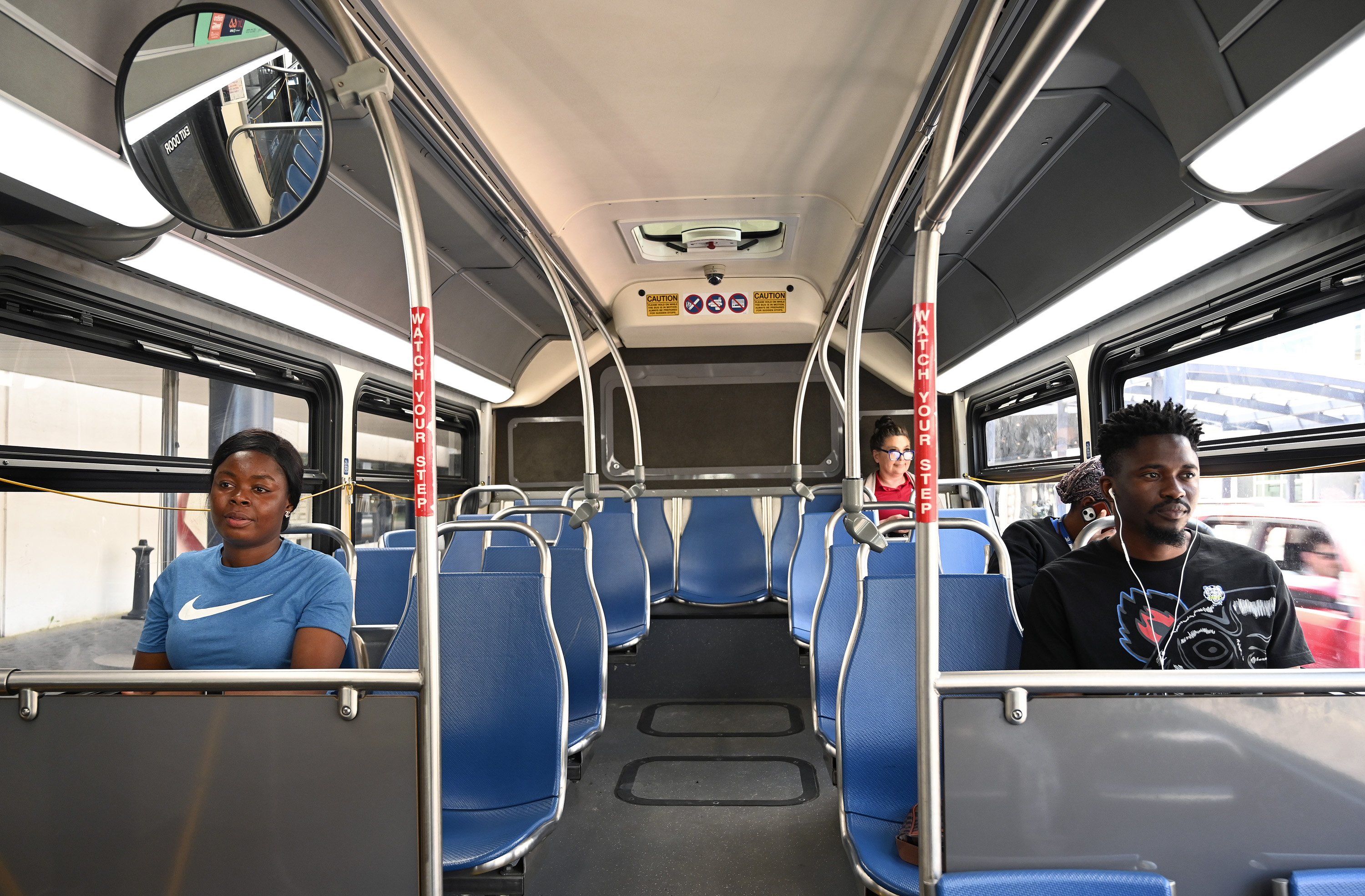
There were only a few people on board already, so I got a two-seat row in back to myself. As we made our way toward Westbrook, a loudspeaker announced each upcoming stop, the locations of which also scrolled on a sign near the front of the bus. Still nervous from my previous mishap, I kept a close eye on the app, too, following our location on a map of the route to make sure I didn’t miss my window to pull the cord.
Before I got off, a new concern had arisen: making my transfer in time.
I had four minutes to cross two busy streets, both of which required waiting for signals, and I was still walking up to the stop as the bus was arriving. I’m not sure what I would have done if I’d missed it. Walk the rest of the way and be late for work? Call an Uber? Wait until the next one came? What if it had started raining? As at most stops, there was no bench or shelter.
I was beginning to see how, aside from user error, things could go wrong.
HOW DOES IT COMPARE?
For my trip home that afternoon, I decided to make things easy on myself and take a bus that would pick me up right by my office driveway, a luxury I’d never appreciated. It was scheduled to arrive earlier than I’d normally leave work, but the option closer to 5 p.m. would have taken 35 minutes longer, and I figured I’d technically still be on the clock, taking notes on my commute. (If you’re going to be glued to your phone throughout your travels, don’t forget to get on Metro’s Wi-Fi and to charge between trips.)
This route took me to the Maine Mall, where I would transfer to a bus into town. The hub in front of JCPenney was the most active stop I’d seen, with more interactions among riders.
A woman who was having trouble standing asked a man for his seat on a bench and, after he obliged, scolded him for smoking near her. After I boarded, a man behind me got into a disagreement with the driver about whether he’d paid the full fare. I wondered how often these clashes among strangers, each bringing their day’s problems into a confined space, end up escalating.
Add the peace and quiet of your own vehicle to the flexibility and efficiency of commuting by car, and what is it all worth?
Cost: I spent more money on my bus trips ($5.40 out of my discounted 10-ride pass) than I would have on gas, even at its currently elevated price, but taking the bus allows people to save when parking costs are a factor — and, of course, adds up to much more in savings when you think about avoiding car payments, maintenance and insurance.
Environment: If I took the bus instead of my car every week to the grocery store, work and a weekend jaunt to Biddeford or Freeport, I’d save 2,218 pounds of carbon dioxide emissions in a year, according to the U.S. Environmental Protection Agency’s Carbon Footprint Calculator. That’s the equivalent of planting 25 trees, it said. Just as Taylor Swift purchased carbon credits to offset her Eras Tour travel, I could pay the Arbor Day Foundation to plant trees on my behalf for $2 a pop. Fifty dollars seems like a small price to pay for guilt-free use of my car for a year.
Community: There were nonfinancial benefits I got out of riding the bus, too — most notably, a new perspective on the city from standing in places I hadn’t before and a better understanding of its people from seeing the challenges anyone reliant on the bus might face on a daily basis. My bus experiments also gave me a sense of empowerment. Now I know that if I can’t or don’t want to use my car, there’s a low-cost option I hadn’t previously considered. (Granted, I’m sure my frustrations about the limitations of the bus would take over if I didn’t have a choice.)
But my fridge was bare by the end of the week, having cut my groceries down to what I could carry home from the bus stop. And if I had a more rigid work schedule, I would have spent a lot more time commuting or waiting around for the best option to arrive. With all the walking that many of the routes required, mobility issues must make it exhausting.
My experience may have convinced me to make more use of the bus. It also made me more grateful to have a car.

We invite you to add your comments. We encourage a thoughtful exchange of ideas and information on this website. By joining the conversation, you are agreeing to our commenting policy and terms of use. More information is found on our FAQs. You can update your screen name on the member's center.
Comments are managed by our staff during regular business hours Monday through Friday as well as limited hours on Saturday and Sunday. Comments held for moderation outside of those hours may take longer to approve.
Join the Conversation
Please sign into your Press Herald account to participate in conversations below. If you do not have an account, you can subscribe here. Questions? Please see our FAQs.